OWASP Developer Security Guide
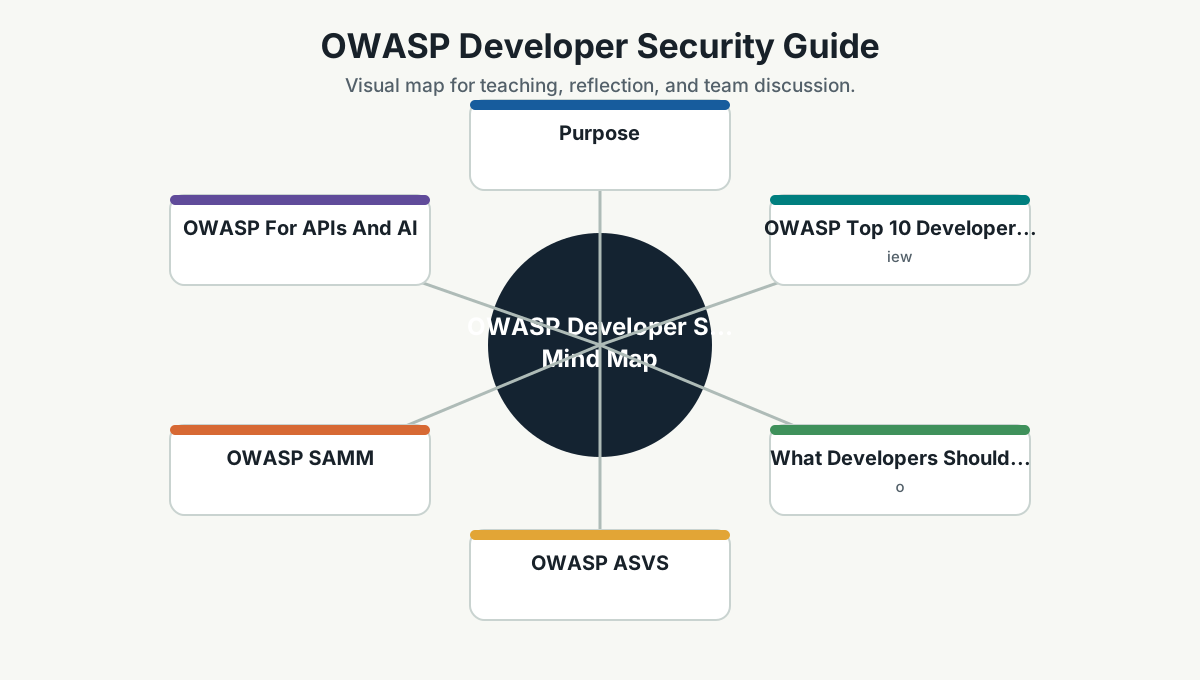
Purpose
OWASP gives developers practical, open security guidance. This page turns the most useful OWASP ideas into Simpro developer habits.
OWASP should not be treated as a scary compliance word. It is a library of common mistakes the industry has already paid for. We should not pay for them again.
OWASP Top 10 Developer View
| Risk | Developer Meaning |
|---|---|
| Broken access control | Users can do things they should not be able to do |
| Cryptographic failures | Sensitive data is not protected correctly |
| Injection | Untrusted input becomes command/query/code |
| Insecure design | The architecture allows abuse even if code works |
| Security misconfiguration | Defaults, headers, permissions, or services are unsafe |
| Vulnerable/outdated components | Dependencies contain known vulnerabilities |
| Identification/authentication failures | Login, sessions, tokens, or password flows are weak |
| Software/data integrity failures | Build, update, plugin, or data integrity can be compromised |
| Security logging/monitoring failures | Attacks happen without useful visibility |
| SSRF | Server can be tricked into calling unintended internal/external resources |
What Developers Should Do
Access Control
- Enforce authorization on the server, not only in UI.
- Check tenant/customer boundaries.
- Test direct API calls.
- Deny by default.
- Log important permission failures.
Input And Output
- Validate input at boundaries.
- Use parameterized queries.
- Avoid string-built SQL, commands, LDAP queries, or file paths.
- Encode output based on context.
- Use safe framework APIs.
Authentication And Sessions
- Use approved identity providers where possible.
- Use MFA for admin or sensitive access.
- Avoid rolling custom auth.
- Protect session cookies.
- Rotate/revoke tokens where needed.
Configuration
- Disable debug settings in production.
- Use secure headers.
- Restrict CORS.
- Review cloud/network exposure.
- Keep environment-specific configuration visible and controlled.
Dependencies
- Keep dependencies updated.
- Use lock files.
- Scan dependencies.
- Remove unused packages.
- Review risky transitive dependencies.
Logging
- Log security-relevant events.
- Do not log passwords, tokens, secrets, full card numbers, or unnecessary PII.
- Include correlation IDs.
- Make logs useful for investigation.
OWASP ASVS
The OWASP Application Security Verification Standard, or ASVS, is useful for defining how much security verification a system needs.
Practical use:
- Use ASVS as a checklist for important applications.
- Pick controls based on risk.
- Convert relevant controls into engineering standards.
- Use it during design review, not only audit.
OWASP SAMM
OWASP SAMM helps organizations improve software assurance maturity across governance, design, implementation, verification, and operations.
Practical use:
- Assess current maturity.
- Pick a few improvements per quarter.
- Use it to plan capability growth, not to shame teams.
OWASP For APIs And AI
Use OWASP API Security Top 10 for API-heavy systems:
- Broken object property or function-level authorization.
- Unrestricted resource consumption.
- Broken authentication.
- Server-side request forgery.
- Unsafe consumption of APIs.
Use OWASP Top 10 for LLM Applications when building AI features:
- Prompt injection.
- Sensitive information disclosure.
- Supply-chain risks.
- Excessive agency.
- Insecure output handling.
Team Reference Guide
Guidelines For Teams
- Use OWASP Top 10 as baseline awareness.
- Use ASVS for verification of important apps.
- Use API Top 10 for API design and testing.
- Use LLM Top 10 for AI-enabled features.
- Convert OWASP lessons into tests, templates, and review checklists.
Reflection Questions
- Which OWASP category appears most often in our work?
- What access-control test should every API include?
- Which dependency or configuration risk is currently invisible?
- Which AI feature needs LLM-specific threat modeling?
Further Study
- OWASP Top 10: https://owasp.org/www-project-top-ten/
- OWASP ASVS: https://owasp.org/www-project-application-security-verification-standard/
- OWASP SAMM: https://owasp.org/www-project-samm/
- OWASP API Security Top 10: https://owasp.org/API-Security/
- OWASP Top 10 for LLM Applications: https://owasp.org/www-project-top-10-for-large-language-model-applications/
- OWASP Cheat Sheet Series: https://cheatsheetseries.owasp.org/