Design And Architecture For Developers
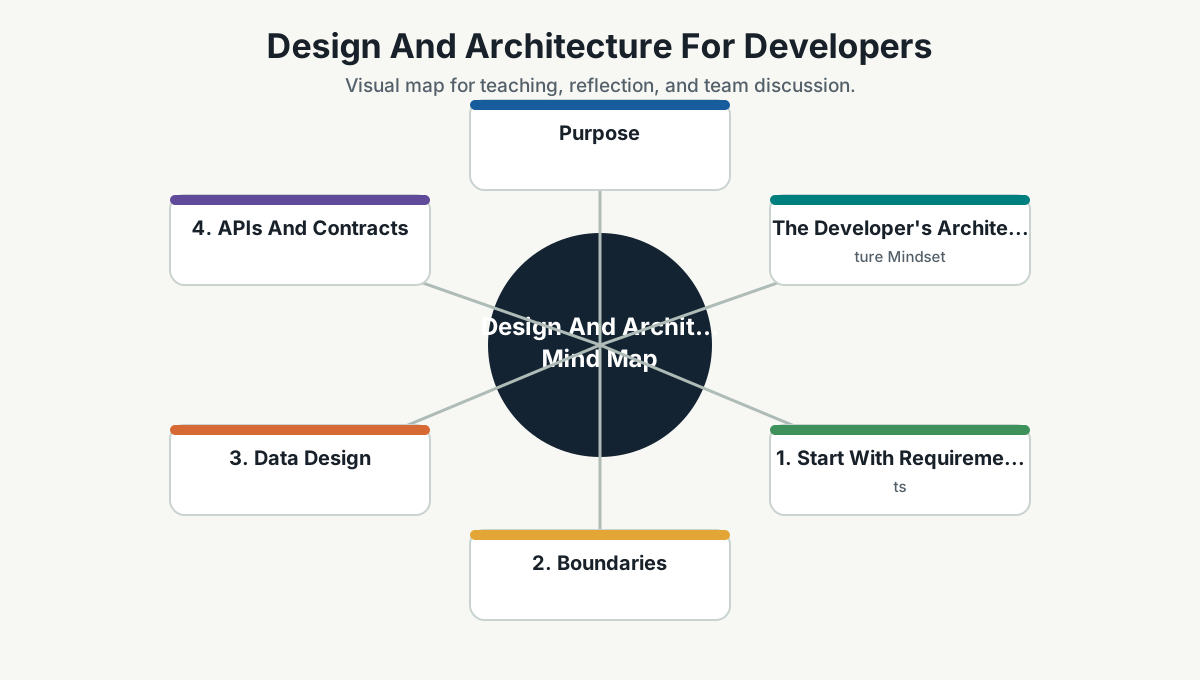
Purpose
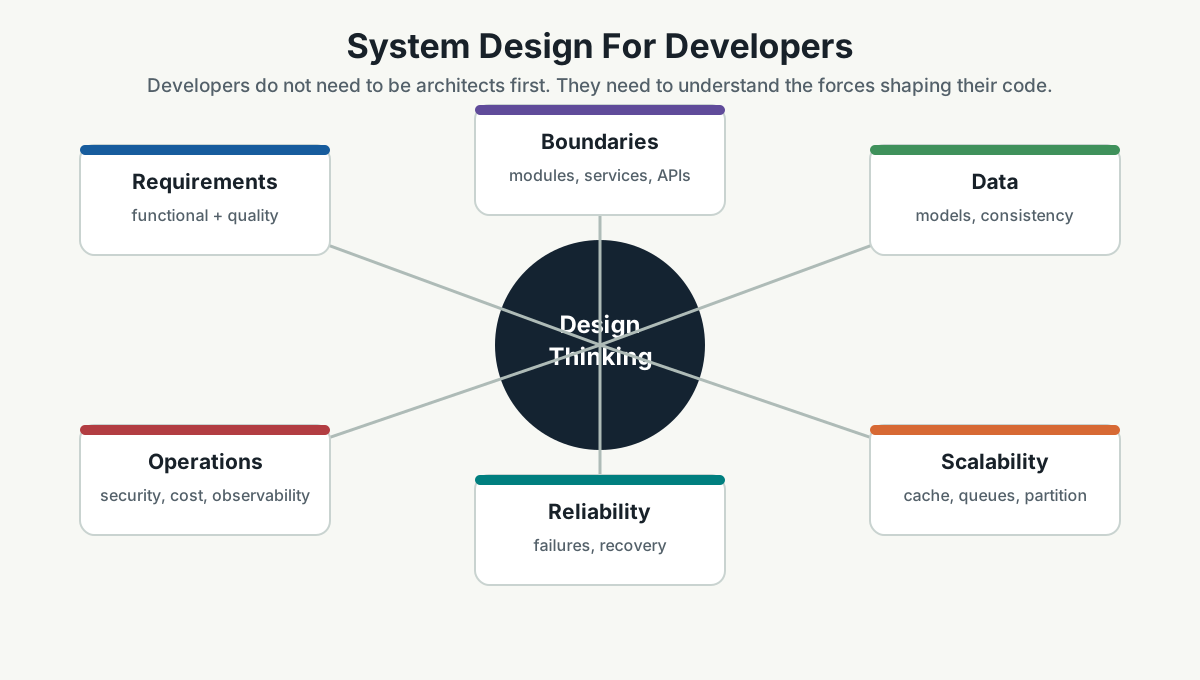
Developers do not need to become architects before they write code. But every developer should understand the design forces that shape good software: requirements, boundaries, data, scalability, reliability, operations, security, and cost.
This page is inspired by practical system-design learning resources such as ByteByteGo, but it is written as original Simpro guidance.
Further study:
- ByteByteGo: https://bytebytego.com/
- ByteByteGo Visual Dev Guides: https://bytebytego.com/visual-dev-guides
- Microsoft Azure Architecture Center: https://learn.microsoft.com/en-us/azure/architecture/
- AWS Well-Architected Framework: https://aws.amazon.com/architecture/well-architected/
- Google Cloud Architecture Framework: https://cloud.google.com/architecture/framework
The Developer's Architecture Mindset
Architecture is not only diagrams. Architecture is the set of decisions that make software easier or harder to change later.
When developers understand architecture, they write code that fits the system:
- They know which module should own behavior.
- They understand why a service boundary exists.
- They avoid hidden coupling.
- They think about failure and latency.
- They add logs and metrics where future debugging will need them.
- They understand the cost of synchronous calls, database queries, and deployment choices.
Humor:
Architecture is what remains after the sprint ends and the system has to live with our decisions.
1. Start With Requirements
System design starts with two kinds of requirements.
Functional requirements:
- What should the system do?
- Who uses it?
- What workflows matter?
Quality requirements:
- How fast?
- How available?
- How secure?
- How much data?
- How many users?
- What cost limit?
- What compliance or data constraints?
Developer guideline:
Do not discuss architecture only in terms of technology. Discuss it in terms of forces.
Example:
Weak:
Should we use microservices?
Better:
Do we need independent deployment, separate scaling, different ownership, or stronger fault isolation? If not, a modular monolith may be better.
2. Boundaries
Boundaries decide where change should be isolated.
Common boundaries:
- Function.
- Class.
- Module.
- Component.
- Package.
- API.
- Service.
- Database.
- Deployment unit.
- Team ownership area.
Good boundaries follow business concepts and change patterns. If two things change together, they may belong together. If two things change for different reasons, they may need separation.
Developer guideline:
Do not create a network boundary where a module boundary is enough.
3. Data Design
Most systems are data systems with behavior around them.
Developers should understand:
- Entity modeling.
- Relationships.
- Indexes.
- Transactions.
- Consistency.
- Caching.
- Data ownership.
- Data migration.
- Reporting needs.
Important tradeoff:
Strong consistency is simpler for correctness. Eventual consistency can improve scale and decoupling, but it increases reasoning complexity.
Developer guideline:
Before duplicating data, know who owns the source of truth and how changes propagate.
4. APIs And Contracts
APIs are promises between teams and systems.
Good API design considers:
- Clear resource or operation model.
- Versioning.
- Error responses.
- Idempotency.
- Authentication and authorization.
- Rate limits.
- Pagination.
- Backward compatibility.
- Observability.
Developer guideline:
An API is not just a route. It is a contract other people build their work around.
5. Scalability
Scalability means the system can handle growth in users, data, traffic, or complexity.
Common techniques:
- Caching.
- Load balancing.
- Asynchronous processing.
- Queues.
- Partitioning.
- Read replicas.
- Horizontal scaling.
- CDN.
- Database indexing.
But scalability has costs. Caches create invalidation problems. Queues create eventual consistency. Partitioning creates operational complexity.
Developer guideline:
Scale the bottleneck you have, not the bottleneck you imagine for a conference talk.
6. Reliability And Resilience
Distributed systems fail in partial and surprising ways.
Developers should design for:
- Timeouts.
- Retries with backoff.
- Circuit breakers.
- Idempotency.
- Graceful degradation.
- Health checks.
- Rollback.
- Backup and recovery.
- Incident diagnosis.
Developer guideline:
Every remote call is a conversation with a system that may be slow, unavailable, or confused.
7. Observability
Observability lets the team understand production behavior.
Developers should add:
- Useful logs.
- Metrics.
- Traces where needed.
- Correlation IDs.
- Business events.
- Error context.
- Health endpoints.
Avoid:
- Logging secrets.
- Logging too much noise.
- Creating alerts nobody acts on.
Developer guideline:
If we cannot observe it, we will debug it with hope and screenshots.
8. Security
Security is part of design.
Developers should consider:
- Authentication.
- Authorization.
- Input validation.
- Secrets.
- Sensitive data.
- Audit logs.
- Dependency risk.
- Least privilege.
- Secure defaults.
Developer guideline:
Security is easier when it is a design constraint, not a release surprise.
9. Cost
Cost is an architecture quality attribute.
Developers influence cost through:
- Database query patterns.
- Logging volume.
- Storage decisions.
- Compute usage.
- Network traffic.
- Cloud service choices.
- AI model usage.
- Environment cleanup.
Developer guideline:
A feature is not done if nobody can explain its major cost drivers.
10. On-Prem And Cloud Awareness
Developers should understand whether a system runs on-premise, cloud, hybrid, or edge because deployment context affects design.
On-prem often emphasizes:
- Fixed capacity.
- Network boundaries.
- Upgrade planning.
- Hardware lifecycle.
- Local compliance.
- Operational control.
Cloud often emphasizes:
- Elastic capacity.
- Managed services.
- Pay-as-you-go cost.
- Automation.
- Global services.
- Identity and policy.
Hybrid emphasizes:
- Integration.
- Data movement.
- Latency.
- Security boundaries.
- Operational consistency.
Simpro Developer Checklist
Before implementing a meaningful feature, ask:
- What problem and user outcome are we supporting?
- Which module/service owns this behavior?
- What data is read or changed?
- What API contract is affected?
- What can fail?
- What should be logged or measured?
- What security/privacy concern exists?
- What performance or cost issue could appear?
- How will this be tested?
- How will this be released or rolled back?
How To Learn More
Use visual resources like ByteByteGo for concept intuition, then use official cloud architecture documentation for production-grade design guidance.
Good learning path:
- Learn the concept visually.
- Apply it to one Simpro system.
- Identify tradeoffs.
- Discuss with a senior developer or architect.
- Capture the decision in an ADR if it matters.
Team Reference Guide
How To Explain This Page
Use this page as a reference conversation, not as a checklist to read aloud. Start by explaining why the topic matters, then connect it to current team work, and finally ask what behavior should change.
The most useful way to teach this material is to move from concept to example. Explain the principle, show how it appears in daily work, ask the team where it is currently strong or weak, and finish with one small action.
Guidelines For Teams
- Connect the topic to a current project, customer problem, incident, or decision.
- Translate concepts into visible behaviors.
- Keep the guidance lightweight enough to use weekly.
- Capture decisions, examples, and improvements back into the wiki.
- Review the page again after a project, incident, or retrospective to update what the team has learned.
Reflection Questions
- What part of this topic is already working well for us?
- What part is still mostly theory?
- What is one behavior we can change in the next 30 days?