Team Quest Catalog
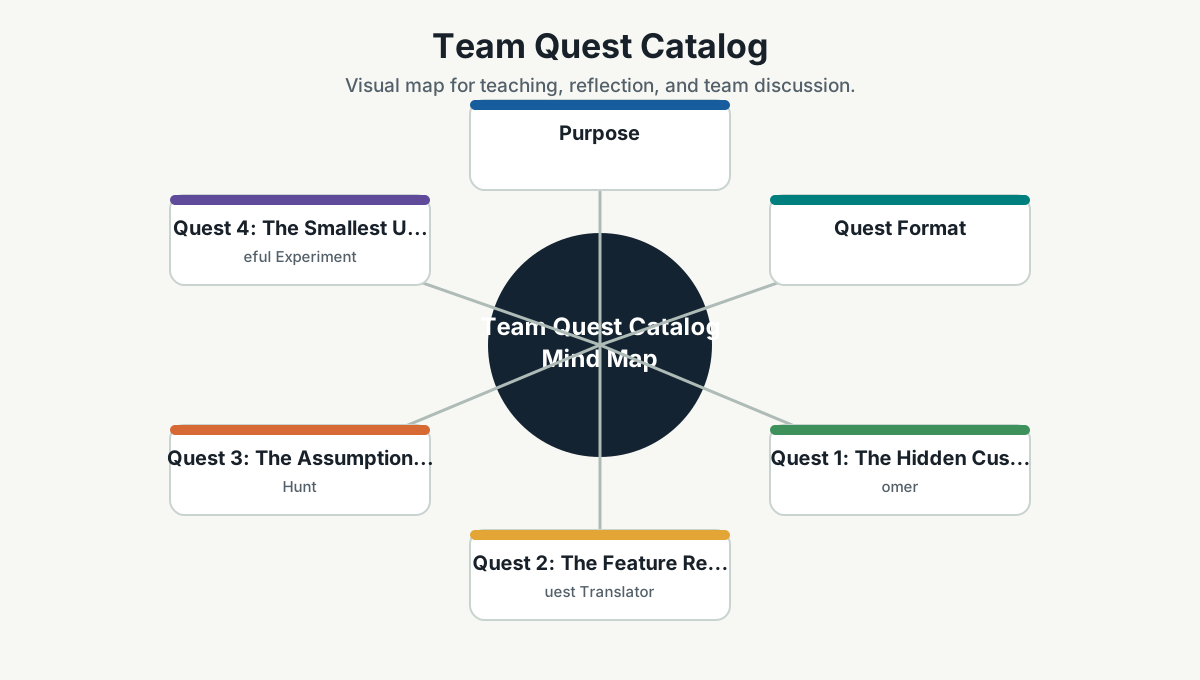
Purpose
This catalog gives teams practical quests to learn and apply the concepts in the wiki. Each quest is designed to be small, evidence-based, and useful in real work.
Use one quest per team per week or one quest per sprint. Do not run all quests at once. The point is focused behavior change.
Quest Format
Each quest has:
- Story hook: why the quest matters.
- Mission: what the team must do.
- Players: who should participate.
- Evidence: what proves completion.
- Reflection: what the team should discuss.
- Badge: what capability the team earns.
Quest 1: The Hidden Customer
Story Hook
A team is building a feature, but nobody can clearly explain who will use it or what decision it helps them make.
Mission
Choose one active feature and identify:
- Primary user.
- Job they are trying to do.
- Pain or risk.
- Current workaround.
- Desired outcome.
Players
Product/stakeholder, developer, QA, support/operations, team lead.
Evidence
A one-paragraph problem statement and one success metric.
Reflection
What did we assume before this quest? What changed after naming the user clearly?
Badge
Customer Clarity.
Quest 2: The Feature Request Translator
Story Hook
The team receives a request: "Build this screen." Instead of starting design or development immediately, the team translates it into value.
Mission
Convert one feature request into:
- Problem.
- Outcome.
- Metric.
- Assumptions.
- Smallest experiment.
Evidence
Feature request rewritten as a product bet.
Reflection
Did the original request still look correct after reframing?
Badge
Product Bet Maker.
Quest 3: The Assumption Hunt
Story Hook
Every plan contains assumptions. The dangerous ones are invisible.
Mission
For one initiative, list assumptions under:
- Customer need.
- Usability.
- Feasibility.
- Data.
- Security/privacy.
- Performance.
- Adoption.
Mark the riskiest assumption.
Evidence
One assumption map and one experiment to test the riskiest assumption.
Reflection
Which assumption were we treating as fact?
Badge
Risk Spotter.
Quest 4: The Smallest Useful Experiment
Story Hook
The team wants to build a full solution, but the question is still uncertain.
Mission
Design an experiment that can be completed in one week or less.
Experiment options:
- Prototype test.
- Customer interview.
- Feature flag release.
- Manual concierge workflow.
- Analytics review.
- Technical spike.
- Support-ticket analysis.
Evidence
Experiment result and decision: scale, refine, or stop.
Reflection
What did we learn before spending full build effort?
Badge
Experiment Builder.
Quest 5: The Batch Size Challenge
Story Hook
Large changes are hard to review, test, and release. The team wants faster feedback and lower risk.
Mission
Take one planned large change and split it into smaller increments.
Each increment should have:
- Clear purpose.
- Reviewable size.
- Test approach.
- Rollback or mitigation path.
Evidence
A large change split into at least three smaller deliverable increments.
Reflection
What became easier when the batch became smaller?
Badge
Flow Improver.
Quest 6: The Definition Of Done Upgrade
Story Hook
The team says work is done, but quality issues still appear later.
Mission
Pick one workflow and update Definition of Done to include:
- Problem/outcome confirmed.
- Tests appropriate to risk.
- Observability for important flows.
- Security/privacy check if relevant.
- Performance consideration.
- Documentation/runbook update if needed.
Evidence
Updated Definition of Done used on one real work item.
Reflection
Which late surprise does this prevent?
Badge
Done Means Trusted.
Quest 7: The AI Accountability Check
Story Hook
AI helps the team move faster, but the team needs guardrails so speed does not outrun understanding.
Mission
Choose one AI-assisted workflow and define:
- Allowed use.
- Prohibited use.
- Human review requirement.
- Data sensitivity rule.
- Test or validation rule.
- Security concern.
Evidence
AI usage rule added to team working agreement.
Reflection
Where does AI help us most? Where could it create hidden risk?
Badge
AI With Judgment.
Quest 8: The Incident Without Blame
Story Hook
Something went wrong. The team can either search for a person to blame or improve the system.
Mission
Run a mini postmortem:
- Impact.
- Timeline.
- Detection gap.
- Contributing factors.
- What went well.
- What should change.
- Owner and due date.
Evidence
One system improvement completed.
Reflection
What made the problem possible?
Badge
Learning From Failure.
Quest 9: The Stakeholder Feedback Loop
Story Hook
Stakeholders see the product late and ask for changes late. The team wants faster alignment.
Mission
Create one lightweight feedback loop:
- Prototype review.
- Weekly demo.
- Decision log.
- Acceptance examples.
- Customer evidence review.
Evidence
One stakeholder decision made earlier than usual.
Reflection
What misunderstanding did early feedback prevent?
Badge
Alignment Builder.
Quest 10: The Team Lead Loop
Story Hook
The team lead wants to move from status tracking to learning leadership.
Mission
For one week, run the loop:
- Context.
- Commitment.
- Action.
- Evidence.
- Refinement.
Evidence
One weekly update written in this format.
Reflection
What changed when we discussed evidence instead of only tasks?
Badge
Loop Keeper.
Quest 11: The Role Clarity Reset
Story Hook
Work slows down because ownership is fuzzy.
Mission
For one active initiative, clarify:
- Product/stakeholder responsibility.
- Developer responsibility.
- QA responsibility.
- IT/admin responsibility.
- Operations responsibility.
- Team lead responsibility.
Evidence
Simple role map for the initiative.
Reflection
Which handoff became clearer?
Badge
Ownership Mapper.
Quest 12: The 30-Day System Improvement
Story Hook
The team has learned enough. Now it must improve how it works.
Mission
Choose one system improvement:
- Smaller PRs.
- Better acceptance examples.
- Earlier QA risk review.
- CI stability.
- Observability.
- Security checklist.
- Weekly experiment review.
- Faster stakeholder feedback.
Evidence
Before/after comparison after 30 days.
Reflection
Did the change improve value, flow, quality, trust, or learning?
Badge
System Improver.
Scoreboard
Use this scoreboard lightly. The purpose is motivation, not competition theater.
| Badge | Evidence Required | Review |
|---|---|---|
| Customer Clarity | Problem statement and metric | Product/stakeholder |
| Product Bet Maker | Request reframed as bet | Product trio |
| Risk Spotter | Assumption map | Team lead |
| Experiment Builder | Experiment decision | Team |
| Flow Improver | Smaller delivery increments | Engineering lead |
| Done Means Trusted | Updated DoD used once | QA + dev |
| AI With Judgment | AI working agreement | Tech lead |
| Learning From Failure | Postmortem action done | Team lead |
| Alignment Builder | Earlier stakeholder decision | Stakeholder |
| Loop Keeper | Weekly loop update | Team lead |
| Ownership Mapper | Role map | Team |
| System Improver | 30-day before/after | Leadership |
Team Reference Guide
How To Explain This Page
Use this page as a reference conversation, not as a checklist to read aloud. Start by explaining why the topic matters, then connect it to current team work, and finally ask what behavior should change.
The most useful way to teach this material is to move from concept to example. Explain the principle, show how it appears in daily work, ask the team where it is currently strong or weak, and finish with one small action.
Guidelines For Teams
- Connect the topic to a current project, customer problem, incident, or decision.
- Translate concepts into visible behaviors.
- Keep the guidance lightweight enough to use weekly.
- Capture decisions, examples, and improvements back into the wiki.
- Review the page again after a project, incident, or retrospective to update what the team has learned.
Reflection Questions
- What part of this topic is already working well for us?
- What part is still mostly theory?
- What is one behavior we can change in the next 30 days?