Industry Transformation Stories
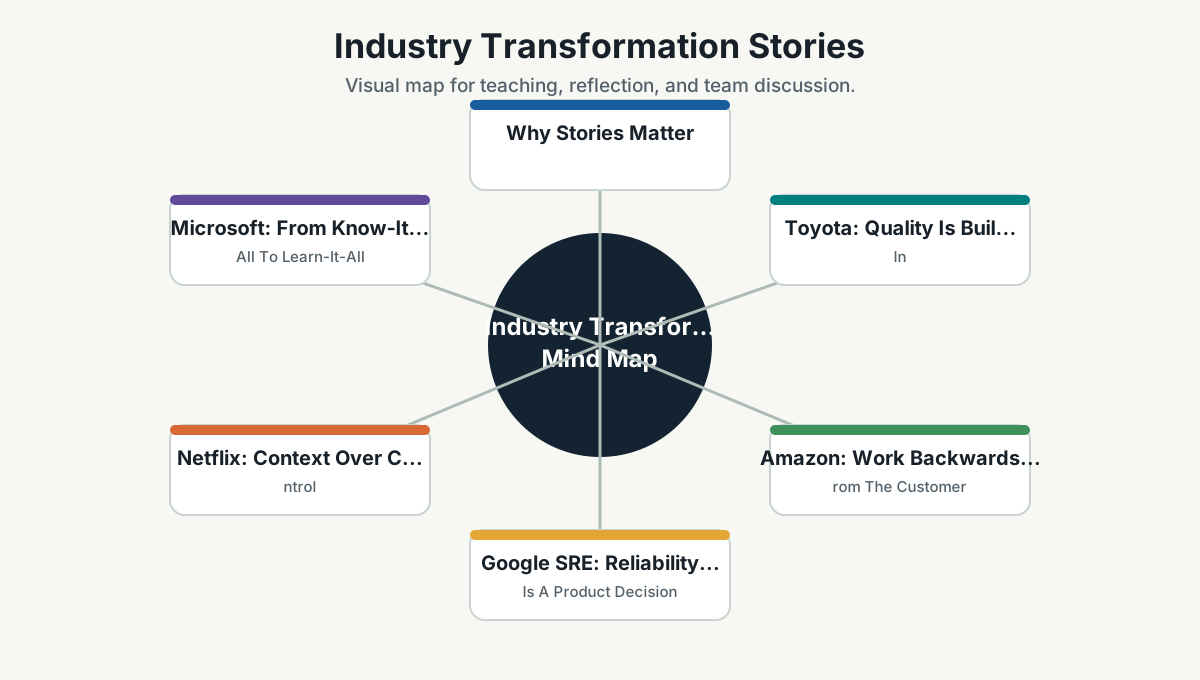
Why Stories Matter
Concepts become memorable when they have stories attached. People may forget the formal definition of SRE or product discovery, but they remember why Google created error budgets, why Amazon writes PR/FAQ documents, why Netflix talks about context over control, and why Microsoft made growth mindset central to its transformation.
Use these stories carefully. We are not copying big companies blindly. We are extracting the values behind their practices and adapting them to Simpro.
Toyota: Quality Is Built In
Toyota's production system became influential because it treated quality as something built into the work. The famous idea of stopping the line is powerful because it says defects should not silently travel downstream.
Software translation:
- Broken CI should be treated seriously.
- Flaky tests are quality debt.
- Late QA surprises are system signals.
- Repeated manual work should become automation.
- People closest to the work should improve the work.
Simpro lesson:
We should not wait until UAT or production to discover predictable problems. Quality should move left, but ownership should move everywhere.
Humor:
If a test fails every Tuesday and everyone ignores it, that is not a flaky test. That is a team tradition.
Amazon: Work Backwards From The Customer
Amazon is known for customer obsession and working backwards. The PR/FAQ style forces teams to describe the future customer experience before committing heavy investment.
The value is not the exact document format. The value is clarity before execution.
Software translation:
- Write the customer problem before the solution.
- Explain the benefit in plain language.
- Anticipate objections.
- Name risks and tradeoffs.
- Decide what success looks like.
Simpro lesson:
Before building, we should be able to say what the customer can do after the work that they cannot do today.
Humor:
If we cannot explain the customer benefit without opening Jira, the idea is probably not ready.
Google SRE: Reliability Is A Product Decision
Google's SRE model made reliability measurable through SLOs and error budgets. The important idea is that reliability is not an emotional argument between product and engineering. It is a promise to users.
Software translation:
- Define what reliability matters.
- Measure user journeys.
- Use error budgets to balance speed and stability.
- Reduce toil through engineering.
- Learn from incidents without blame.
Simpro lesson:
Reliability should not depend on heroic memory. It should be visible, measured, and improved.
Humor:
Hope is not an incident response strategy, even if it has been our fastest deployment plan.
Netflix: Context Over Control
Netflix's culture emphasizes freedom with responsibility and context over control. This is often misunderstood as "no process." The deeper lesson is that high autonomy requires high context, strong talent, and real accountability.
Software translation:
- Share business context.
- Give teams decision rights.
- Expect judgment.
- Keep standards high.
- Remove unnecessary approval layers when guardrails exist.
Simpro lesson:
We should not add approval steps to compensate for missing context. We should improve context, capability, and guardrails.
Humor:
Autonomy without context is just people confidently running in different directions.
Microsoft: From Know-It-All To Learn-It-All
Microsoft's culture shift under Satya Nadella is often summarized as moving from a know-it-all culture to a learn-it-all culture. The lesson is powerful for technology teams: expertise matters, but learning orientation matters more when the environment changes.
Software translation:
- Reward curiosity.
- Encourage cross-team learning.
- Treat mistakes as learning opportunities with follow-through.
- Make leaders model learning.
- Reduce ego in technical debate.
Simpro lesson:
The smartest person in the room is less useful than the room that learns fastest.
Humor:
A know-it-all culture has excellent answers to yesterday's questions.
Meta: Move Fast Requires Infrastructure
Meta's early "move fast" culture evolved because speed at scale requires infrastructure. Fast releases only work when supported by tooling, testing, monitoring, and internal platforms.
Software translation:
- Invest in developer experience.
- Reduce friction in environments and deployments.
- Use shared tooling.
- Make production learning safe.
- Keep changes small.
Simpro lesson:
Moving fast is not a personality trait. It is an engineering capability.
Humor:
If every release needs a prayer meeting, we do not have release management. We have release religion.
Atlassian And Team Health: Make The Invisible Visible
Atlassian's team health practices emphasize open conversation around team effectiveness. The deeper lesson is that team problems should be visible enough to improve.
Software translation:
- Discuss team health explicitly.
- Look at ownership, clarity, collaboration, and delivery.
- Make improvement actions small and trackable.
Simpro lesson:
Team health is not a soft topic. It is a delivery risk and a growth enabler.
The Combined Industry Lesson
| Industry Story | Practice | Deeper Value | Simpro Adaptation |
|---|---|---|---|
| Toyota | Built-in quality | Stop defects early | Shift quality left and everywhere |
| Amazon | Working backwards | Customer clarity | Product bet before build |
| Google SRE | Error budgets | Reliability economics | SLOs for critical flows |
| Netflix | Context over control | Autonomous accountability | Decision rights with context |
| Microsoft | Growth mindset | Learn faster | Learning as leadership behavior |
| Meta | Fast release infrastructure | Speed through platforms | Reusable platform strategy |
| Atlassian | Team health | Visible collaboration | Team health reviews |
How To Tell These Stories To The Team
Do not say:
Google does this, so we should do it.
Say:
Google faced a reliability and scale problem. Their answer was to make reliability measurable. Our scale is different, but our need for customer trust is real. What is the small-company version of that idea?
That framing prevents cargo-culting.
Team Reference Guide
How To Explain This Page
Use this page as a reference conversation, not as a checklist to read aloud. Start by explaining why the topic matters, then connect it to current team work, and finally ask what behavior should change.
The most useful way to teach this material is to move from concept to example. Explain the principle, show how it appears in daily work, ask the team where it is currently strong or weak, and finish with one small action.
Guidelines For Teams
- Connect the topic to a current project, customer problem, incident, or decision.
- Translate concepts into visible behaviors.
- Keep the guidance lightweight enough to use weekly.
- Capture decisions, examples, and improvements back into the wiki.
- Review the page again after a project, incident, or retrospective to update what the team has learned.
Reflection Questions
- What part of this topic is already working well for us?
- What part is still mostly theory?
- What is one behavior we can change in the next 30 days?