Strong Foundations For Scale
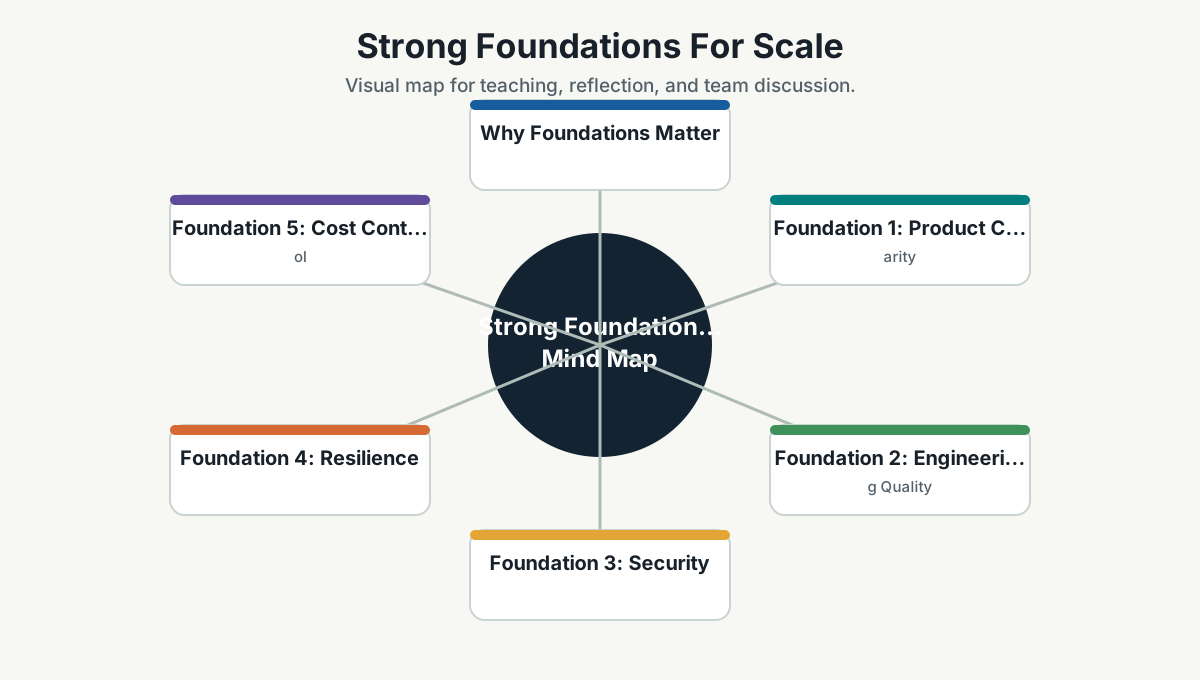
Why Foundations Matter
Growth exposes weak foundations. A small product can survive with manual steps, tribal knowledge, informal security, unclear ownership, and fragile deployments. A growing product cannot.
The purpose of foundations is not bureaucracy. The purpose is to make good work repeatable.
Humor:
Foundations are boring in the same way brakes are boring. You only notice their strategic importance when they are missing.
Foundation 1: Product Clarity
Teams need to know what problem they are solving and why it matters.
Minimum standard:
- User.
- Problem.
- Outcome.
- Success metric.
- Key assumptions.
- Stakeholder owner.
Anti-pattern:
We are building it because someone important asked.
Better:
We are building it because this user segment has this measurable pain, and we have evidence that solving it matters.
Foundation 2: Engineering Quality
Engineering quality is the foundation of sustainable speed.
Minimum standard:
- Small pull requests.
- Code review.
- Tests appropriate to risk.
- Clear ownership.
- Definition of Done.
- Technical debt visibility.
Anti-pattern:
We will clean it up later.
Better:
We know what debt we are taking, why, who owns it, and when it must be repaid.
Foundation 3: Security
Security must start with basics done consistently.
Minimum standard:
- Secrets management.
- Access control.
- Dependency scanning.
- Sensitive data awareness.
- Secure CI/CD.
- Logging for important actions.
- Threat modeling for risky changes.
Anti-pattern:
We are too small to worry about security.
Better:
We are small enough to build secure habits before bad habits harden.
Foundation 4: Resilience
Resilience means the system can handle failure without panic.
Minimum standard:
- Ownership map.
- Monitoring.
- Alerts for user-impacting issues.
- Runbooks.
- Backup and recovery where needed.
- Incident response process.
- Postmortems with action.
Anti-pattern:
Call the person who knows the system.
Better:
The system should be understandable and recoverable even when the expert is unavailable.
Foundation 5: Cost Control
Cloud and AI make experimentation easy, but they also make hidden cost easy.
Minimum standard:
- Cost visibility.
- Environment cleanup.
- Right-sized resources.
- Usage budgets for AI.
- Ownership of major cost areas.
- Cost review during architecture decisions.
Anti-pattern:
We will optimize cost after growth.
Better:
We design for useful cost visibility now, so growth does not become surprise billing.
Foundation 6: Observability
Observability is how the team sees reality.
Minimum standard:
- Logs for important flows.
- Metrics for user journeys.
- Traces where distributed behavior matters.
- Dashboards tied to outcomes.
- Alerts that are actionable.
Anti-pattern:
It works on my machine.
Better:
We can see how it behaves for users in production.
Foundation 7: Developer Productivity
Developer productivity is not about typing speed. It is about reducing friction between idea and safe release.
Minimum standard:
- Fast local setup.
- Reliable CI.
- Clear branching/release strategy.
- Reusable templates.
- Useful documentation.
- Automated repetitive work.
Anti-pattern:
Every new developer must learn the secret path from someone.
Better:
The golden path is documented, automated, and easy to follow.
The Foundation Checklist
For every major product area, ask:
| Foundation | Question |
|---|---|
| Product clarity | Do we know the problem and outcome? |
| Engineering quality | Can we change it safely? |
| Security | Are data, access, and dependencies controlled? |
| Resilience | Can we detect and recover from failure? |
| Cost | Can we see and manage cost drivers? |
| Observability | Can we see user-impacting behavior? |
| Developer productivity | Can teams deliver without repeated friction? |
Simpro Guideline
Do the basics right before scaling complexity. The basics are not beginner work. They are what market leaders keep doing after others get bored.
Team Reference Guide
How To Explain This Page
Use this page as a reference conversation, not as a checklist to read aloud. Start by explaining why the topic matters, then connect it to current team work, and finally ask what behavior should change.
The most useful way to teach this material is to move from concept to example. Explain the principle, show how it appears in daily work, ask the team where it is currently strong or weak, and finish with one small action.
Guidelines For Teams
- Connect the topic to a current project, customer problem, incident, or decision.
- Translate concepts into visible behaviors.
- Keep the guidance lightweight enough to use weekly.
- Capture decisions, examples, and improvements back into the wiki.
- Review the page again after a project, incident, or retrospective to update what the team has learned.
Reflection Questions
- What part of this topic is already working well for us?
- What part is still mostly theory?
- What is one behavior we can change in the next 30 days?