Simpro Platform And Growth Engineering Stakeholder Brief
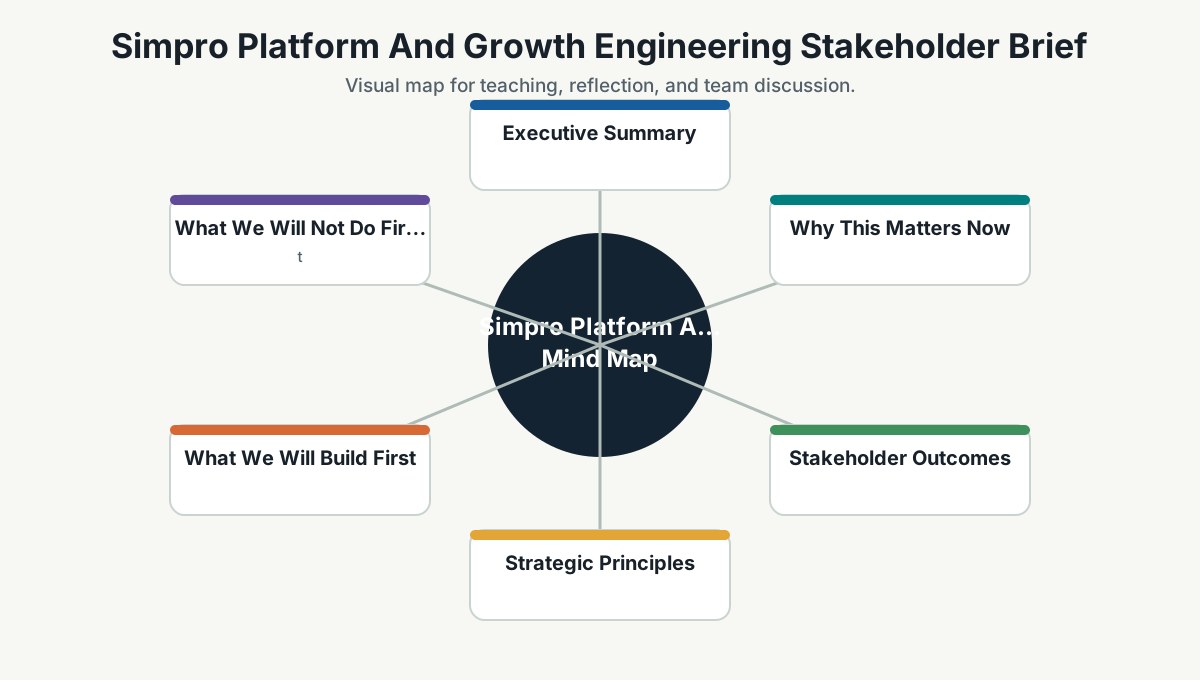
Executive Summary
Simpro should lay a practical platform engineering foundation now, while the company is still small enough to shape habits, standards, and architecture deliberately.
The goal is not to create a large central platform team or buy a collection of tools. The goal is to make product development faster, safer, easier to operate, and easier to learn from.
For Simpro development, platform engineering and growth engineering should be treated as two sides of the same operating system:
- Platform engineering improves how reliably teams build, test, deploy, secure, and operate software.
- Growth engineering improves how teams learn from product usage, experiments, onboarding, activation, retention, and customer behavior.
Together, they create a foundation where engineering quality and business learning reinforce each other.
Why This Matters Now
A small company can move quickly because there are fewer layers. That advantage disappears when each project invents its own delivery process, deployment path, observability model, environment setup, security practice, and product analytics.
The early platform investment should prevent avoidable complexity:
- Repeated setup work across products.
- Manual deployments and environment drift.
- Weak visibility into failures and customer impact.
- Slow onboarding for developers.
- Security and compliance work happening late.
- Product decisions based on opinion instead of evidence.
- Growth experiments implemented in inconsistent ways.
The right foundation gives Simpro speed with discipline.
Stakeholder Outcomes
| Stakeholder | What They Should See |
|---|---|
| Founders and leadership | Faster product execution, clearer investment choices, fewer operational surprises |
| Product leaders | Better activation and adoption data, safer experiments, clearer customer journey metrics |
| Engineering leaders | Repeatable delivery, stronger architecture discipline, less firefighting |
| Developers | Easier local setup, clear golden paths, better tooling, less waiting |
| Customer success and support | Better insight into user friction, incidents, and adoption risks |
| Security and compliance owners | Evidence generated continuously instead of assembled manually at the end |
Strategic Principles
- Start small, but design for scale.
- Build paved roads before enforcing rules.
- Prefer self-service over ticket-based dependency.
- Use metrics to learn, not to blame.
- Make security, observability, and quality defaults.
- Connect engineering metrics with product and business outcomes.
- Buy or adopt commodity capabilities; build only where Simpro needs strategic differentiation.
- Treat the platform as a product with internal users.
What We Will Build First
The first foundation should contain:
- A developer portal or lightweight service catalog.
- A golden path for one standard service or application.
- A standard CI/CD pipeline.
- A consistent local development and environment strategy.
- Feature flag and release control standards.
- Observability dashboards for technical and product signals.
- Security checks built into delivery.
- A product event taxonomy for growth analytics.
- A small experimentation workflow.
- A 90-day roadmap with measurable outcomes.
What We Will Not Do First
We should avoid premature enterprise ceremony:
- Do not create a large platform team before there is adoption demand.
- Do not standardize every tool immediately.
- Do not make Kubernetes, Backstage, service mesh, or any single tool the strategy.
- Do not add approvals where automation can provide guardrails.
- Do not use DORA, SLO, or growth metrics as punishment.
- Do not copy big-company processes without adapting them to Simpro's size.
Recommended Operating Model
Start with a small virtual platform group:
- One engineering leader as sponsor.
- One senior engineer or architect as platform owner.
- One DevOps/SRE-minded engineer.
- One product/growth partner.
- One security-minded reviewer.
- One pilot product team.
This group should spend the first 90 days building one usable paved road and proving that teams want to adopt it.
First Platform Use Case
Choose one representative Simpro product workflow and build the platform foundation around it.
Recommended first workflow:
Lead or request intake -> quote -> job -> schedule -> mobile field update -> invoice/payment -> reporting.
This workflow is valuable because it touches product experience, backend services, integrations, mobile behavior, data, reliability, and business outcomes.
Success Measures
By the end of the first 90 days, stakeholders should be able to see:
- One product team using the golden path.
- One service catalog view of owned systems.
- One standard pipeline running from code to deployable artifact.
- One preview or test environment pattern.
- One release flag pattern.
- One operational dashboard.
- One product journey dashboard.
- One documented security baseline.
- One growth experiment run or ready to run.
Decision Request
Approve a 90-day platform and growth engineering foundation initiative with a small cross-functional working group, focused on one pilot product workflow and measured through engineering speed, reliability, developer experience, and product learning outcomes.
Team Reference Guide
How To Explain This Page
Use this page as a reference conversation, not as a checklist to read aloud. Start by explaining why the topic matters, then connect it to current team work, and finally ask what behavior should change.
The most useful way to teach this material is to move from concept to example. Explain the principle, show how it appears in daily work, ask the team where it is currently strong or weak, and finish with one small action.
Guidelines For Teams
- Connect the topic to a current project, customer problem, incident, or decision.
- Translate concepts into visible behaviors.
- Keep the guidance lightweight enough to use weekly.
- Capture decisions, examples, and improvements back into the wiki.
- Review the page again after a project, incident, or retrospective to update what the team has learned.
Reflection Questions
- What part of this topic is already working well for us?
- What part is still mostly theory?
- What is one behavior we can change in the next 30 days?