Simpro Platform Tooling And Environment Lab
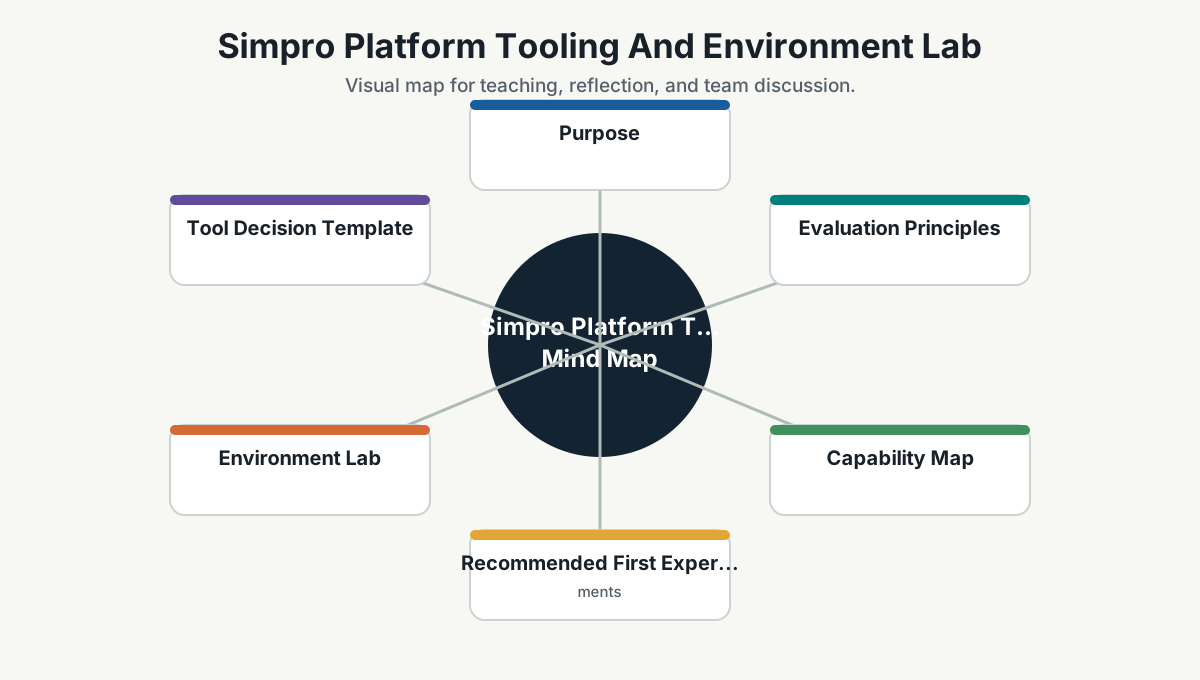
Purpose
This lab is where Simpro can experiment with platform engineering tools before standardizing them.
The rule is simple: evaluate tools by the capability they provide and the friction they remove, not by popularity.
Evaluation Principles
- Start with the problem.
- Prefer tools that integrate with existing workflows.
- Prefer low operational burden for a small company.
- Prefer open standards where possible.
- Prefer adoption by pull before mandate.
- Measure the experiment.
- Keep exit criteria clear.
Capability Map
| Capability | Tools To Consider | Experiment Question |
|---|---|---|
| Developer portal | Backstage, Port, Roadie, MkDocs | Can teams find ownership, docs, APIs, runbooks, and templates faster? |
| API documentation | OpenAPI/Swagger, Stoplight | Can developers and partners understand APIs without tribal knowledge? |
| Service templates | Backstage templates, GitHub templates, custom scripts | Can a developer create a compliant service quickly? |
| CI/CD | GitHub Actions, Azure DevOps, Jenkins, GitLab CI | Can one pipeline pattern handle build, test, scan, package, deploy? |
| Infrastructure as code | Terraform, OpenTofu, Terragrunt | Can environments be reproduced and reviewed safely? |
| IaC automation | Atlantis, Digger, Terrateam | Can infra changes be reviewed and applied through pull requests? |
| Feature flags | OpenFeature, LaunchDarkly, ConfigCat | Can releases and experiments be controlled safely? |
| Preview environments | Qovery, Bunnyshell, Okteto, GitHub Actions plus IaC | Can teams validate changes before merge without manual setup? |
| Local cloud simulation | LocalStack, Docker Compose | Can developers test integrations locally with less waiting? |
| Security scanning | Semgrep, Checkov, tfsec, KICS, dependency scanners | Can security feedback arrive during development? |
| Observability | Sentry, Grafana/Loki, OpenTelemetry, Jaeger, SigNoz | Can teams detect and explain failures quickly? |
| Cost visibility | Infracost, OpenCost, cloud cost reports | Can cost impact be visible before or soon after deployment? |
| Quality metrics | SonarQube, code coverage, test reports | Can quality issues be visible without slowing flow? |
| Load testing | k6 | Can critical workflows be tested before customer impact? |
Recommended First Experiments
Experiment 1: Lightweight Developer Portal
Options:
- Start with Markdown catalog pages in this KB.
- Trial Backstage if integration and templating are priorities.
- Trial Port or Roadie if SaaS speed matters.
Success criteria:
- At least 10 services or systems documented.
- Each service has owner, repo, environment, dashboard, runbook.
- Developers can find ownership without asking in chat.
Experiment 2: Golden Path Service Template
Options:
- GitHub repository template.
- Backstage software template.
- Internal CLI later if repeated setup becomes painful.
Success criteria:
- New service/app created in less than one hour.
- Pipeline runs automatically.
- Security and quality checks are included.
- Health check, logging, and ownership metadata are included.
Experiment 3: Feature Flag Standard
Options:
- OpenFeature as SDK abstraction.
- LaunchDarkly or ConfigCat as managed provider.
- Simple internal flag config only for very early low-risk use cases.
Success criteria:
- One release uses a flag.
- Rollout can be limited by environment or customer segment.
- Flag owner and cleanup date are recorded.
- Product event data includes experiment or flag context.
Experiment 4: Observability Baseline
Options:
- Sentry for application errors.
- OpenTelemetry for traces and metrics.
- Grafana/Loki or SigNoz for open-source observability.
Success criteria:
- One dashboard shows latency, volume, errors, and saturation.
- One dashboard shows core product workflow conversion.
- Release events are visible on dashboards.
- Incidents can be investigated without searching multiple chat threads.
Experiment 5: Growth Event Pipeline
Options:
- Start with application events written to a central store.
- Add analytics warehouse later.
- Add product analytics tooling if needed.
Success criteria:
- Events follow a naming convention.
- Events include account, user, product area, surface, and timestamp.
- Dashboard answers at least one stakeholder question.
- Event quality issues are visible.
Environment Lab
Local Development
Minimum standard:
- One command or documented sequence to run locally.
- Local config example.
- Safe local secrets strategy.
- Seed data or fixture guidance.
- Mock or local substitutes for external dependencies where practical.
Preview Environment
Use when:
- UI changes need stakeholder review.
- API changes need integration testing.
- Cross-service changes are risky.
Avoid preview environments if setup cost exceeds learning value for the current phase.
Test And Staging
Minimum standard:
- Stable integration test environment.
- Clear data refresh policy.
- Known deployment owner.
- Monitoring and logs enabled.
- Production-like configuration where feasible.
Production
Minimum standard:
- Automated deployment or documented controlled release.
- Rollback plan.
- Feature flag plan for risky changes.
- Health checks.
- Alerts.
- Dashboard.
- Runbook.
Tool Decision Template
Use this before adopting a tool:
- Capability:
- Problem:
- Users:
- Current pain:
- Options compared:
- Recommended option:
- Why now:
- Cost:
- Operational burden:
- Security/compliance considerations:
- Integration points:
- Exit plan:
- Success metrics:
- Decision date:
- Review date:
Adoption States
| State | Meaning |
|---|---|
| Assess | Interesting, not yet tried |
| Trial | Used in a bounded experiment |
| Adopt | Recommended default |
| Hold | Useful but not now |
| Retire | No longer recommended |
Team Reference Guide
How To Explain This Page
Use this page as a reference conversation, not as a checklist to read aloud. Start by explaining why the topic matters, then connect it to current team work, and finally ask what behavior should change.
The most useful way to teach this material is to move from concept to example. Explain the principle, show how it appears in daily work, ask the team where it is currently strong or weak, and finish with one small action.
Guidelines For Teams
- Connect the topic to a current project, customer problem, incident, or decision.
- Translate concepts into visible behaviors.
- Keep the guidance lightweight enough to use weekly.
- Capture decisions, examples, and improvements back into the wiki.
- Review the page again after a project, incident, or retrospective to update what the team has learned.
Reflection Questions
- What part of this topic is already working well for us?
- What part is still mostly theory?
- What is one behavior we can change in the next 30 days?