Learning System and Daily Research Rituals
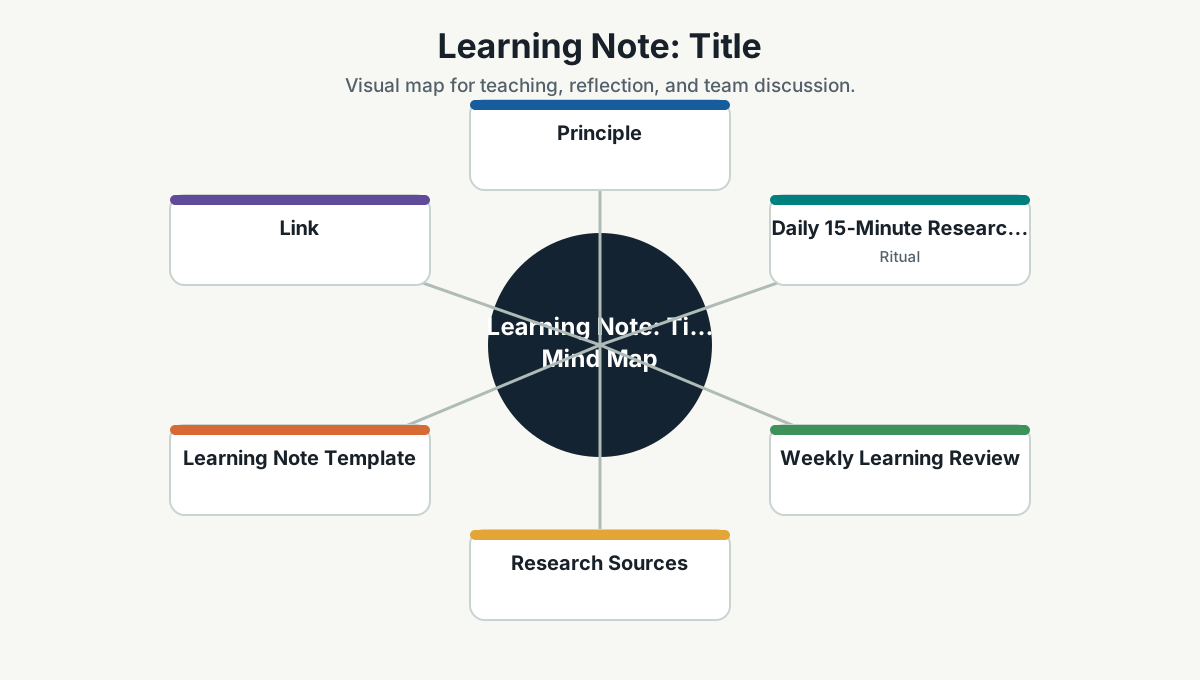
Principle
The team should learn faster than the market, technology landscape, and customer expectations change.
Learning must become a visible operating habit, not an occasional training event.
Daily 15-Minute Research Ritual
Each person or pair scans one source and posts a short note:
- Link.
- One-sentence summary.
- Why it matters.
- Possible action or question.
Rotate focus areas:
| Day | Focus |
|---|---|
| Monday | Engineering practices, GitHub projects, architecture |
| Tuesday | AI, local LLMs, edge, multimodal, agents |
| Wednesday | Security, DevSecOps, SRE, incidents |
| Thursday | Product, design, UX, customer behavior |
| Friday | Market, sales, competitors, operations, leadership |
Weekly Learning Review
Agenda:
- Top three insights.
- One trend to assess.
- One risk to watch.
- One experiment to run.
- One wiki update needed.
Research Sources
Track:
- Official engineering blogs.
- GitHub trending and release notes.
- Thoughtworks Technology Radar.
- Google DORA.
- Google SRE.
- OWASP.
- NIST.
- CNCF landscape and project updates.
- Cloud provider architecture blogs.
- Product and design research sources.
- Competitor changelogs.
- Customer support tickets.
- Sales call notes.
- Incident reports from major platforms.
Learning Note Template
# Learning Note: Title

## Link

## Summary

## Why It Matters

## Applicability
Adopt | Trial | Assess | Ignore

## Risks

## Next Action
Monthly Learning Outputs
Each month produce:
- Updated technology radar.
- Top five customer insights.
- Top five engineering improvements.
- Top three security/reliability risks.
- One internal demo or brown-bag session.
- One process improvement.
Personal Learning Plans
Each team member should maintain a quarterly plan:
- One deep technical skill.
- One product/business skill.
- One communication or leadership skill.
- One AI/tooling capability.
- One contribution to the team knowledge base.
Team Reference Guide
How To Explain This Page
Learning is not a training event. It is the operating rhythm that keeps a company relevant. Markets change, tools change, customer expectations change, and competitors change. A team that does not learn deliberately becomes outdated accidentally.
The daily research ritual is intentionally small. The point is not to create homework. The point is to keep useful signals flowing into the team.
Guidelines For Teams
- Spend 15 minutes daily or a few times weekly scanning a focused source.
- Share one link, one summary, one implication, and one possible action.
- Rotate topics: engineering, AI, security, product, design, market, operations.
- Convert useful insights into experiments, radar updates, or wiki improvements.
- Review learning weekly and choose one action.
- Keep personal learning plans practical and role-specific.
What Good Looks Like
The team can point to recent external or internal learning that changed a decision, improved a practice, reduced risk, or created an experiment.
Reflection Questions
- What did we learn this week that should change our work?
- Which source gives us the strongest signal?
- Are we collecting links or changing decisions?