Visual Models
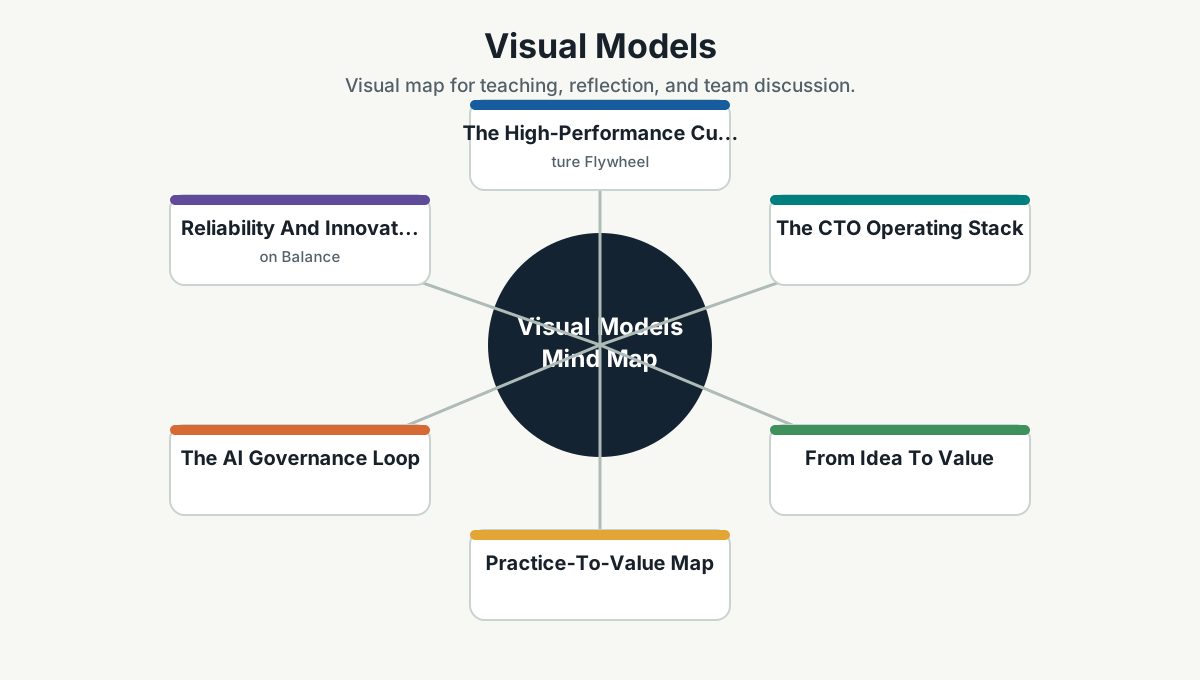
These diagrams are original models for this wiki. They can be used in presentations, workshops, onboarding, and the June 25 annual-day sessions.
The High-Performance Culture Flywheel
flowchart LR
    A[Customer Value] --> B[Clear Outcomes]
    B --> C[Team Ownership]
    C --> D[Engineering Discipline]
    D --> E[Reliable Delivery]
    E --> F[Fast Feedback]
    F --> G[Learning]
    G --> H[Innovation]
    H --> A
Meaning:
- Customer value gives direction.
- Outcomes create focus.
- Ownership creates energy.
- Engineering discipline creates sustainable speed.
- Reliable delivery earns trust.
- Feedback creates truth.
- Learning improves judgment.
- Innovation creates new value.
The CTO Operating Stack
flowchart TB
    L1[Values and Principles]
    L2[Strategy and Operating Model]
    L3[Customer Discovery and Product Direction]
    L4[Design and Experience]
    L5[Architecture and Engineering]
    L6[DevSecOps and SRE]
    L7[Platform and Developer Experience]
    L8[AI-Assisted Workflows]
    L9[Go-To-Market Feedback]
    L10[Learning System]
    L1 --> L2 --> L3 --> L4 --> L5 --> L6 --> L7 --> L8 --> L9 --> L10 --> L1
Meaning:
The stack is circular, not linear. Learning refreshes values, strategy, and decisions.
From Idea To Value
flowchart LR
    A[Signal: customer market tech incident] --> B[Problem Framing]
    B --> C[Discovery and Options]
    C --> D[Decision and Bet]
    D --> E[Design and Build]
    E --> F[Secure and Test]
    F --> G[Release]
    G --> H[Operate]
    H --> I[Measure Impact]
    I --> J[Learn and Adjust]
    J --> B
Meaning:
The work is not done at release. The work is done when impact is understood and learning changes the next decision.
Practice-To-Value Map
mindmap
  root((High Performance))
    Customer Value
      Product Discovery
      Design Thinking
      Working Backwards
    Sustainable Speed
      CI/CD
      Small Batches
      Platform Engineering
    Trust
      DevSecOps
      SRE
      Privacy
    Learning
      Daily Research
      Retrospectives
      Postmortems
      Tech Radar
    Ownership
      Clear Outcomes
      Decision Rights
      Accountability
    Innovation
      Experiments
      AI Assistants
      Architecture Evolution
The AI Governance Loop
flowchart LR
    A[Use Case] --> B[Data Classification]
    B --> C[Model and Tool Choice]
    C --> D[Evaluation Set]
    D --> E[Human Approval Boundary]
    E --> F[Deployment Guardrails]
    F --> G[Monitoring and Audit]
    G --> H[Incident and Feedback Learning]
    H --> A
Meaning:
AI adoption should move quickly, but every use case needs clarity about data, tools, evaluation, human responsibility, and monitoring.
Reliability And Innovation Balance
flowchart TB
    A[Product Ambition] --> C[Release Decisions]
    B[User Trust] --> C
    C --> D{Error Budget Healthy?}
    D -- Yes --> E[Ship and Experiment]
    D -- No --> F[Stabilize and Reduce Risk]
    E --> G[Observe SLOs]
    F --> G
    G --> D
Meaning:
Reliability is not the enemy of innovation. It is the agreement that tells teams when to accelerate and when to stabilize.
Team Reference Guide
How To Explain This Page
Use this page as a reference conversation, not as a checklist to read aloud. Start by explaining why the topic matters, then connect it to current team work, and finally ask what behavior should change.
The most useful way to teach this material is to move from concept to example. Explain the principle, show how it appears in daily work, ask the team where it is currently strong or weak, and finish with one small action.
Guidelines For Teams
- Connect the topic to a current project, customer problem, incident, or decision.
- Translate concepts into visible behaviors.
- Keep the guidance lightweight enough to use weekly.
- Capture decisions, examples, and improvements back into the wiki.
- Review the page again after a project, incident, or retrospective to update what the team has learned.
Reflection Questions
- What part of this topic is already working well for us?
- What part is still mostly theory?
- What is one behavior we can change in the next 30 days?