Simpro Technology Review Dashboard And Rituals
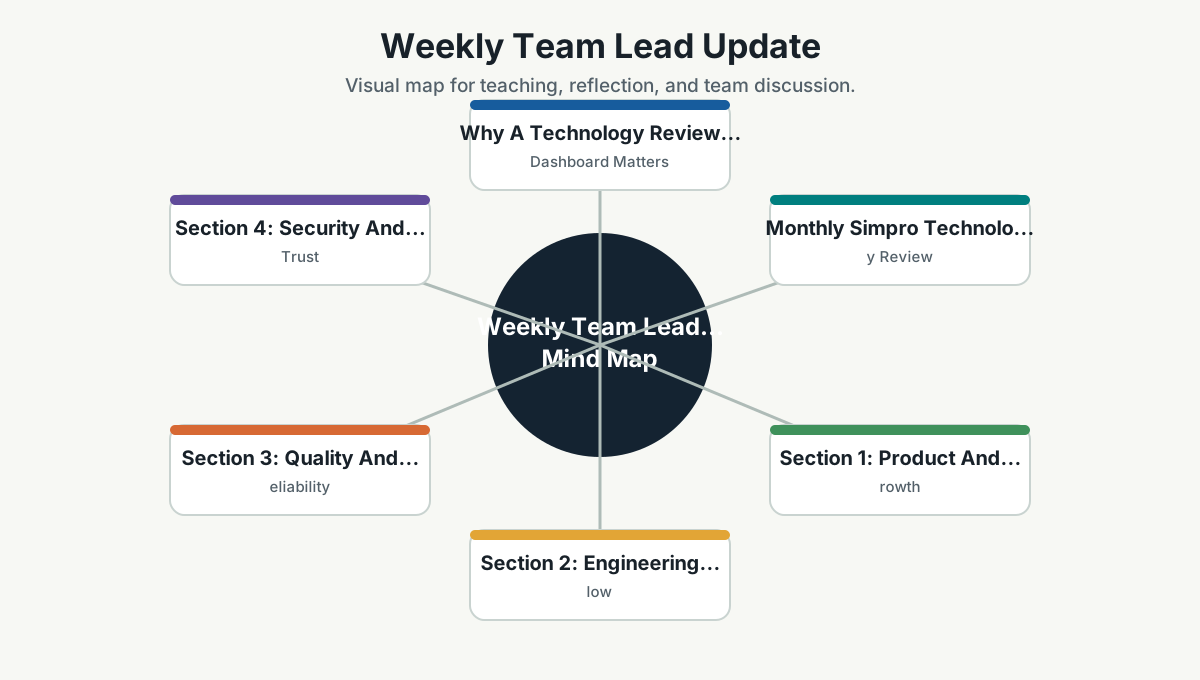
Why A Technology Review Dashboard Matters
Simpro needs a cockpit, not a pile of status updates. Status tells you what people are doing. A dashboard should tell you whether the operating system is healthy.
The dashboard should show:
- Are we building the right things?
- Are we building them the right way?
- Are we releasing safely?
- Are customers receiving value?
- Are teams learning?
- Are foundations improving?
- Are risks visible early enough?
Monthly Simpro Technology Review
Run this once per month.
Duration: 60 to 90 minutes.
Participants:
- CTO.
- Engineering leads.
- Product/stakeholder leads.
- QA lead.
- IT/Ops lead.
- Security/reliability owner.
- Platform/growth owner if available.
Section 1: Product And Growth
Ask:
- What product bets are active?
- What experiments were run?
- What did we learn?
- What adoption, activation, retention, or support signal changed?
- What should we scale, refine, or stop?
Dashboard:
| Signal | Current View |
|---|---|
| Active product bets | |
| Experiments completed | |
| Adoption/activation trend | |
| Customer/support pain | |
| Decisions made from evidence |
Section 2: Engineering Flow
Ask:
- Is work flowing?
- Where are delays?
- Are changes small enough?
- Is review healthy?
- Are deployments predictable?
Dashboard:
| Signal | Current View |
|---|---|
| Lead time | |
| Deployment frequency | |
| PR size/review time | |
| CI stability | |
| Blocked work |
Section 3: Quality And Reliability
Ask:
- Are defects found early or late?
- Are critical journeys observable?
- Are incidents repeating?
- Are postmortem actions completed?
Dashboard:
| Signal | Current View |
|---|---|
| Escaped defects | |
| Change failure | |
| Recovery time | |
| Incident themes | |
| SLO health |
Section 4: Security And Trust
Ask:
- Are secrets, access, and dependencies controlled?
- Are sensitive data flows understood?
- Are AI use cases governed?
- Are security findings being remediated?
Dashboard:
| Signal | Current View |
|---|---|
| Open vulnerabilities | |
| Secrets/access issues | |
| Security exceptions | |
| AI risk reviews | |
| Audit/logging gaps |
Section 5: Platform And Developer Productivity
Ask:
- What repeated friction should become reusable platform capability?
- Are golden paths being adopted?
- Is setup/deployment easier than last month?
Dashboard:
| Signal | Current View |
|---|---|
| Time to environment | |
| Time to first deployment | |
| Platform adoption | |
| Repeated support requests | |
| Developer satisfaction |
Section 6: Cost And Performance
Ask:
- Which systems or workflows drive cost?
- Are AI and cloud costs visible?
- Are performance problems affecting adoption or trust?
Dashboard:
| Signal | Current View |
|---|---|
| Cloud cost trend | |
| AI usage cost | |
| Cost by environment | |
| Performance hotspots | |
| Optimization actions |
Section 7: Team Health And Learning
Ask:
- Are teams raising risks early?
- Are people learning?
- Are retrospectives changing behavior?
- Are team leads using the operating loop?
Dashboard:
| Signal | Current View |
|---|---|
| Team health themes | |
| Learning notes | |
| Quest/badge progress | |
| Retro actions completed | |
| Capability gaps |
Decision Log
Every review should end with:
- Top three decisions.
- Top three risks.
- Top three improvements.
- Owners and dates.
Weekly Team Lead Update
Use this format:
# Weekly Team Lead Update

## Context
Why did this week's work matter?

## Commitment
What outcome did we commit to?

## Action
What did we do?

## Evidence
What changed in value, flow, quality, trust, or learning?

## Refinement
What will we change next?

## Help Needed
What decision, support, or unblock is needed?
Simpro Guideline
The Simpro technology review should not become a reporting ceremony. It should be a decision and learning ritual.
If no decision changes, no risk becomes clearer, and no system improvement is owned, the review needs redesign.
Team Reference Guide
How To Explain This Page
Use this page as a reference conversation, not as a checklist to read aloud. Start by explaining why the topic matters, then connect it to current team work, and finally ask what behavior should change.
The most useful way to teach this material is to move from concept to example. Explain the principle, show how it appears in daily work, ask the team where it is currently strong or weak, and finish with one small action.
Guidelines For Teams
- Connect the topic to a current project, customer problem, incident, or decision.
- Translate concepts into visible behaviors.
- Keep the guidance lightweight enough to use weekly.
- Capture decisions, examples, and improvements back into the wiki.
- Review the page again after a project, incident, or retrospective to update what the team has learned.
Reflection Questions
- What part of this topic is already working well for us?
- What part is still mostly theory?
- What is one behavior we can change in the next 30 days?