Storytelling And Gamified Learning Journey
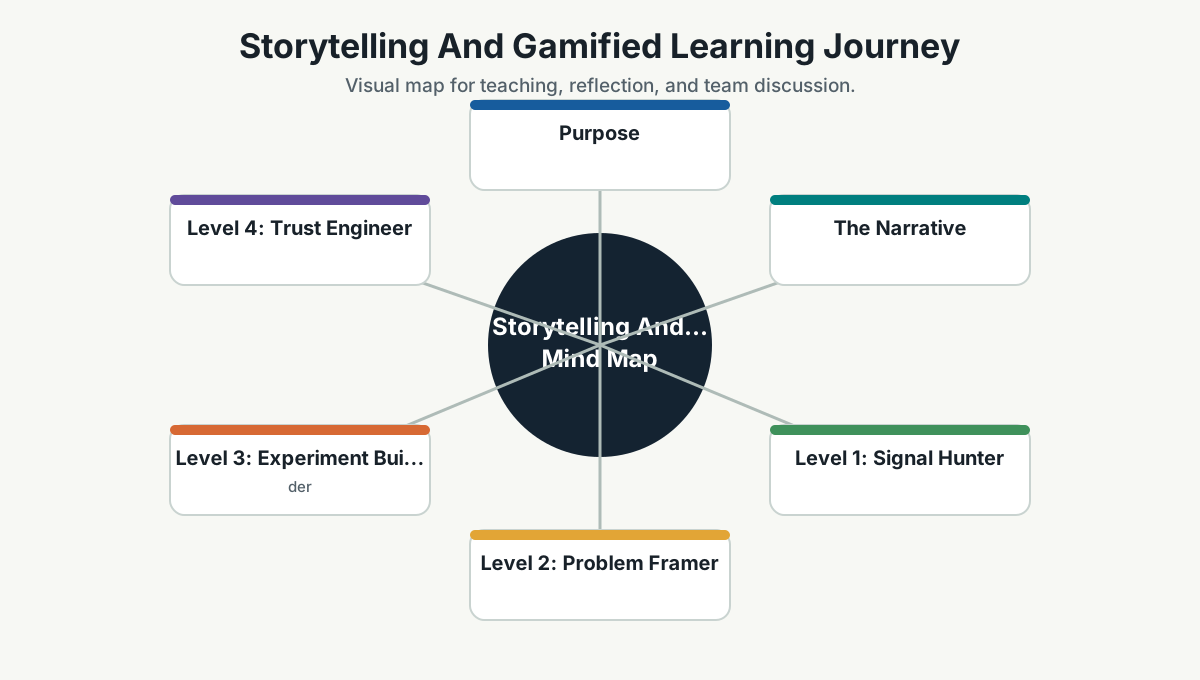
Purpose
This page turns the knowledge base into a guided learning journey. The goal is to help teams learn concepts through story, practice, reflection, and evidence rather than only reading definitions.
The story is:
We are a small company building serious products. Our advantage is not size. Our advantage is learning speed, ownership, engineering discipline, customer closeness, and trust.
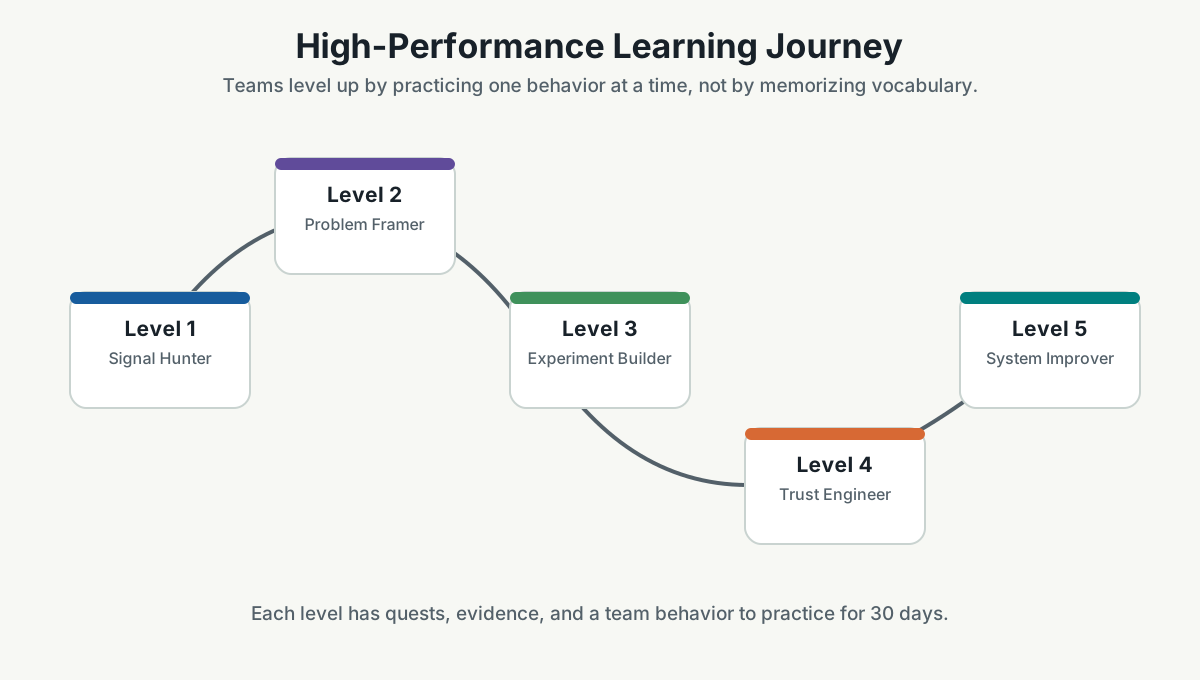
The journey has five levels. Each level teaches one capability and asks the team to prove it with a small behavior change.
The Narrative
Imagine the team as a product crew preparing for a difficult mission. The market is changing, AI is changing how software is built, customers expect faster improvement, and competitors are learning quickly. The team cannot win by working harder in the same old way. It must become sharper.
The team begins as task executors. Work comes in, tickets are created, people build, QA tests, operations handles production, stakeholders wait, and learning happens late. The team is busy, but the system is not yet intelligent.
The journey transforms the team into a high-performance product team. Signals become product bets. Product bets become experiments. Experiments become engineered releases. Releases generate evidence. Evidence improves the operating system.
This is the central loop:
Signal -> Bet -> Experiment -> Build -> Release -> Measure -> Learn -> Improve
Every concept in the wiki fits somewhere in that loop.
Level 1: Signal Hunter
Story
The team first learns to notice signals. A signal is any clue that reality is trying to teach us something: a customer complaint, a support ticket, a sales objection, a slow workflow, a production incident, a competitor launch, a new technology trend, or repeated internal friction.
Average teams ignore weak signals until they become urgent. High-performance teams notice signals early and convert them into learning.
Skill To Learn
Separate noise from useful signal.
Practice
For one week, every team member brings one signal:
- Customer signal.
- Product usage signal.
- Engineering friction signal.
- Quality or reliability signal.
- Market or technology signal.
Each signal must answer:
- What happened?
- Why might it matter?
- What should we investigate?
Evidence
The team creates a signal board with at least five useful signals and chooses one to investigate.
Badge
Signal Hunter badge: awarded when the team chooses one real signal and turns it into a problem statement.
Level 2: Problem Framer
Story
The team now learns not to jump from signal to solution. A stakeholder may say, "build a dashboard." A customer may say, "we need export." A developer may say, "we need a new framework." These may be valid, but they are not yet problems.
Problem framing asks:
- Who is affected?
- What are they trying to do?
- What pain, delay, risk, or opportunity exists?
- How do we know?
- What would improve if we solved it?
Skill To Learn
Turn requests into problem statements and outcomes.
Practice
Use this format:
For user segment, who are trying to job/workflow, the problem is pain or risk. We believe solving it will improve outcome measured by metric.
Example:
For finance admins reconciling monthly transactions, the problem is that data must be manually collected from three screens. We believe solving it will reduce reconciliation time from two hours to thirty minutes.
Evidence
The team rewrites one current feature request as a problem statement with a measurable outcome.
Badge
Problem Framer badge: awarded when the team can explain the user, problem, outcome, and evidence before discussing the solution.
Level 3: Experiment Builder
Story
Now the team learns growth engineering. The team does not bet weeks of effort on untested assumptions. It builds the smallest useful experiment that can create evidence.
An experiment is not always an A/B test. It can be a prototype, concierge workflow, small release, feature flag rollout, customer interview, technical spike, or analytics review.
Skill To Learn
Convert a product bet into a measurable experiment.
Practice
Use this hypothesis format:
We believe change will improve metric for user group because evidence. We will test this by experiment.
Example:
We believe a guided setup checklist will improve first-week activation for new administrators because support tickets show configuration confusion. We will test it with a clickable prototype and five onboarding sessions before building the full flow.
Evidence
The team runs one small experiment and records the decision:
- Scale.
- Refine.
- Stop.
Badge
Experiment Builder badge: awarded when the team makes a decision from evidence, not opinion.
Level 4: Trust Engineer
Story
Growth without trust is not success. A feature that increases usage but creates security risk, performance pain, production instability, or support burden is unhealthy growth.
At this level, the team learns that quality, security, reliability, performance, and usability are not separate departments. They are part of the customer promise.
Skill To Learn
Build the right thing safely and sustainably.
Practice
For one experiment or feature, define:
- Quality risk.
- Security or privacy risk.
- Performance risk.
- Observability signal.
- Rollback or mitigation path.
Evidence
The team shifts one quality, security, or reliability check earlier in the workflow.
Badge
Trust Engineer badge: awarded when the team prevents a late risk by making it visible earlier.
Level 5: System Improver
Story
The final level is not about one release. It is about improving how the team works. Every incident, defect, missed expectation, delayed release, and confusing requirement is a chance to improve the system.
Average teams solve the immediate issue and move on. High-performance teams ask:
What made this problem possible, and how do we make the better behavior easier next time?
Skill To Learn
Turn learning into operating-system improvement.
Practice
After one project, incident, or experiment, record:
- What happened?
- What did we learn?
- What system behavior should change?
- Who owns the change?
- How will we know it worked?
Evidence
The team implements one workflow improvement and reviews it after 30 days.
Badge
System Improver badge: awarded when the team changes a habit, tool, checklist, dashboard, or decision rule based on evidence.
Gamification Rules
Rule 1: Badges Require Evidence
No badge should be awarded for attending a session or agreeing with a concept. A badge requires evidence of behavior.
Rule 2: Small Beats Grand
A small real behavior change is better than a large declaration. The game rewards visible improvement, not ambition theater.
Rule 3: Teams Win Together
Badges are team badges by default. Individual recognition can exist, but the real goal is improving the team operating system.
Rule 4: Reflection Is Part Of The Game
Each quest ends with:
- What did we believe?
- What did we do?
- What happened?
- What did we learn?
- What will we change?
Suggested 30-Day Campaign
Week 1: Signal Hunter.
Week 2: Problem Framer.
Week 3: Experiment Builder.
Week 4: Trust Engineer and System Improver.
At the end of 30 days, each team presents:
- One signal.
- One product bet.
- One experiment.
- One engineering/trust improvement.
- One measurable learning.
Facilitator Tip
Do not present this as a school exercise. Present it as a way to make the team stronger. People enjoy games when the game respects their real work.
Team Reference Guide
How To Explain This Page
Use this page as a reference conversation, not as a checklist to read aloud. Start by explaining why the topic matters, then connect it to current team work, and finally ask what behavior should change.
The most useful way to teach this material is to move from concept to example. Explain the principle, show how it appears in daily work, ask the team where it is currently strong or weak, and finish with one small action.
Guidelines For Teams
- Connect the topic to a current project, customer problem, incident, or decision.
- Translate concepts into visible behaviors.
- Keep the guidance lightweight enough to use weekly.
- Capture decisions, examples, and improvements back into the wiki.
- Review the page again after a project, incident, or retrospective to update what the team has learned.
Reflection Questions
- What part of this topic is already working well for us?
- What part is still mostly theory?
- What is one behavior we can change in the next 30 days?