On-Premise And Cloud Architecture Fundamentals
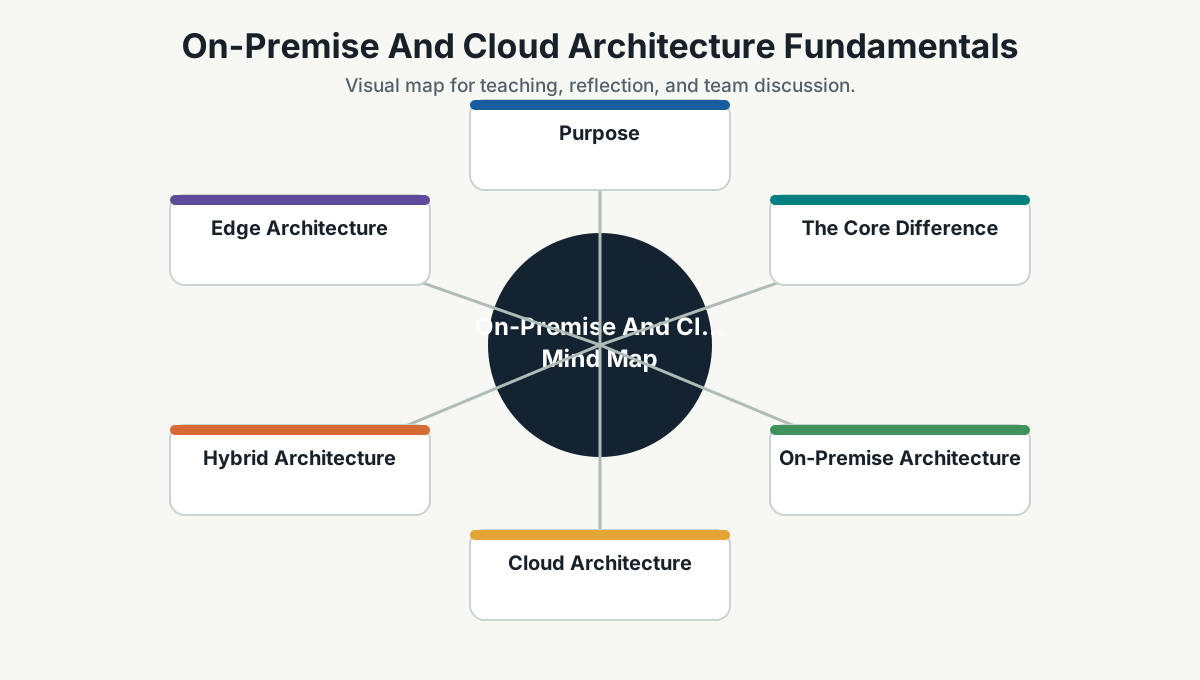
Purpose
Developers should understand how design decisions change between on-premise, cloud, hybrid, and edge environments. The code may look similar, but the operating model can be very different.
The Core Difference
On-premise architecture usually starts from owned or controlled infrastructure.
Cloud architecture usually starts from programmable, elastic, managed infrastructure.
Hybrid architecture combines both, which means the team must design carefully around network, identity, data, monitoring, and operational ownership.
On-Premise Architecture
On-premise systems often run in a company-controlled data center or customer-controlled environment.
Strengths:
- Strong control over infrastructure.
- Predictable hardware ownership.
- Useful for strict data locality.
- Can support disconnected or low-latency local operations.
- Existing enterprise integration may be easier.
Challenges:
- Capacity planning is slower.
- Hardware lifecycle matters.
- Upgrades may be harder.
- Disaster recovery requires explicit planning.
- Automation may be less mature.
- Observability may be fragmented.
Developer implications:
- Be careful with version compatibility.
- Make upgrades and migrations repeatable.
- Support clear configuration.
- Design for backup and restore.
- Avoid assumptions about internet connectivity.
Cloud Architecture
Cloud systems use managed infrastructure and services from cloud providers.
Strengths:
- Elastic scaling.
- Managed databases, queues, storage, identity, and monitoring.
- Faster provisioning.
- Global reach.
- Automation-friendly.
- Pay-as-you-go model.
Challenges:
- Cost can surprise teams.
- Managed services create provider coupling.
- Identity and network design matter.
- Security configuration mistakes can be serious.
- Observability spans many services.
Developer implications:
- Understand managed service limits.
- Add cost visibility.
- Design for failure and retries.
- Use infrastructure as code.
- Use cloud-native identity and secrets.
- Treat logs, metrics, and traces as product requirements.
Hybrid Architecture
Hybrid systems combine on-premise and cloud.
Common reasons:
- Gradual migration.
- Data residency.
- Existing enterprise systems.
- Latency requirements.
- Customer deployment constraints.
- Regulatory needs.
Challenges:
- Network reliability.
- Identity federation.
- Data synchronization.
- Consistency.
- Monitoring across environments.
- Split ownership.
Developer implications:
- Make integration contracts explicit.
- Handle partial connectivity.
- Design idempotent sync.
- Use clear retry and reconciliation logic.
- Log correlation IDs across boundaries.
Edge Architecture
Edge systems run compute near the source of data or user activity.
Use cases:
- Low latency.
- Offline operation.
- IoT.
- Local AI inference.
- Manufacturing and field operations.
- Privacy-sensitive processing.
Challenges:
- Device constraints.
- Updates.
- Observability.
- Local storage.
- Security.
- Intermittent connectivity.
Developer implications:
- Design offline-first where needed.
- Sync carefully.
- Keep local models/data manageable.
- Plan remote diagnostics.
- Protect secrets and local data.
Architecture Decision Lens
| Question | Why It Matters |
|---|---|
| Where does the data live? | Privacy, latency, compliance |
| Who operates the infrastructure? | Support and responsibility |
| What happens when network fails? | Reliability and user experience |
| How do we deploy updates? | Maintainability |
| How do we observe issues? | Support and recovery |
| What are the cost drivers? | Sustainability |
| What services are managed vs self-hosted? | Team capability and vendor coupling |
Simpro Guidance
Use cloud where elasticity, managed services, and automation create advantage.
Use on-premise or edge where locality, control, offline use, or customer constraints require it.
Use hybrid only with clear ownership and integration discipline.
The best architecture is not "cloud" or "on-prem." The best architecture matches the business constraint and operational reality.
Further Study
- Microsoft Azure Architecture Center: https://learn.microsoft.com/en-us/azure/architecture/
- AWS Well-Architected Framework: https://aws.amazon.com/architecture/well-architected/
- Google Cloud Architecture Framework: https://cloud.google.com/architecture/framework
- CNCF Cloud Native Definition: https://github.com/cncf/toc/blob/main/DEFINITION.md
Team Reference Guide
How To Explain This Page
Use this page as a reference conversation, not as a checklist to read aloud. Start by explaining why the topic matters, then connect it to current team work, and finally ask what behavior should change.
The most useful way to teach this material is to move from concept to example. Explain the principle, show how it appears in daily work, ask the team where it is currently strong or weak, and finish with one small action.
Guidelines For Teams
- Connect the topic to a current project, customer problem, incident, or decision.
- Translate concepts into visible behaviors.
- Keep the guidance lightweight enough to use weekly.
- Capture decisions, examples, and improvements back into the wiki.
- Review the page again after a project, incident, or retrospective to update what the team has learned.
Reflection Questions
- What part of this topic is already working well for us?
- What part is still mostly theory?
- What is one behavior we can change in the next 30 days?