Engineering Excellence
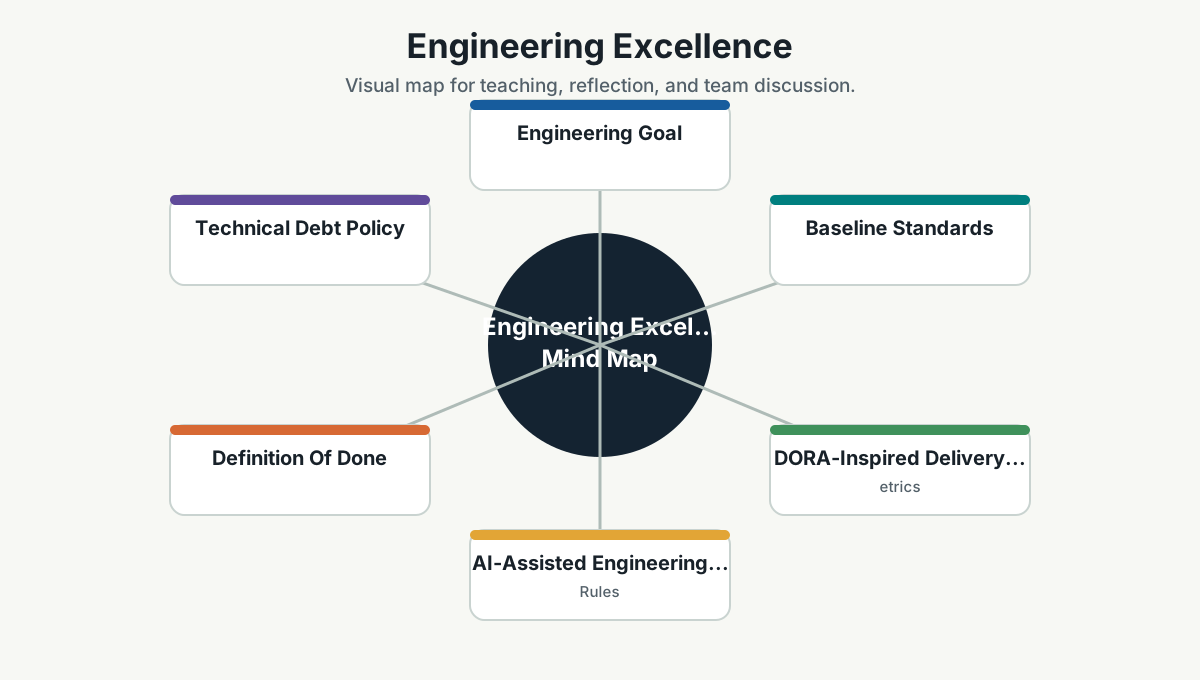
Engineering Goal
Build systems that are easy to understand, change, test, secure, operate, and retire.
Great engineering is not only clever implementation. It is reducing future cognitive load for the team while delivering current value.
For a practical checklist-based companion, see Simpro Engineering Fundamentals Playbook, adapted from Microsoft's public Engineering Fundamentals Playbook.
Baseline Standards
Code Quality
- Prefer simple, explicit code over clever abstractions.
- Keep changes small and reviewable.
- Make domain concepts visible in names and module boundaries.
- Avoid hidden coupling and unexplained side effects.
- Add comments only where they explain non-obvious intent or tradeoffs.
- Delete dead code promptly.
Code Review
Review for:
- Correctness.
- Readability.
- Tests and observability.
- Security and privacy.
- Backward compatibility.
- Operational impact.
- Simplicity of design.
- AI-generated or copied code that the author cannot explain.
Code review is a quality conversation, not a permission ceremony.
Testing
Use a balanced test strategy:
- Unit tests for core logic and edge cases.
- Integration tests for contracts between modules and services.
- Contract tests for APIs and event schemas.
- End-to-end tests for critical journeys.
- Security and dependency checks in CI.
- Load and chaos tests where reliability matters.
Every bug fix should ask: "What test would have caught this?"
Continuous Delivery
Healthy delivery systems favor:
- Trunk-based development or short-lived branches.
- Automated builds and tests.
- Feature flags for risky changes.
- Reversible deployments.
- Automated rollback or fast manual rollback.
- Release notes and migration plans for customer-visible changes.
Architecture
Architecture should optimize for change and flow:
- Clear service and module boundaries.
- Explicit ownership.
- Evolutionary decisions recorded in ADRs.
- APIs designed as products.
- Data contracts owned and versioned.
- Observability designed with the system, not added after failure.
- Platform capabilities that remove repeated work from stream-aligned teams.
DORA-Inspired Delivery Metrics
Use delivery metrics to learn, not to punish:
- Deployment frequency.
- Lead time for changes.
- Change failure rate.
- Failed deployment recovery time.
- Reliability and user-impact metrics.
- Developer experience and cognitive load.
If metrics improve but users do not benefit, the metric system is incomplete.
AI-Assisted Engineering Rules
AI can help with:
- Code explanation.
- Refactoring options.
- Test cases.
- Documentation drafts.
- Threat modeling prompts.
- Log and incident summarization.
- Migration planning.
AI output must be:
- Reviewed by a human owner.
- Tested.
- Checked for security, licensing, and privacy issues.
- Understood by the person submitting it.
- Kept small enough for meaningful review.
Avoid large AI-generated pull requests that the team cannot fully reason about.
Definition Of Done
For meaningful work, done means:
- Solves the stated problem or updates the problem statement.
- Has tests appropriate to risk.
- Has observable signals.
- Handles failure modes.
- Meets security and privacy expectations.
- Updates relevant docs or runbooks.
- Is deployed or has a clear release path.
- Has an owner for follow-up learning.
Technical Debt Policy
Technical debt is acceptable when deliberate, visible, and time-bound.
Each debt item should include:
- Impact.
- Trigger for repayment.
- Owner.
- Risk if ignored.
- Link to affected systems.
Debt becomes dangerous when it is invisible, normalized, or used to mask poor engineering habits.
Team Reference Guide
How To Explain This Page
Engineering excellence is the discipline of making software easy to understand, change, test, secure, operate, and retire. It is not gold-plating. It is how a team protects future speed.
Poor engineering can look fast in the short term because it skips thinking, tests, review, and observability. But the skipped work returns later as defects, slow onboarding, risky releases, production incidents, and fear of change. Strong engineering is not about making everything perfect. It is about making the important things safe enough to change repeatedly.
Guidelines For Teams
- Keep changes small enough for real review.
- Prefer clear design over clever design.
- Treat tests as part of the design, not an afterthought.
- Review code for readability, operability, security, performance, and future change.
- Add observability to important user journeys before production pain begins.
- Use DORA metrics to find system constraints, not to blame individuals.
- Do not merge AI-generated code that the author cannot explain.
- Treat technical debt as a visible business risk with owner, impact, and repayment trigger.
What Good Looks Like
A good engineering team can release small changes frequently, recover quickly, explain its architecture, detect important failures, and onboard new people without relying on tribal memory.
Reflection Questions
- What part of our system are people afraid to change?
- Which tests give us confidence, and which tests only give us noise?
- Where are we paying interest on invisible technical debt?