Team Culture Playbook
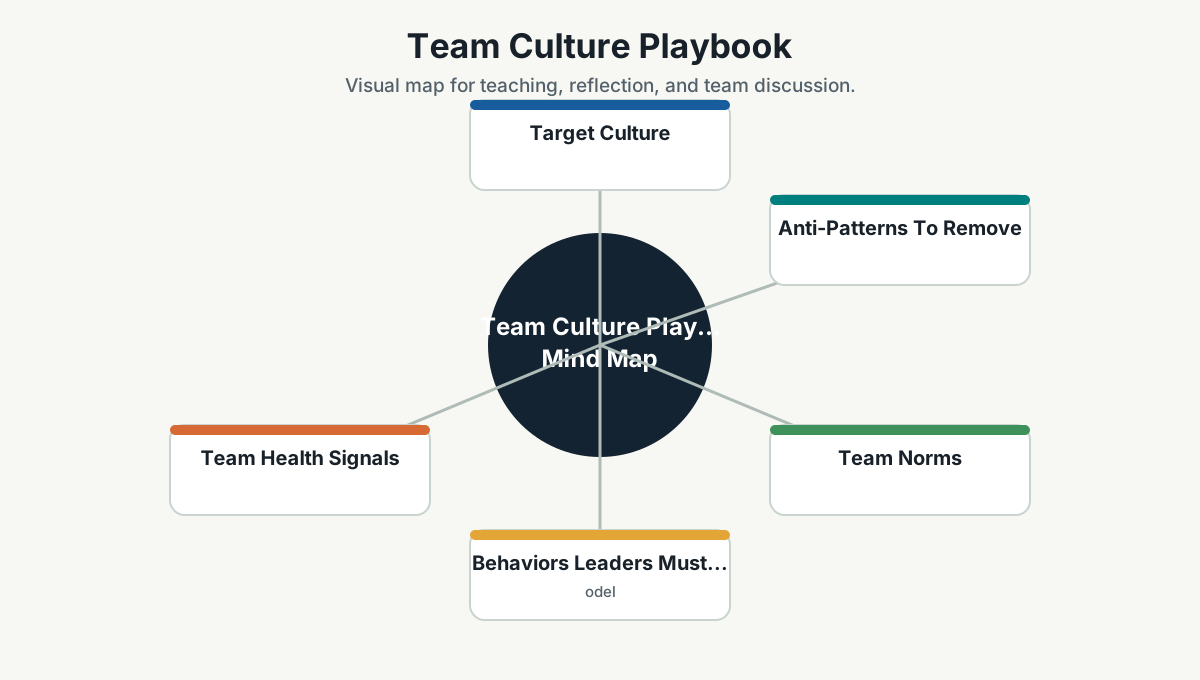
Target Culture
We want a culture where people:
- Understand the mission and business model.
- Ask why before building.
- Challenge weak assumptions respectfully.
- Share learning quickly.
- Own quality, reliability, security, and customer impact.
- Bring options and data into decisions.
- Treat feedback as a tool for improvement.
- Use automation, AI, and platforms to remove repetitive toil.
- Help others level up.
Anti-Patterns To Remove
| Anti-Pattern | Replacement Habit |
|---|---|
| "Just tell me what to do" | Clarify intent, propose options, own the outcome |
| Ceremony without learning | Keep rituals only if they improve decisions or flow |
| Hero culture | Sustainable systems, shared ownership, automation |
| Big-bang releases | Small, reversible changes |
| Opinion-only planning | Evidence, user insight, data, technical discovery |
| Local optimization | Optimize for customer and system outcomes |
| Blame after failures | Blameless learning with clear action items |
| AI copy-paste | AI-assisted work with review, tests, threat thinking, and understanding |
Team Norms
Clarity
- Every initiative has an owner, outcome, success measure, constraints, and decision log.
- Every team has a clear ownership map for services, modules, data, and operational duties.
- Every meeting has a decision, learning, or coordination purpose.
Accountability
- Commitments are explicit and updated when risk changes.
- Teams own defects, incidents, security issues, and customer pain in their area.
- Accountability is not blame. It is the obligation to make reality visible and improve it.
Learning
- Engineers read code outside their immediate ticket.
- Teams review external trends weekly.
- Customer feedback and incident learnings are shared across functions.
- Every project ends with a learning note: what worked, what failed, what changed.
Innovation
- Innovation is expected in the daily work, not only in special events.
- Each team maintains a backlog of improvement experiments.
- Teams reserve capacity for platform improvements, automation, developer experience, and technical discovery.
- Proofs of concept must define the decision they are trying to enable.
Behaviors Leaders Must Model
- Explain the strategic context, not only the task.
- Reward truth-telling and early risk escalation.
- Ask for evidence and user impact.
- Protect time for quality and learning.
- Remove organizational friction.
- Coach decision-making instead of centralizing every decision.
- Share their own learning publicly.
Team Health Signals
Healthy teams show:
- Members can explain the business outcome of current work.
- Work moves in small batches.
- Incidents produce learning and follow-up action.
- Engineers speak to users or hear user evidence regularly.
- Reviews improve the code without becoming ego contests.
- People disagree respectfully before decisions and commit after decisions.
- Metrics are used to learn, not punish.
Risk signals:
- People hide bad news.
- Planning is dominated by output commitments without outcome discussion.
- Code review is slow or superficial.
- Deployments are rare or stressful.
- Security is a final gate.
- Product decisions are mostly stakeholder opinion.
- AI usage is untracked and unreviewed.
Team Reference Guide
How To Explain This Page
Culture is the pattern of behavior that repeats when leaders are not in the room. It is not the values written on a slide. It is what people believe will be rewarded, ignored, punished, or copied.
A high-performance culture combines ownership, learning, innovation, discipline, and trust. If we have ownership without learning, we repeat old solutions. If we have learning without accountability, insights do not become action. If we have innovation without discipline, experiments become chaos. If we have discipline without psychological safety, people hide truth.
Guidelines For Teams
- Replace "just tell me what to do" with "help me understand the outcome and constraints."
- Replace heroics with repeatable systems, automation, shared knowledge, and sustainable pace.
- Treat ceremonies as tools. Keep them only if they improve decisions, flow, quality, or learning.
- Make disagreement normal before decisions and commitment normal after decisions.
- Share one learning every week from customers, incidents, competitors, open source, or production data.
- Reward people who surface problems early and help improve the system.
What Good Looks Like
In a healthy team, people can explain why their work matters, risks are discussed before they become emergencies, code review teaches rather than shames, and team members improve the workflow rather than only complete assigned work.
Reflection Questions
- What behavior do we unintentionally reward today?
- Where are we depending on heroes instead of systems?
- What topic is people-safe but performance-important and therefore needs a better conversation?