Simpro Security Learning Path
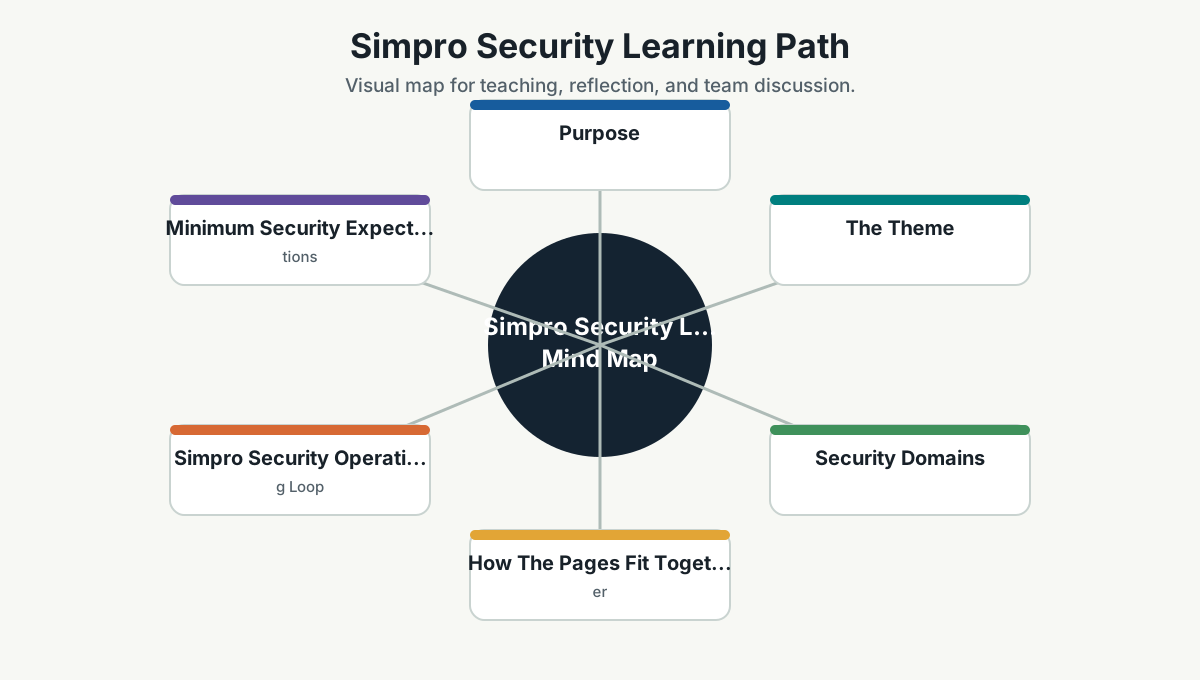
Purpose
Security is not a department that appears near release time with a red pen. Security is part of how we design, build, run, support, and improve software.
This learning path gives Simpro teams a practical way to understand secure development, layered defense, zero trust, threat modeling, security testing, encryption, certificates, and the human side of security.
The Theme
Build trust by design, verify continuously, and make secure behavior the easy behavior.
Security fails when it depends only on heroic experts, late reviews, or people remembering everything under pressure. Security works when the system makes good choices visible and repeatable.
Security Domains
| Domain | What Developers Should Understand |
|---|---|
| Secure SDLC | Security starts from requirements and design, not after coding |
| Threat modeling | Ask what can go wrong before attackers answer for us |
| Secure coding | Prevent common flaws like broken access control, injection, weak auth, and insecure configuration |
| Security testing | Use SAST, SCA, secrets scanning, DAST, API testing, IaC scanning, and penetration testing appropriately |
| Defense in depth | Use multiple layers so one mistake does not become a full breach |
| Zero trust | Verify explicitly, use least privilege, and assume breach |
| Identity and access | Authentication proves who, authorization decides what |
| Cryptography | Use encryption, hashing, signing, and certificates correctly |
| Operations security | Monitor, patch, respond, recover, and learn |
| Human security | Reduce social engineering risk and create a culture where people report issues early |
How The Pages Fit Together
Start with:
- Secure Development Lifecycle
- Defense In Depth And Zero Trust
- Threat Modeling And Risk Analysis
- Security Testing Tools And Practices
- OWASP Developer Security Guide
- Encryption, TLS, Certificates, And PKI
- Human Side Of Security
Simpro Security Operating Loop
Security should follow a loop:
- Identify what we are protecting.
- Understand threats and abuse cases.
- Design controls.
- Build with secure defaults.
- Test automatically and manually.
- Release with visibility.
- Monitor and respond.
- Learn from incidents and update standards.
This loop mirrors the engineering improvement loop. The trick is to make security part of normal work, not a separate ritual people fear.
Minimum Security Expectations
Every meaningful product/service should have:
- Clear owner.
- Data classification.
- Authentication and authorization model.
- Threat model for sensitive flows.
- Secure configuration.
- Secrets management.
- Dependency scanning.
- Static analysis or code scanning.
- Security tests for critical flows.
- Logging and alerting for suspicious events.
- Patch and vulnerability response process.
- Incident response plan.
- Backup and recovery expectations.
The Useful Mental Model
Security is not "Can nobody break this?"
Security is:
- What are we protecting?
- Who can access it?
- What can go wrong?
- How hard is abuse?
- How quickly can we detect it?
- How quickly can we recover?
- What did we learn?
Team Reference Guide
Guidelines For Teams
- Discuss security during design, not only during release.
- Treat identity, access, secrets, data, and logging as first-class architecture topics.
- Automate checks where possible.
- Escalate uncertainty early.
- Use incidents and near-misses as learning inputs, not blame events.
Reflection Questions
- What data in this system would hurt customers or Simpro if exposed?
- What action should only certain users or services perform?
- Where are we trusting input without verification?
- What security failure would we notice too late?
Further Study
- NIST Secure Software Development Framework: https://csrc.nist.gov/pubs/sp/800/218/final
- OWASP Software Assurance Maturity Model: https://owasp.org/www-project-samm/
- OWASP Application Security Verification Standard: https://owasp.org/www-project-application-security-verification-standard/
- Microsoft Security Development Lifecycle: https://www.microsoft.com/en-us/securityengineering/sdl/
- CISA Secure by Design: https://www.cisa.gov/securebydesign