Design Thinking and Product Mindset
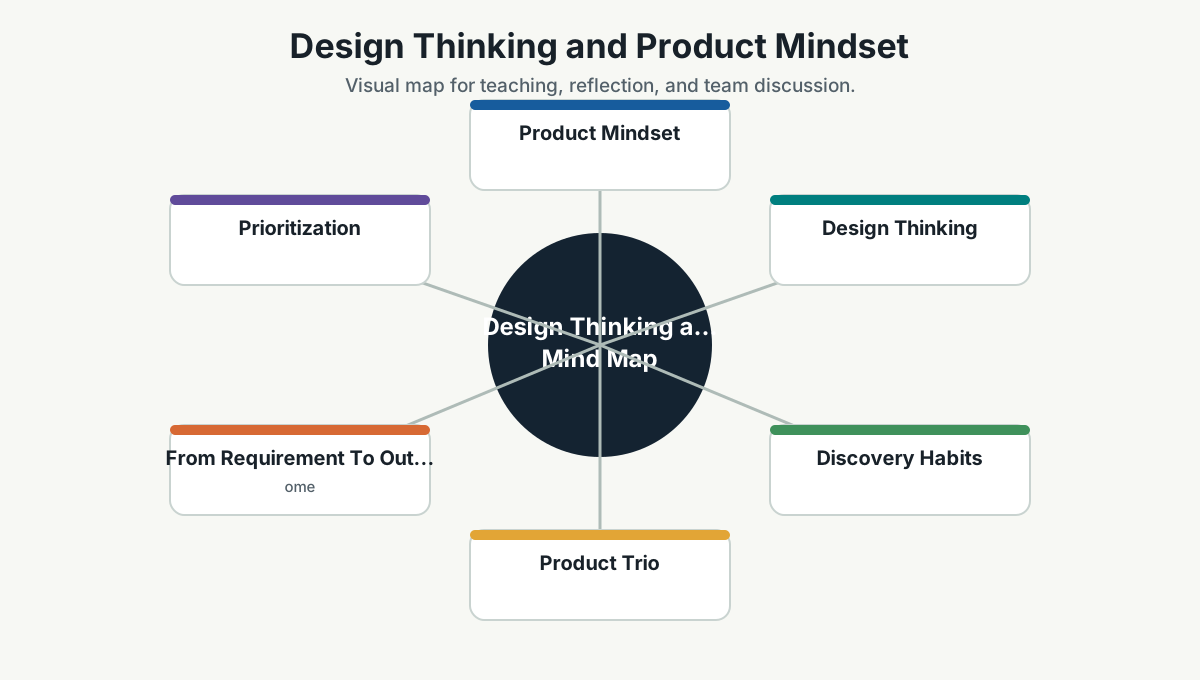
Product Mindset
A product-minded team starts with problems, users, outcomes, and evidence.
It asks:
- Who is the user or buyer?
- What job are they trying to get done?
- What pain, risk, or opportunity matters?
- What behavior do we want to change?
- What business outcome should improve?
- What is the smallest experiment that can reduce uncertainty?
Design Thinking
Use design thinking to balance:
- Desirability: do people need or want this?
- Feasibility: can we build and operate it?
- Viability: can it work for the business?
- Responsibility: should we build it, given security, ethics, privacy, accessibility, and social impact?
Discovery Habits
Each product area should maintain:
- Customer interview notes.
- Opportunity solution tree.
- Assumption map.
- Experiment backlog.
- Competitor and market observations.
- Usage analytics.
- Support and sales feedback.
Recommended cadence:
- At least one customer/user touchpoint per week for active product teams.
- Weekly product trio discussion: product, design, engineering.
- Fortnightly synthesis of insights and decisions.
Product Trio
The product manager, designer, and engineering lead should jointly own discovery.
| Role | Primary Contribution |
|---|---|
| Product | Business outcome, prioritization, market/customer context |
| Design | Human needs, workflow, usability, experience quality |
| Engineering | Feasibility, architecture, data, operational constraints |
From Requirement To Outcome
Weak requirement:
Build an export button.
Better framing:
Finance admins need to reconcile monthly transactions faster. We believe export will reduce reconciliation time by 40%, but we need to validate format, frequency, permission, and audit needs.
Prioritization
Prioritize by:
- Customer pain.
- Business value.
- Strategic fit.
- Risk reduction.
- Learning value.
- Effort and opportunity cost.
- Reliability/security impact.
Avoid prioritizing only by stakeholder volume or seniority.
Experiment Types
- Customer interview.
- Prototype test.
- Concierge/manual service.
- Landing page or waitlist.
- Feature flag rollout.
- A/B test.
- Technical spike.
- Data analysis.
- Sales discovery.
- Support ticket analysis.
Product Review Template
For every major initiative:
- Problem statement.
- Target users/customers.
- Business outcome.
- Current evidence.
- Key assumptions.
- Options considered.
- Chosen approach.
- Risks.
- Success metrics.
- Rollout plan.
- Learning plan.
Team Reference Guide
How To Explain This Page
Product mindset means the team cares about the problem, not only the feature. Design thinking means the team understands the human workflow before committing to a solution.
The product trio of product, design, and engineering is powerful because each role protects a different truth. Product protects customer and business value. Design protects usability and human context. Engineering protects feasibility, architecture, data, and operability. When these perspectives meet early, the team avoids expensive rework.
Guidelines For Teams
- Start with problem, user, outcome, and evidence.
- Ask what customer behavior should change.
- Prototype risky workflows before full implementation.
- Include engineers in discovery, not only delivery.
- Use experiments to reduce uncertainty before scaling effort.
- Prioritize by value, risk, learning, and opportunity cost.
- Keep customer quotes, support signals, sales objections, and usage data visible.
What Good Looks Like
A good product team can explain why a problem matters, who has it, what evidence supports it, how success will be measured, and what small experiment will reduce uncertainty.
Reflection Questions
- Which current feature is still a request rather than a problem statement?
- What assumption are we treating as fact?
- Where would a prototype save us from building the wrong thing?