Architecture and Technology Radar
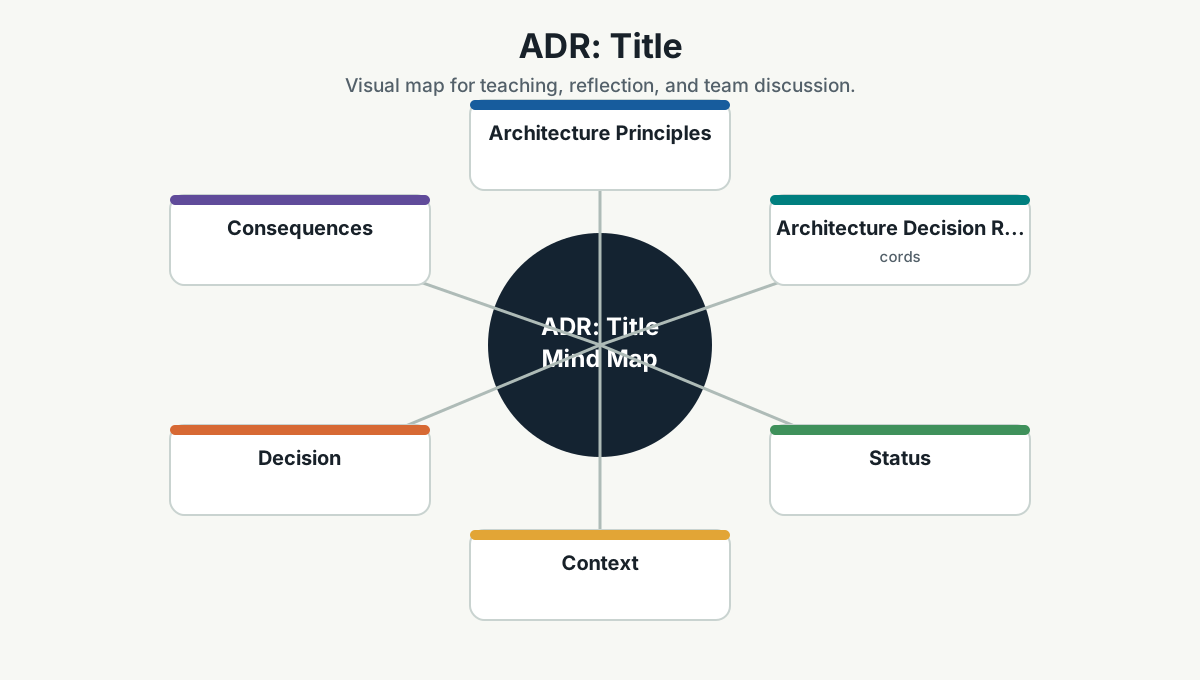
Architecture Principles
- Optimize for change, not theoretical elegance.
- Make boundaries explicit.
- Keep cognitive load low.
- Prefer boring technology for undifferentiated problems.
- Experiment deliberately for strategic capabilities.
- Record decisions and revisit them when assumptions change.
Architecture Decision Records
Use ADRs for:
- New services.
- Major framework choices.
- Data architecture changes.
- AI model/provider choices.
- Security-sensitive changes.
- Build/deployment platform decisions.
- Significant tradeoffs.
ADR template:
# ADR: Title

## Status
Proposed | Accepted | Superseded

## Context
What situation or problem led to this decision?

## Decision
What are we choosing?

## Consequences
What improves, what worsens, and what must we monitor?

## Alternatives
What did we reject and why?
Technology Radar
Maintain a local radar with four rings:
- Adopt: safe default for relevant teams.
- Trial: use in bounded production or serious pilot.
- Assess: investigate, prototype, learn.
- Hold: avoid or retire.
Categories:
- Techniques.
- Tools.
- Platforms.
- Languages and frameworks.
- AI models and agent frameworks.
- Security and compliance.
- Data and analytics.
- Mobile and edge.
Current Themes To Track
AI-Native Software Delivery
Track:
- Coding agents.
- AI-assisted testing.
- Repository-aware development tools.
- Evaluation frameworks.
- Secure AI development.
- AI-generated code review risk.
- Developer experience impact.
Local And Edge AI
Track:
- On-device LLMs.
- Small multimodal models.
- Mobile inference runtimes.
- Privacy-preserving personalization.
- Offline RAG.
- Battery, memory, latency, and cost constraints.
Platform Engineering
Track:
- Internal developer portals.
- Golden paths.
- Self-service environments.
- Standardized observability.
- Secure CI/CD templates.
- Service catalogs.
Cloud, Data, And Connectivity
Track:
- Cloud cost governance.
- Data contracts.
- Lakehouse and semantic layers.
- Event-driven architecture.
- Edge compute.
- Real-time analytics.
Security And Trust
Track:
- Software supply-chain security.
- SBOM adoption.
- Zero trust.
- Secrets management.
- Identity-first security.
- AI and agent security.
- Post-quantum cryptography readiness where relevant.
Monthly Architecture Council Agenda
- Review top architecture risks.
- Review technology radar updates.
- Discuss one production incident from an architecture lens.
- Review major ADRs.
- Identify platform investments that reduce cognitive load.
- Decide experiments for the next month.
Team Reference Guide
How To Explain This Page
Architecture is the cost of future change. Good architecture does not mean complex diagrams or fashionable technology. It means boundaries, ownership, data contracts, failure modes, and decisions are clear enough that teams can move without constant coordination.
The technology radar prevents novelty-driven engineering. It gives teams a language for adoption: adopt, trial, assess, or hold. This helps small companies experiment without turning every project into a technology adventure.
Guidelines For Teams
- Record major architecture decisions as ADRs.
- Make service and module ownership explicit.
- Design APIs and data contracts as products.
- Use the radar to evaluate tools deliberately.
- Define success and exit criteria for technology trials.
- Prefer boring technology for undifferentiated problems.
- Revisit decisions when scale, team capability, or assumptions change.
What Good Looks Like
The team can explain why the architecture is shaped the way it is, what tradeoffs were made, which parts are stable, which parts are risky, and what would trigger a change.
Reflection Questions
- Which architecture decision lives only in someone's memory?
- Which tool are we using because it is useful, and which because it is fashionable?
- Where does architecture create too much coordination?