Software Industry Evolution
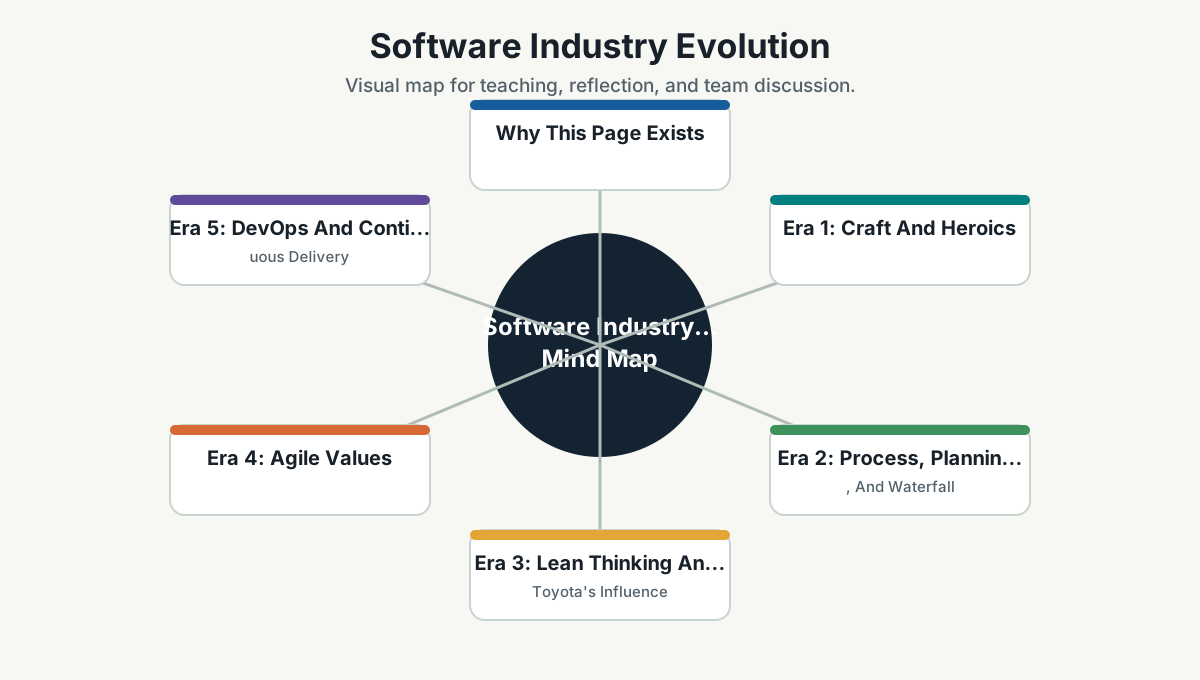
Why This Page Exists
To build a high-performance technology culture, the team needs to understand where today's practices came from. Scrum, DevOps, SRE, platform engineering, product discovery, design thinking, AI-assisted development, and growth mindset are not isolated movements. They are responses to recurring pressures in the software industry:
- Software keeps becoming more central to business value.
- Systems keep becoming more connected and complex.
- Customer expectations keep rising.
- Security and reliability risks keep increasing.
- The cost of slow learning keeps growing.
- Tools keep changing faster than organizations can absorb them.
The lesson from industry history is simple: the winning organizations are not the ones that copy ceremonies. They are the ones that preserve the underlying values while adapting their practices.
Era 1: Craft And Heroics
Early software teams often worked like small craft groups. Individual expertise mattered enormously. A strong programmer could hold much of the system in their head. Releases were infrequent, users were often internal or technical, and software was seen as a support function for hardware, finance, operations, telecom, or back-office automation.
What This Era Taught Us
- Deep technical skill matters.
- Taste and craftsmanship matter.
- Ownership matters because weak ownership creates systems nobody understands.
What Failed
- Hero dependency.
- Poor documentation.
- Late integration.
- Weak testing.
- Project plans that assumed software behaved like physical construction.
Value To Keep
Craft. We still need engineers who care about correctness, simplicity, readability, and maintainability. But craft must become a team capability, not a private talent.
Era 2: Process, Planning, And Waterfall
As software became larger and more expensive, organizations tried to control risk with heavier planning, sequential phases, and formal handoffs. Requirements moved to design, then implementation, then testing, then release.
This approach made sense when change was expensive and feedback was slow. It still has useful lessons for regulated, safety-critical, or contract-heavy environments. But for most digital products, it created a dangerous illusion: that uncertainty could be removed at the beginning.
What This Era Taught Us
- Requirements need clarity.
- Architecture and design matter.
- Risk should be managed deliberately.
- Large systems need coordination.
What Failed
- Late feedback from users.
- Late discovery of technical risk.
- Testing as an end-stage activity.
- Handoffs that diluted ownership.
- Plans treated as truth even after reality changed.
Value To Keep
Intentionality. Good teams still plan, design, and manage risk. The difference is that they do it continuously and empirically.
Era 3: Lean Thinking And Toyota's Influence
Lean thinking changed how technology leaders thought about work. Toyota's production system emphasized flow, waste reduction, built-in quality, continuous improvement, respect for people, and stopping the line when defects appear.
Software is not car manufacturing, but the deeper ideas transferred powerfully:
- Work should flow in small batches.
- Quality should be built in, not inspected at the end.
- Teams should improve the system daily.
- People closest to the work should help improve the work.
- Waste includes waiting, rework, handoffs, partially done work, unnecessary features, and context switching.
Industry Translation
In software, lean ideas show up as:
- Smaller releases.
- Continuous integration.
- Automated testing.
- Limit work in progress.
- Value-stream mapping.
- Fast feedback.
- Retrospectives.
- Blameless incident learning.
- Platform engineering to reduce repetitive work.
Value To Keep
Respect for people does not mean low standards. It means designing work so people can succeed, learn, improve, and stop defects before they harm customers.
Era 4: Agile Values
The Agile Manifesto reacted against heavy, document-driven processes that lost touch with working software and customers. Its lasting contribution is not the sprint. It is the value system:
- People and collaboration over process theater.
- Working software over decorative documentation.
- Customer collaboration over contract defense.
- Responding to change over pretending the plan is still correct.
What The Industry Learned
Agile works when teams are empowered, cross-functional, close to users, and able to deliver in small increments.
Agile fails when:
- It becomes a project-management wrapper around command-and-control.
- Story points become a productivity weapon.
- Product discovery is absent.
- Teams are measured by output rather than outcomes.
- Ceremonies remain after learning disappears.
Value To Keep
Empirical learning. Agile is a way to reduce uncertainty by building, observing, and adapting.
Era 5: DevOps And Continuous Delivery
As web products grew, the old split between development and operations became a bottleneck. Developers optimized for change; operations optimized for stability. DevOps reframed this as a system problem.
The core DevOps idea is shared responsibility for delivering and operating software.
The CALMS model captures the spirit:
- Culture: shared ownership and collaboration.
- Automation: repeatable, reliable delivery.
- Lean: flow and waste reduction.
- Measurement: decisions based on evidence.
- Sharing: knowledge moves across boundaries.
Industry Translation
DevOps became real through:
- Continuous integration.
- Continuous delivery.
- Infrastructure as code.
- Automated deployment.
- Monitoring and observability.
- Incident response.
- Shared on-call.
- Blameless postmortems.
Value To Keep
You build it, you understand it, you operate it, and you improve it.
Era 6: Cloud, Product-Led Scale, And Platform Engineering
Cloud changed the economics of experimentation. Teams could provision infrastructure quickly, scale globally, and use managed services. But cloud also introduced new complexity: cost, identity, networking, observability, compliance, platform sprawl, and operational fragmentation.
Platform engineering emerged because telling every product team to master every tool creates too much cognitive load.
Industry Translation
Mature organizations create "paved roads":
- Standard CI/CD templates.
- Self-service environments.
- Secure defaults.
- Observability by default.
- Service catalogs.
- Golden paths.
- Internal developer portals.
- Reusable infrastructure modules.
Value To Keep
Autonomy needs enablement. Platform teams should not become a new ticket queue. They should build products for internal teams.
Era 7: SRE And Reliability Economics
Google's SRE model reframed reliability as an engineering and product tradeoff. Instead of saying "everything must be 100% reliable," SRE asks:
- What level of reliability do users need?
- How do we measure it?
- How much unreliability can we tolerate?
- How should release decisions change when the error budget is being consumed?
This changed reliability from an opinion battle into a measurable operating agreement.
Industry Translation
SRE practices include:
- Service-level indicators.
- Service-level objectives.
- Error budgets.
- Toil reduction.
- Observability.
- Incident command.
- Blameless postmortems.
- Production readiness reviews.
Value To Keep
Reliability is not perfection. Reliability is keeping promises that matter to users.
Era 8: Product Discovery, Design Thinking, And Outcome Teams
As software became the product rather than a support function, building the requested feature was no longer enough. Teams needed to discover what customers valued and what business model could sustain it.
Product thinking brought:
- Customer discovery.
- Problem framing.
- Outcome metrics.
- Opportunity mapping.
- Experimentation.
- Product trios.
- Continuous discovery.
Design thinking added empathy, prototyping, usability, and a bias toward understanding human workflows.
Industry Translation
Strong teams do not ask only "What should we build?" They ask:
- What problem is worth solving?
- Who has the problem?
- What evidence do we have?
- What behavior must change?
- What is the smallest test?
- How will we measure value?
Value To Keep
Love the problem more than the solution.
Era 9: AI-Native And Agentic Software
AI is changing how software is built, operated, and experienced. Coding assistants, retrieval-augmented generation, multimodal models, agents, local LLMs, and edge intelligence are shifting the boundary between human work and machine assistance.
But the value system remains familiar:
- AI should reduce toil.
- AI should improve learning.
- AI should amplify judgment, not replace accountability.
- AI should be governed by security, privacy, testing, and measurable outcomes.
- AI-generated work needs stronger review and evaluation, not weaker discipline.
Industry Translation
AI-native teams will need:
- Prompt and context engineering.
- Evaluation datasets.
- AI security controls.
- Human approval boundaries.
- Model cost management.
- Agent audit logs.
- RAG quality measurement.
- Local/cloud model tradeoff discipline.
- New definitions of code review and quality.
Value To Keep
Understanding remains the scarce resource. If AI makes production faster than comprehension, the organization accumulates cognitive debt.
The Pattern Across Eras
Every major movement tried to solve a real pain:
| Era | Pain | Practice Response | Enduring Value |
|---|---|---|---|
| Craft | Need expertise | Strong individual ownership | Craftsmanship |
| Waterfall | Need predictability | Planning and phase control | Intentionality |
| Lean | Waste and defects | Flow, kaizen, built-in quality | Respect and improvement |
| Agile | Late feedback | Iteration and collaboration | Empirical learning |
| DevOps | Dev/ops split | Shared delivery ownership | Whole-system ownership |
| Cloud | Infrastructure friction | Self-service and automation | Elastic experimentation |
| SRE | Reliability conflict | SLOs and error budgets | Reliability economics |
| Product discovery | Feature waste | Customer evidence and experiments | Outcome orientation |
| AI-native | Cognitive scale | AI-assisted workflows | Amplified judgment |
The CTO Lesson
Do not copy a practice without understanding the value it protects.
- Scrum protects feedback and cadence.
- Kanban protects flow.
- DevOps protects shared ownership.
- SRE protects user trust.
- Product discovery protects value.
- Design thinking protects empathy.
- Platform engineering protects focus.
- DevSecOps protects trust.
- AI protects cognitive leverage when governed well.
- Leadership principles protect decision quality.
The job of technology leadership is to connect these practices into one operating system.
Sources
- Toyota Production System: https://global.toyota/en/company/vision-and-philosophy/production-system/
- Lean Enterprise Institute on TPS: https://www.lean.org/lexicon-terms/toyota-production-system/
- Agile Manifesto: https://agilemanifesto.org/
- Atlassian CALMS framework: https://www.atlassian.com/devops/frameworks/calms-framework
- Google SRE book: https://sre.google/sre-book/table-of-contents/
- Google DORA: https://dora.dev/
- Thoughtworks Technology Radar: https://www.thoughtworks.com/radar/
Team Reference Guide
How To Explain This Page
Use this page as a reference conversation, not as a checklist to read aloud. Start by explaining why the topic matters, then connect it to current team work, and finally ask what behavior should change.
The most useful way to teach this material is to move from concept to example. Explain the principle, show how it appears in daily work, ask the team where it is currently strong or weak, and finish with one small action.
Guidelines For Teams
- Connect the topic to a current project, customer problem, incident, or decision.
- Translate concepts into visible behaviors.
- Keep the guidance lightweight enough to use weekly.
- Capture decisions, examples, and improvements back into the wiki.
- Review the page again after a project, incident, or retrospective to update what the team has learned.
Reflection Questions
- What part of this topic is already working well for us?
- What part is still mostly theory?
- What is one behavior we can change in the next 30 days?