Operating Strategy, Marketing, and Sales
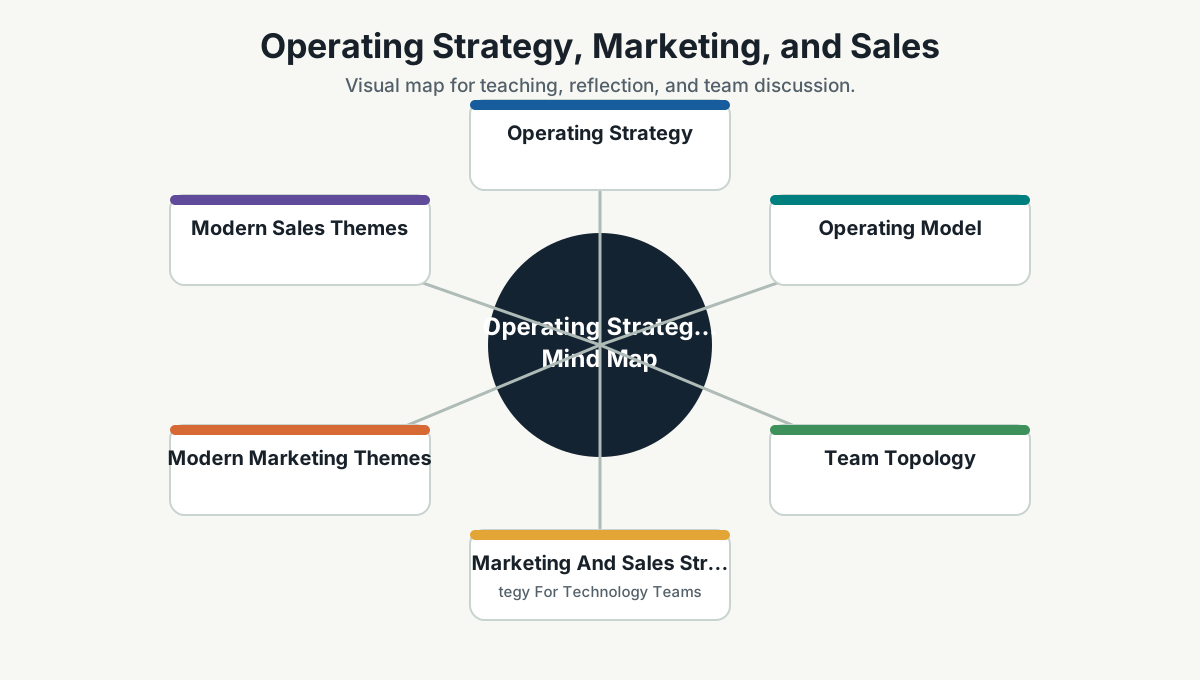
Operating Strategy
Operating strategy converts ambition into repeatable execution.
It answers:
- What markets and customers matter most?
- What capabilities must we build?
- What should we stop doing?
- What constraints shape execution?
- Which metrics show progress?
- Which risks need active management?
Operating Model
Clarify:
- Team topology.
- Ownership boundaries.
- Decision rights.
- Planning cadence.
- Funding model.
- Platform capabilities.
- Governance expectations.
- Communication channels.
Team Topology
Use four practical team patterns:
- Stream-aligned teams: own a customer, product, or business flow.
- Platform teams: provide self-service capabilities to accelerate other teams.
- Enabling teams: temporarily help teams adopt new practices or technologies.
- Complicated subsystem teams: own specialized technical areas that require deep expertise.
Design teams to reduce handoffs and cognitive load.
Marketing And Sales Strategy For Technology Teams
Engineering and product leaders should understand go-to-market because product value is only real when customers discover, adopt, trust, and pay for it.
Core concepts:
- Ideal customer profile.
- Jobs to be done.
- Positioning.
- Differentiation.
- Pricing and packaging.
- Sales motion.
- Product-led growth loops.
- Customer onboarding.
- Retention and expansion.
Modern Marketing Themes
Track:
- AI-assisted content and personalization.
- Community-led growth.
- Founder/expert-led thought leadership.
- Search changes driven by AI answers.
- Product education as marketing.
- Data-driven lifecycle marketing.
- Trust, privacy, and proof over generic claims.
Modern Sales Themes
Track:
- Account research with AI assistance.
- Consultative selling.
- Sales engineering as product feedback.
- CRM quality.
- Buyer committee mapping.
- ROI and business-case selling.
- Fast feedback from lost deals.
- Customer success-led expansion.
Product, Sales, And Engineering Feedback Loop
Minimum loop:
- Sales shares top objections weekly.
- Customer success shares adoption and retention issues.
- Product shares roadmap intent and discovery questions.
- Engineering shares feasibility, reliability, and platform constraints.
- Marketing shares message performance and market signals.
Shared artifacts:
- Win/loss notes.
- Customer pain map.
- Objection library.
- Competitive intelligence.
- Feature adoption dashboards.
- Revenue-impacting technical debt list.
Team Reference Guide
How To Explain This Page
Operating strategy connects the product and engineering engine to the market. Marketing, sales, operations, and customer success are not downstream departments; they are sources of learning.
Sales objections reveal unclear value. Marketing performance reveals message-market fit. Support tickets reveal usability and quality gaps. Operations reveals whether the promise can be delivered repeatedly.
Guidelines For Teams
- Review top sales objections and lost-deal reasons regularly.
- Feed support pain into product and engineering planning.
- Connect roadmap decisions to positioning, onboarding, retention, and expansion.
- Treat operations issues as product signals when they affect customer experience.
- Make revenue-impacting technical debt visible.
- Keep a shared customer pain map across functions.
What Good Looks Like
Product, engineering, sales, marketing, and operations share one story about the customer problem, the value proposition, the adoption barriers, and the reliability of the promise.
Reflection Questions
- What customer objection should influence our roadmap?
- Which operational pain is actually a product problem?
- What technical issue has revenue impact but low visibility?