Operating Principles
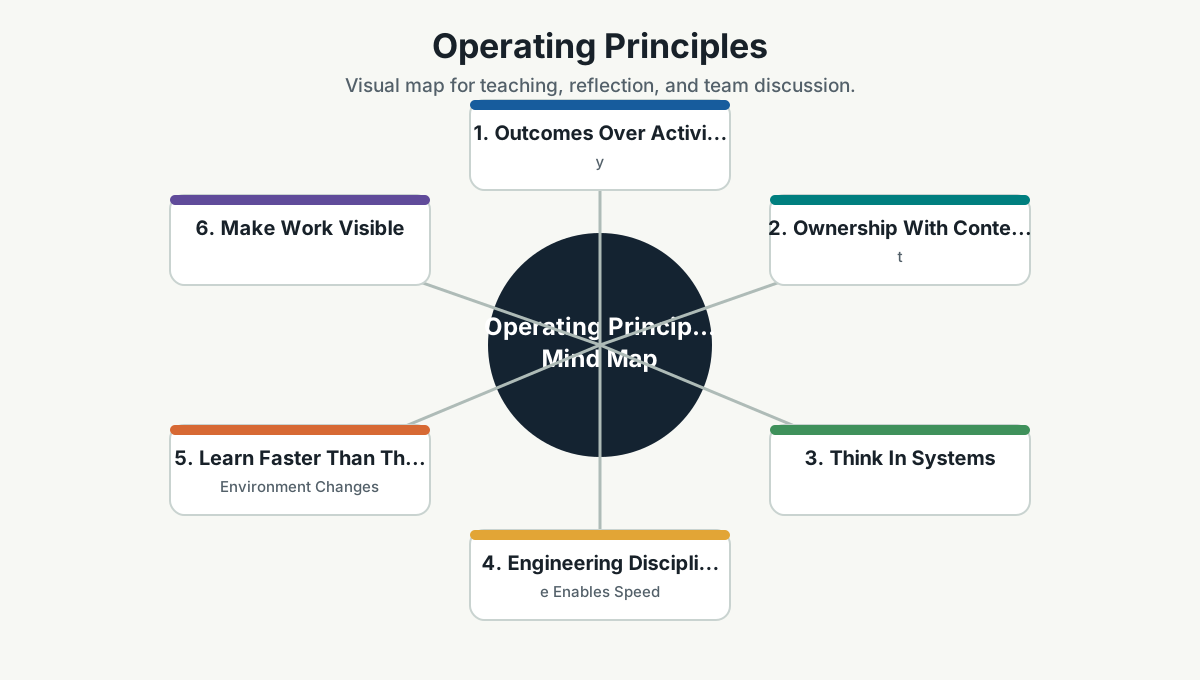
1. Outcomes Over Activity
We do not celebrate busyness. We celebrate shipped value, reduced risk, customer learning, system health, and team capability.
Ask:
- What customer or business outcome changes if this work succeeds?
- How will we know?
- What risk or uncertainty are we reducing?
- What evidence would make us stop, pivot, or double down?
2. Ownership With Context
Ownership means understanding the intent, constraints, users, risks, and expected outcomes. It does not mean blindly completing assigned tasks.
Good owners:
- Clarify ambiguity early.
- Make tradeoffs visible.
- Escalate risks with options, not just problems.
- Keep promises small and reliable.
- Improve the system, not only their ticket.
3. Think In Systems
Most recurring problems are system problems: unclear priorities, weak feedback loops, brittle architecture, missing tests, handoffs, invisible work, overloaded people, or incentives that reward the wrong behavior.
When something fails, ask:
- What made the wrong action easy?
- What made the right action hard?
- What signal was missing?
- What assumption was false?
- What habit, tool, or decision rule should change?
4. Engineering Discipline Enables Speed
Speed without discipline creates drag. Strong fundamentals such as small pull requests, readable code, automated tests, observability, secure defaults, and deployment automation let teams move quickly without accumulating hidden risk.
AI-generated code makes this more important, not less. If code becomes easier to produce, understanding, reviewing, testing, and operating it become the bottlenecks.
5. Learn Faster Than The Environment Changes
Every team should maintain a learning loop:
- What did users do?
- What did the market do?
- What did the system do?
- What did competitors or open source communities do?
- What did our incidents, metrics, and experiments teach us?
- What should we change next?
6. Make Work Visible
Invisible work becomes unmanaged work. Make visible:
- Goals and metrics.
- Decisions and tradeoffs.
- Technical debt.
- Operational risk.
- Customer assumptions.
- Security exceptions.
- Dependencies.
- Learning notes.
7. Psychological Safety Plus High Standards
People should feel safe to speak up, admit uncertainty, disagree, and report mistakes. That safety is paired with high expectations for preparation, accountability, learning, and follow-through.
Blame hides truth. Low standards hide capability gaps. We avoid both.
8. Value Is Cross-Functional
Engineering alone does not create value. Product, design, engineering, operations, security, marketing, sales, customer success, and leadership must share context.
Teams should understand:
- Who the customer is.
- Why the problem matters.
- How the business captures value.
- How the solution is adopted, sold, supported, and measured.
9. Use AI With Judgment
AI should increase the quality and speed of thinking, not replace thinking.
Use AI for:
- Research synthesis.
- Code exploration.
- Test generation.
- Design alternatives.
- Incident summaries.
- Documentation drafts.
- Data analysis.
- Learning support.
Require human accountability for:
- Architecture decisions.
- Security-sensitive changes.
- Customer commitments.
- Production releases.
- Legal, compliance, or privacy impact.
- Business-critical analysis.
10. Improve The Operating System
Every retro, incident review, architecture discussion, and planning cycle should produce at least one improvement to how the team works.
Good teams deliver. Great teams improve their ability to deliver.
Team Reference Guide
How To Explain This Page
Operating principles are the decision rules of the organization. They matter most when the situation is ambiguous, urgent, or politically uncomfortable. A team does not prove its values when everything is calm; it proves them when a deadline is close, a defect is found late, a customer is unhappy, or a stakeholder wants a shortcut.
The principles on this page are connected. Outcomes over activity prevents busy work. Ownership with context prevents blind execution. Systems thinking prevents blame. Engineering discipline prevents fragile speed. Learning prevents stagnation. Visibility prevents unmanaged risk. Psychological safety with high standards prevents fear and complacency. Cross-functional value prevents engineering from becoming isolated. AI with judgment prevents automation without accountability. Improving the operating system ensures every cycle makes the team stronger.
Guidelines For Teams
- Begin every meaningful piece of work with the outcome, user, risk, and success measure.
- Do not accept a task if the intent is unclear. Clarify context before committing.
- Raise risks early with options. A risk without options creates anxiety; a risk with options creates decision-making.
- Treat recurring problems as system signals. Ask what made the problem easy to repeat.
- Make work visible: assumptions, dependencies, quality risks, security exceptions, and technical debt.
- Use AI to accelerate thinking, but keep human accountability for decisions, reviews, and production impact.
- End retrospectives, incidents, and project reviews with at least one operating-system improvement.
What Good Looks Like
A good team member does not only ask, "What should I do?" They ask, "What outcome are we trying to create, what could go wrong, what evidence will tell us we are right, and how can I improve the system while doing the work?"
Reflection Questions
- Where are we currently measuring activity instead of outcomes?
- Which risk do people raise too late?
- Which recurring problem is actually a system design issue?
- What principle do we forget first when deadlines become tight?