Annual Day Interactive Sessions - June 25
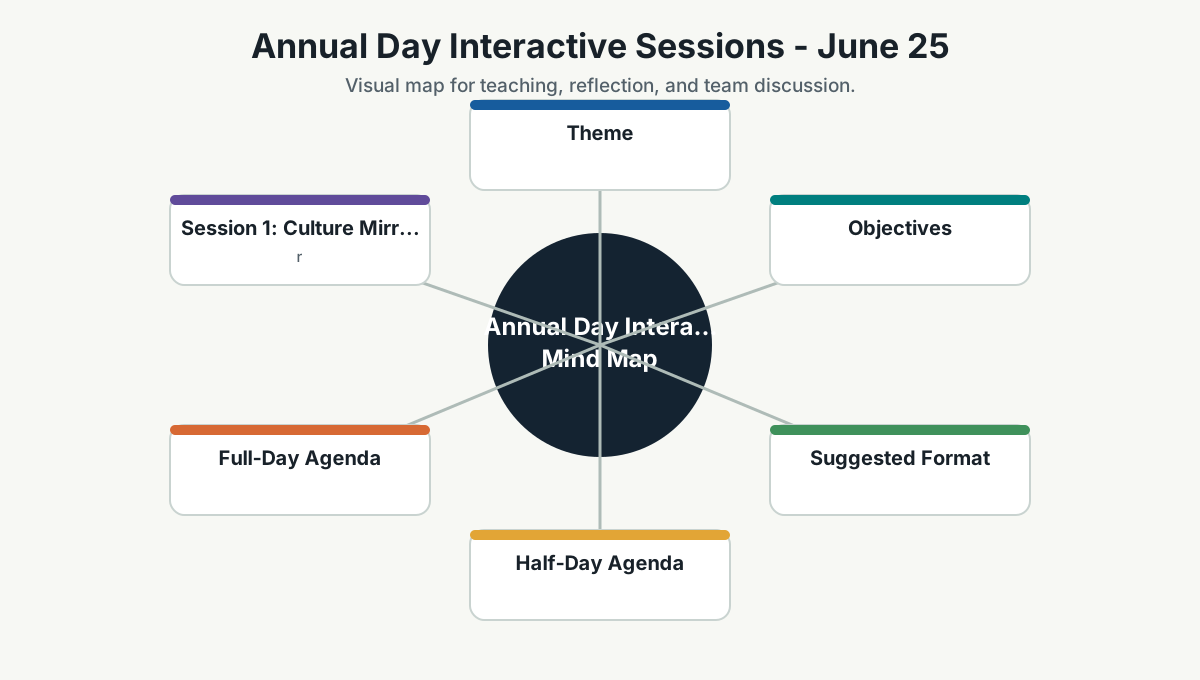
Theme
High-Performance Culture: Ownership, Learning, Innovation, and Value.
Objectives
By the end of the event, participants should:
- Understand why culture is a system of behaviors, not slogans.
- Connect daily work to customer and business outcomes.
- Practice ownership and decision-making.
- Experience product, engineering, security, reliability, AI, and go-to-market tradeoffs.
- Leave with team-level commitments for the next 30 days.
Suggested Format
Audience: engineering, product, design, QA, DevOps, security, operations, marketing, sales, support, and leadership.
Duration options:
- Half day: 4 hours.
- Full day: 6 to 7 hours.
Half-Day Agenda
| Time | Session | Outcome |
|---|---|---|
| 00:00 - 00:15 | Opening: Why High Performance Matters | Shared context |
| 00:15 - 00:45 | Culture Mirror | Current behaviors and blockers |
| 00:45 - 01:30 | Customer Value Challenge | Outcome thinking |
| 01:30 - 01:40 | Break | Reset |
| 01:40 - 02:30 | AI-Augmented Team Simulation | Practical AI use with governance |
| 02:30 - 03:10 | Incident Game Day Lite | Reliability, security, communication |
| 03:10 - 03:45 | Team Commitments | 30-day action plans |
| 03:45 - 04:00 | Closing | Shared commitments |
Full-Day Agenda
| Time | Session | Outcome |
|---|---|---|
| 09:30 - 09:45 | Opening | Shared intent |
| 09:45 - 10:30 | Culture Mirror | Honest diagnosis |
| 10:30 - 11:30 | Product Discovery Lab | Problem framing and customer value |
| 11:30 - 11:45 | Break | Reset |
| 11:45 - 12:45 | Architecture Tradeoff Arena | Decision discipline |
| 12:45 - 13:30 | Lunch | Connection |
| 13:30 - 14:30 | AI-Augmented Team Simulation | AI as amplifier with controls |
| 14:30 - 15:30 | Incident Game Day | SRE, DevSecOps, communication |
| 15:30 - 15:45 | Break | Reset |
| 15:45 - 16:30 | Go-To-Market Relay | Product, sales, marketing alignment |
| 16:30 - 17:15 | Team Commitments | 30-day improvement plan |
| 17:15 - 17:30 | Closing | Recognition and next steps |
Session 1: Culture Mirror
Purpose: Surface current behaviors that help or hurt performance.
Instructions:
- Divide into groups of 5 to 7.
- Give each group four prompts:
- What behavior helps us move fast and learn?
- What behavior slows us down?
- Where do we follow ceremony without value?
- What should leaders do differently?
- Ask groups to cluster themes.
- Vote on the top three system blockers.
Output:
- Top culture strengths.
- Top blockers.
- One immediate improvement per group.
Session 2: Customer Value Challenge
Purpose: Shift from task execution to outcome thinking.
Setup:
- Give each team a fictional or real feature request.
- Example: "Build a dashboard for managers."
Challenge:
Teams must convert the request into:
- User segment.
- Problem statement.
- Business outcome.
- Success metric.
- Key assumptions.
- Smallest experiment.
- Risks.
Scoring:
- Clarity of user problem.
- Evidence orientation.
- Quality of experiment.
- Risk awareness.
- Cross-functional thinking.
Session 3: Architecture Tradeoff Arena
Purpose: Practice decision-making with constraints.
Scenario examples:
- Build vs buy for an AI assistant.
- Monolith modularization vs microservices.
- On-device LLM vs cloud LLM.
- Event-driven architecture vs simpler synchronous API.
- Strong consistency vs speed of delivery.
Each team presents:
- Context.
- Decision.
- Tradeoffs.
- Risks.
- Mitigations.
- What would change the decision later.
Output:
- ADR-style decision note.
Session 4: AI-Augmented Team Simulation
Purpose: Learn how to use AI productively while preserving accountability.
Scenario:
Teams must create a plan for a mobile knowledge-base app with offline daily reading, local search, voice notes, and "ask the wiki" support.
Tasks:
- Define user journey.
- Identify where local AI helps.
- Identify where cloud AI may be needed.
- Define privacy/security controls.
- Define evaluation metrics.
- Draft a release plan.
Rules:
- AI can suggest, summarize, and generate options.
- Humans must justify final decisions.
- Any AI action touching sensitive data needs explicit control.
Output:
- One-page AI product brief.
Session 5: Incident Game Day
Purpose: Practice reliability, security, and communication under pressure.
Scenario:
An AI-powered customer support feature starts giving incorrect account information to some users after a release. At the same time, latency spikes and a sales demo is scheduled in two hours.
Roles:
- Incident commander.
- Engineering lead.
- SRE/DevOps lead.
- Security lead.
- Product lead.
- Customer support lead.
- Executive communicator.
Injects:
- Customer complaint arrives.
- Logs show unusual prompt patterns.
- Rollback may break a dependent feature.
- Sales asks whether demo should proceed.
- Social media post appears.
Teams must decide:
- Severity.
- Mitigation.
- Communication.
- Data/privacy assessment.
- Rollback or feature flag.
- Follow-up actions.
Output:
- Incident timeline.
- Customer update.
- Postmortem action items.
Session 6: Go-To-Market Relay
Purpose: Connect engineering work to adoption and revenue.
Flow:
- Product defines value proposition.
- Engineering explains technical differentiator and constraints.
- Marketing crafts positioning.
- Sales handles objections.
- Customer success defines onboarding and retention risks.
Output:
- One aligned story for the customer.
- Top three objections.
- Product/engineering feedback items.
Final Commitment Exercise
Each team writes:
- One behavior to start.
- One behavior to stop.
- One metric to watch.
- One learning ritual to adopt.
- One owner.
- Review date after 30 days.
Suggested review date: July 25.
Materials Needed
- Printed scenario cards.
- Sticky notes or digital whiteboard.
- Timer.
- Score sheets.
- Projector.
- Incident timeline template.
- ADR template.
- Product brief template.
Facilitator Notes
- Keep energy high but grounded.
- Reward clarity, evidence, tradeoff thinking, and teamwork.
- Do not let the event become a lecture.
- Capture outputs in this repo after the event.
- Turn winning exercises into real team practices.
Team Reference Guide
How To Explain This Page
Use this page as a reference conversation, not as a checklist to read aloud. Start by explaining why the topic matters, then connect it to current team work, and finally ask what behavior should change.
The most useful way to teach this material is to move from concept to example. Explain the principle, show how it appears in daily work, ask the team where it is currently strong or weak, and finish with one small action.
Guidelines For Teams
- Connect the topic to a current project, customer problem, incident, or decision.
- Translate concepts into visible behaviors.
- Keep the guidance lightweight enough to use weekly.
- Capture decisions, examples, and improvements back into the wiki.
- Review the page again after a project, incident, or retrospective to update what the team has learned.
Reflection Questions
- What part of this topic is already working well for us?
- What part is still mostly theory?
- What is one behavior we can change in the next 30 days?