Adoption Plan For Simpro
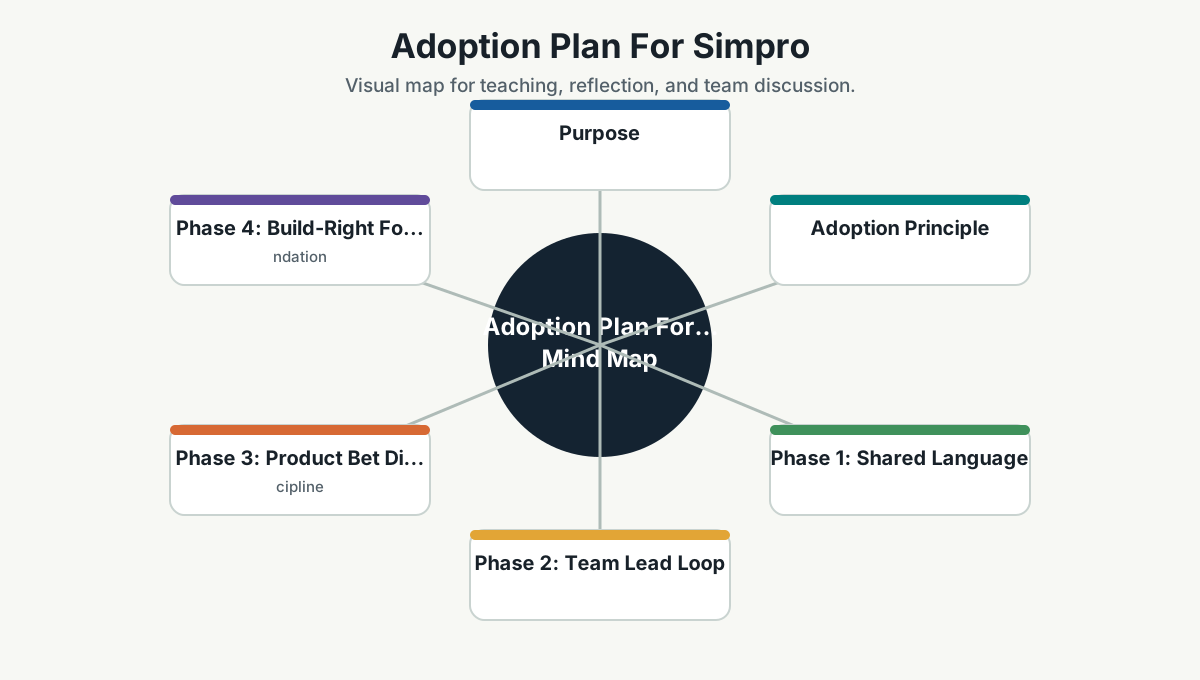
Purpose
This page turns the field guide into adoption steps. The goal is not to publish a beautiful wiki and hope people change. The goal is to make the concepts part of how teams plan, build, review, and improve work.
Adoption Principle
Do not roll out everything at once.
Pick a small number of behaviors, practice them in real work, measure whether they help, then expand.
Phase 1: Shared Language
Duration: 2 weeks.
Goal:
Create common language around:
- Signal.
- Problem.
- Product bet.
- Growth experiment.
- Build it right.
- Trust.
- Evidence.
- Refinement.
Actions:
- Run annual day session.
- Share field guide home.
- Introduce the operating loop.
- Ask teams to pick one quest.
Evidence:
- Teams can explain the loop.
- Teams choose one 30-day experiment.
Phase 2: Team Lead Loop
Duration: 4 weeks.
Goal:
Team leads move from status updates to learning updates.
Actions:
- Use weekly team lead update format.
- Review context, commitment, action, evidence, refinement.
- Ask what changed, not only what was done.
Evidence:
- Weekly updates include evidence.
- Repeated blockers become improvement actions.
Phase 3: Product Bet Discipline
Duration: 4 weeks.
Goal:
Customer-facing work begins with problem, outcome, hypothesis, and metric.
Actions:
- Use product bet template.
- Run Feature Request Translator quest.
- Include engineers and QA earlier.
Evidence:
- At least three initiatives have product bet statements.
- At least one initiative is stopped or refined based on evidence.
Phase 4: Build-Right Foundation
Duration: 6 weeks.
Goal:
Quality, security, performance, and observability become part of normal delivery.
Actions:
- Upgrade Definition of Done.
- Run Trust Engineer quest.
- Define basic security and observability expectations.
- Track escaped defects and recovery time.
Evidence:
- One late quality risk shifted earlier.
- One critical workflow gets better observability.
Phase 5: Platform Foundation
Duration: 8 to 12 weeks.
Goal:
Reduce repeated friction through reusable platform capabilities.
Actions:
- Identify top repeated team frictions.
- Choose one golden path.
- Build lightweight template or automation.
- Measure adoption and time saved.
Evidence:
- Setup, deployment, or observability becomes easier for at least one team.
- Repeated support questions reduce.
Phase 6: Growth Engineering Rhythm
Duration: ongoing.
Goal:
Teams run measured experiments and make product decisions from evidence.
Actions:
- Define product and engineering metrics for key initiatives.
- Instrument experiments.
- Review scale/refine/stop decisions weekly or fortnightly.
Evidence:
- Experiments produce decisions.
- Adoption or activation improves.
- Weak ideas are stopped earlier.
30-Day Adoption Starter
For the first 30 days after annual day:
Week 1:
- Introduce operating loop.
- Each team chooses one signal.
Week 2:
- Convert signal into problem and product bet.
Week 3:
- Run or design one experiment.
Week 4:
- Review evidence and choose one system improvement.
What Leaders Must Do
Leaders must model the system.
They should:
- Ask for outcomes, not only status.
- Reward truth surfaced early.
- Protect time for foundations.
- Avoid changing priorities without context.
- Use the same language repeatedly.
- Recognize teams that improve the system.
What Teams Must Do
Teams should:
- Use the loop on real work.
- Keep the process lightweight.
- Bring evidence.
- Raise risk early.
- Choose one improvement at a time.
- Update the wiki with learning.
What To Avoid
Avoid:
- Turning the field guide into mandatory reading with no practice.
- Running too many quests at once.
- Treating badges like school marks.
- Using metrics to blame.
- Copying big-company practices without adapting them.
- Adding process without removing friction.
Success Criteria
After 90 days, we should see:
- Better problem framing.
- More visible product bets.
- Smaller experiments.
- Earlier quality/security/reliability conversations.
- Improved team lead updates.
- At least one reusable platform capability.
- Better measurement of product value and engineering health.
- Teams using the language without needing a slide.
Team Reference Guide
How To Explain This Page
Use this page as a reference conversation, not as a checklist to read aloud. Start by explaining why the topic matters, then connect it to current team work, and finally ask what behavior should change.
The most useful way to teach this material is to move from concept to example. Explain the principle, show how it appears in daily work, ask the team where it is currently strong or weak, and finish with one small action.
Guidelines For Teams
- Connect the topic to a current project, customer problem, incident, or decision.
- Translate concepts into visible behaviors.
- Keep the guidance lightweight enough to use weekly.
- Capture decisions, examples, and improvements back into the wiki.
- Review the page again after a project, incident, or retrospective to update what the team has learned.
Reflection Questions
- What part of this topic is already working well for us?
- What part is still mostly theory?
- What is one behavior we can change in the next 30 days?