AI, Local LLMs, and Edge Intelligence
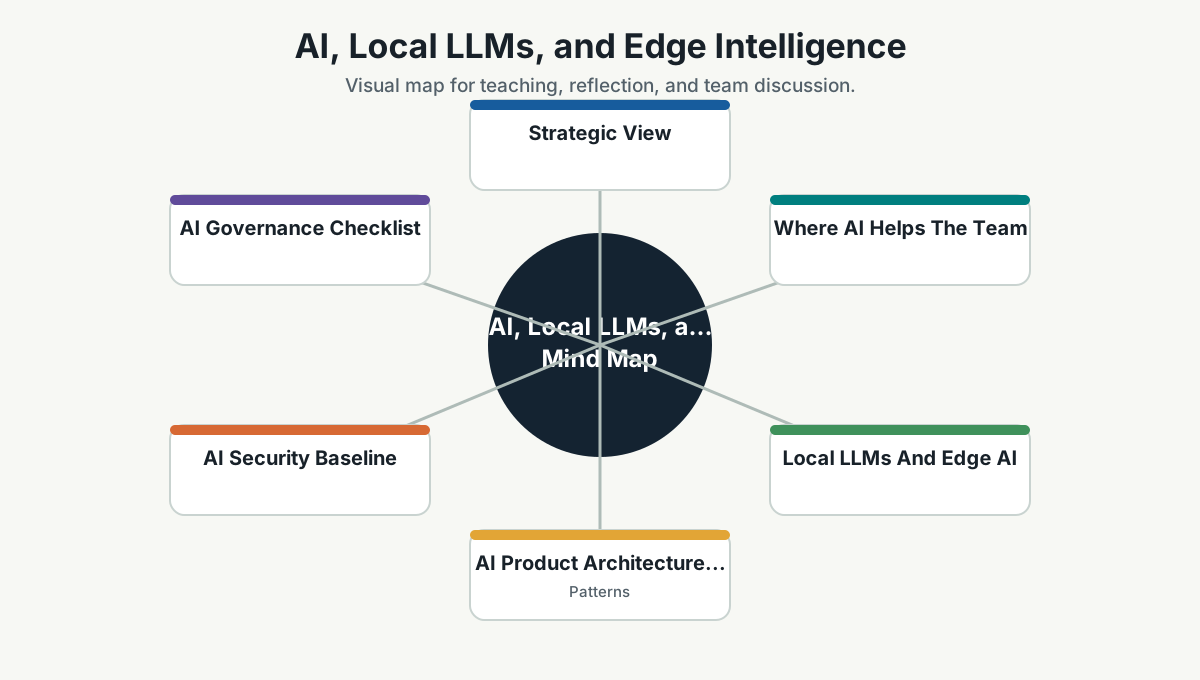
Strategic View
AI is now part of the software delivery system, the product experience, and the operating model of the company.
The winning pattern is not "add a chatbot everywhere." It is to redesign workflows around better cognition, automation, personalization, and decision support while preserving trust, safety, privacy, and accountability.
Where AI Helps The Team
Engineering
- Code search and explanation.
- Test generation.
- Refactoring assistance.
- Migration planning.
- Pull request summaries.
- Static analysis explanation.
- Incident log summarization.
- Internal developer support.
Product And Design
- Research synthesis.
- Interview preparation.
- Persona and journey drafts.
- Prototype copy.
- Opportunity mapping.
- Competitive analysis.
- Accessibility review prompts.
Operations
- SOP and runbook assistants.
- Ticket triage.
- Knowledge-base retrieval.
- Incident timeline creation.
- Anomaly explanation.
- Compliance evidence collection.
Marketing And Sales
- Account research.
- Messaging variants.
- Proposal drafts.
- Objection handling.
- CRM hygiene.
- Customer call summaries.
Local LLMs And Edge AI
Local and edge AI are relevant when:
- Data privacy matters.
- Latency must be low.
- Connectivity is unreliable.
- Costs need control at scale.
- The user experience benefits from on-device personalization.
- Multimodal input from camera, audio, screen, sensors, or documents is central.
Potential mobile app capabilities for this knowledge base:
- Daily CTO reading feed.
- Offline summaries of selected wiki pages.
- Local semantic search over downloaded notes.
- Voice-to-note capture after meetings.
- Camera/document summarization for whiteboards and slides.
- Team quiz and reflection prompts.
- Personalized learning path by role.
- "Ask the wiki" RAG assistant with source citations.
- Spaced repetition cards for principles, checklists, and playbooks.
AI Product Architecture Patterns
Retrieval-Augmented Generation
Use RAG when answers must be grounded in internal docs, policies, code, tickets, or customer records.
Good RAG requires:
- Source quality.
- Chunking strategy.
- Metadata and access control.
- Fresh indexing.
- Citation display.
- Evaluation questions.
- Hallucination tests.
Agents
Use agents when work requires multi-step planning, tool use, and stateful workflow execution.
Agent guardrails:
- Clear task boundary.
- Least-privilege tool access.
- Human approval for high-impact actions.
- Audit logs.
- Cost and rate limits.
- Test cases for failure modes.
- Prompt injection defenses.
- Kill switch.
Small Specialist Models
Use smaller models when:
- The task is narrow.
- Latency or cost matters.
- Data can be domain-specific.
- The model can be evaluated objectively.
Examples:
- Classification.
- Extraction.
- Routing.
- Embeddings.
- On-device summarization.
- Voice command parsing.
AI Security Baseline
Every AI application should consider:
- Prompt injection.
- Sensitive information disclosure.
- Supply-chain risk.
- Insecure plugin or tool design.
- Excessive agency.
- Model denial of service.
- Insecure output handling.
- Data and model poisoning.
- Hallucination and misinformation.
- Unbounded cost.
Use OWASP LLM guidance for LLM apps and OWASP agentic guidance for agent workflows.
AI Governance Checklist
Before production:
- What business outcome is expected?
- What data does the model see?
- What can the model do?
- What must a human approve?
- What logs are kept?
- What evaluation set proves quality?
- What failure modes have been tested?
- What privacy and security controls are in place?
- What is the rollback plan?
- What is the cost ceiling?
Team Practice
Every team should maintain an AI usage note:
- Tools used.
- Accepted use cases.
- Prohibited use cases.
- Security restrictions.
- Review expectations.
- Productivity observations.
- Quality risks found.
- Training needs.
Team Reference Guide
How To Explain This Page
AI is becoming part of the product, the engineering workflow, and the operating model. The important question is not "Where can we add a chatbot?" The better question is "Where can AI improve cognition, reduce toil, personalize experience, or speed learning while preserving trust?"
Local LLMs and edge AI matter because not every intelligent experience should depend on cloud calls. Privacy, latency, offline usage, cost, and device context can make local intelligence valuable. But local AI also brings constraints: model size, battery, memory, evaluation, update strategy, and device compatibility.
Guidelines For Teams
- Start every AI use case with the workflow and outcome, not the model.
- Decide what data the model can see and what actions it can take.
- Prefer RAG when answers must be grounded in internal knowledge.
- Use local or edge AI when privacy, latency, offline use, or cost makes it valuable.
- Define human approval boundaries for agents and high-impact actions.
- Evaluate AI features with test questions, failure cases, and source checks.
- Log enough to debug and audit without exposing sensitive data.
- Treat prompt injection and excessive agency as real security risks.
What Good Looks Like
A good AI feature is useful, measured, secure, explainable enough for its risk level, and designed so a human remains accountable for important outcomes.
Reflection Questions
- Which workflow has the most repetitive cognitive toil?
- Which AI use case could create trust risk if it fails?
- Where would local AI be better than cloud AI?