Expanded Concepts Through Story Cards
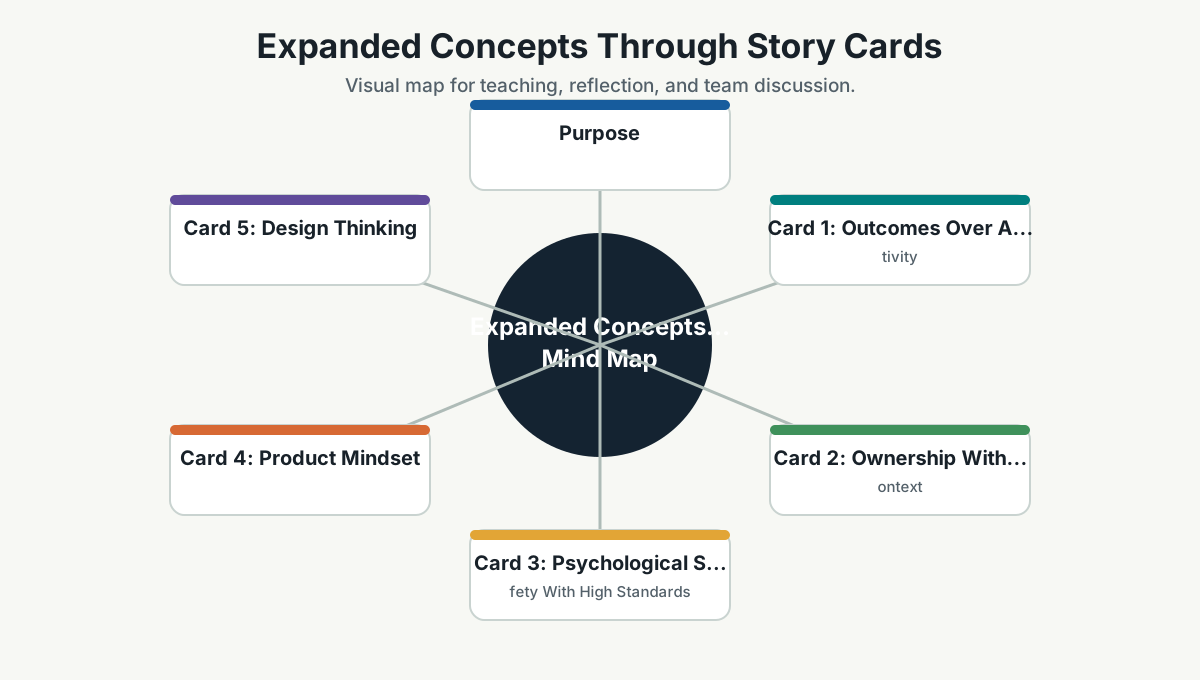
Purpose
This page expands core concepts into story cards that can be used in team sessions, onboarding, leadership coaching, or self-study. Each card gives a narrative explanation, a practical example, a team guideline, and a short exercise.
Card 1: Outcomes Over Activity
Story
A team works hard for two weeks and closes many tickets. At the demo, the stakeholder is pleased that the requested screens exist. But a month later, users are still using spreadsheets. The team delivered output, but the outcome did not change.
Outcomes over activity means we judge work by the change it creates. Did customer behavior improve? Did risk reduce? Did time reduce? Did trust improve? Did revenue, retention, quality, or operational flow improve?
Guideline
Every initiative should answer:
- What outcome should change?
- Who benefits?
- How will we know?
- What evidence would make us stop or adjust?
Exercise
Take one current task and rewrite it as an outcome.
Weak:
Build export button.
Better:
Reduce finance reconciliation time by enabling admins to export the exact monthly data format they need.
Card 2: Ownership With Context
Story
A developer completes a ticket exactly as written. Later, the feature fails because the requirement missed an edge case. The developer says, "I built what was asked." That may be true, but it is not enough for high performance.
Ownership with context means understanding the intent behind the task. The owner asks why, who, what risk, what tradeoff, and what success looks like.
Guideline
Before starting meaningful work, clarify:
- Intent.
- User.
- Constraints.
- Risk.
- Success measure.
- Decision owner.
Exercise
For one ticket, add a "context note" before implementation.
Card 3: Psychological Safety With High Standards
Story
In one team, people are afraid to raise risk. Problems appear late. In another team, everyone is kind, but commitments are vague. Both teams struggle.
The best team has both safety and standards. People can speak honestly, and the team still expects preparation, ownership, quality, and follow-through.
Guideline
Create space for truth, then turn truth into action.
Exercise
Ask in retro:
What risk did we notice earlier but discuss too late?
Then choose one action that makes that risk easier to raise next time.
Card 4: Product Mindset
Story
A customer asks for a report. The team builds the report. Later, the customer still complains. Why? The real problem was not lack of report; it was lack of confidence before making a staffing decision.
Product mindset means understanding the decision, workflow, pain, and desired outcome behind the request.
Guideline
Do not start with "what screen do we build?" Start with "what decision or behavior should improve?"
Exercise
Interview a stakeholder about one request using only why, who, what pain, and what outcome questions.
Card 5: Design Thinking
Story
The team designs a workflow in a meeting room. It makes sense to everyone in the room. Then a real user tries it and gets stuck on step two.
Design thinking reminds us that users do not live inside our assumptions. We need empathy, prototypes, observation, and iteration.
Guideline
Prototype risky workflows before building them fully.
Exercise
Draw a workflow on paper and ask a user or internal proxy to complete a task with it.
Card 6: Growth Engineering
Story
The team launches a feature and waits to see if people like it. Nobody knows what to measure. After a month, opinions replace evidence.
Growth engineering says every product bet should have a hypothesis, instrumentation, and decision rule.
Guideline
Use:
We believe X will improve Y for Z because of evidence E.
Exercise
Write one hypothesis for a feature in progress. Define one product metric and one engineering health metric.
Card 7: Engineering Excellence
Story
The team moves fast by skipping tests and review. For a few weeks, it feels productive. Then every change becomes risky. New people struggle. Bugs return. Releases become tense.
Engineering excellence is not perfectionism. It is protecting future speed.
Guideline
Make code easy to understand, change, test, secure, operate, and retire.
Exercise
Pick one painful module and identify one improvement that reduces cognitive load.
Card 8: DevSecOps
Story
Security review happens at the end. A release is delayed because secrets, access, dependency, or data concerns appear late.
DevSecOps moves trust into the workflow. Security becomes part of design, code, build, test, release, and operate.
Guideline
For sensitive work, ask early:
- What are we protecting?
- Who can misuse it?
- How would we detect misuse?
- How would we recover?
Exercise
Run a 15-minute threat-model discussion for one upcoming change.
Card 9: SRE And Reliability
Story
Product wants speed. Operations wants stability. Engineering is stuck between them.
SRE gives the team a shared language: what reliability promise matters to users, how do we measure it, and when should we slow down to protect trust?
Guideline
Define SLOs for critical user journeys, not every internal metric.
Exercise
Pick one user journey and define one SLI, one SLO, and one alert that matters.
Card 10: DORA Metrics
Story
A leader asks why delivery is slow. People give opinions. Some blame requirements. Some blame testing. Some blame deployment. Nobody has a shared picture.
DORA metrics create a conversation about flow and stability: lead time, deployment frequency, change failure, and recovery time.
Guideline
Use metrics to improve the system, not to punish people.
Exercise
Choose one flow metric and one stability metric for the next 30 days.
Card 11: AI With Judgment
Story
AI helps a developer generate code quickly. The code works in the happy path but has security, edge-case, or maintainability issues. The team saved typing time but created review debt.
AI with judgment means using AI as an assistant while keeping human accountability.
Guideline
Do not submit AI-generated work you cannot explain.
Exercise
Use AI to generate test cases for one feature, then have the team review which tests are useful, missing, or risky.
Card 12: Leadership Loop
Story
A team lead runs status meetings every day. Everyone reports progress, but the same blockers repeat. The lead is tracking activity, not improving the system.
The leadership loop is context, commitment, action, evidence, refinement.
Guideline
Every week, ask:
What evidence proves this week mattered?
Exercise
Rewrite one status update in the loop format.
Card 13: Platform Engineering
Story
Every team solves environments, deployment, logging, security, and setup differently. Delivery slows because teams carry too much cognitive load.
Platform engineering creates paved paths: reusable, self-service capabilities that make good practices easier.
Guideline
Build platforms as products for internal teams.
Exercise
Identify one repeated engineering task that should become self-service.
Card 14: Learning System
Story
The team learns only when something breaks or someone attends training. Meanwhile, tools, competitors, customer expectations, and AI capabilities keep moving.
A learning system makes curiosity operational. It turns reading, incidents, experiments, and customer feedback into decisions.
Guideline
Every week, convert one learning into one action, radar update, experiment, or wiki improvement.
Exercise
Run a 15-minute learning scan and choose one insight to discuss in planning.
Card 15: Minimum Process, Maximum Value
Story
Some teams respond to chaos by adding more process. Soon people are attending meetings about meetings, but customer value is not improving.
Minimum process, maximum value means keeping only the rituals that improve clarity, flow, quality, trust, or learning.
Guideline
Every recurring meeting should produce at least one of:
- Decision.
- Learning.
- Alignment.
- Risk reduction.
- Flow improvement.
Exercise
Review one recurring meeting and decide whether to keep, change, shorten, or stop it.
How To Use These Cards
For a 15-minute team discussion:
- Pick one card.
- Read the story.
- Ask the reflection question.
- Choose one small behavior change.
For onboarding:
- Assign three cards per week.
- Ask the person to connect each card to a real example.
- Discuss in a mentor session.
For team leads:
- Pick one card each week.
- Use it in a team meeting.
- Track one behavior change for 30 days.
Team Reference Guide
How To Explain This Page
Use this page as a reference conversation, not as a checklist to read aloud. Start by explaining why the topic matters, then connect it to current team work, and finally ask what behavior should change.
The most useful way to teach this material is to move from concept to example. Explain the principle, show how it appears in daily work, ask the team where it is currently strong or weak, and finish with one small action.
Guidelines For Teams
- Connect the topic to a current project, customer problem, incident, or decision.
- Translate concepts into visible behaviors.
- Keep the guidance lightweight enough to use weekly.
- Capture decisions, examples, and improvements back into the wiki.
- Review the page again after a project, incident, or retrospective to update what the team has learned.
Reflection Questions
- What part of this topic is already working well for us?
- What part is still mostly theory?
- What is one behavior we can change in the next 30 days?