Integrated Simpro Operating System
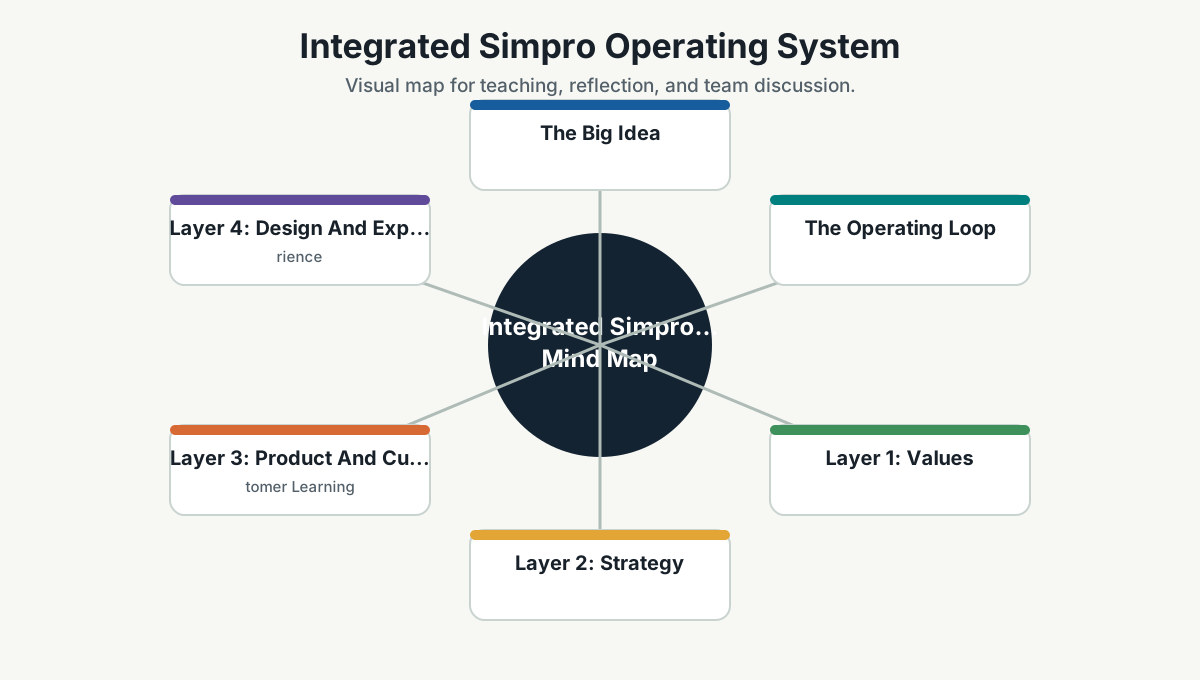
The Big Idea
A high-performance technology organization is not a set of departments. It is a learning system that converts customer problems into reliable, secure, valuable software while continuously improving the people, architecture, and operating model.
The system must connect:
- Strategy.
- Culture.
- Product discovery.
- Design.
- Engineering.
- Architecture.
- Security.
- Reliability.
- Operations.
- Marketing and sales.
- Learning.
- AI-assisted work.
If these are disconnected, teams become busy but not effective. If they are connected, every practice reinforces the others.
The Operating Loop
flowchart LR
    A[Strategy and Values] --> B[Customer and Market Learning]
    B --> C[Product Discovery]
    C --> D[Architecture and Technical Discovery]
    D --> E[Delivery]
    E --> F[Release and Operate]
    F --> G[Observe Reliability Security Usage Revenue]
    G --> H[Learning and Improvement]
    H --> A
This loop is the song. Each discipline is an instrument. The CTO's job is not to make every instrument louder. It is to make them play in rhythm.
Layer 1: Values
Values define how decisions are made when nobody is watching.
Core values for this wiki:
- Customer value before internal convenience.
- Ownership before instruction-following.
- Learning before ego.
- Quality before hidden speed.
- Security and reliability before avoidable trust loss.
- Evidence before opinion.
- Simplicity before cleverness.
- Respect for people with high standards.
- Long-term thinking with short feedback loops.
- AI as amplifier, not autopilot.
Layer 2: Strategy
Strategy answers:
- Where will we play?
- How will we win?
- What capabilities must we build?
- What will we not do?
- What risks must we manage?
Without strategy, product teams chase requests, engineers chase tools, and leaders chase activity.
Layer 3: Product And Customer Learning
Product discovery connects strategy to customer reality.
Good product work produces:
- Clear problem statements.
- Evidence from users, buyers, support, sales, analytics, and operations.
- Prioritized opportunities.
- Experiments that reduce uncertainty.
- Outcome metrics.
Engineering must be present here. If engineers join only after requirements are finalized, the organization loses technical creativity and discovers feasibility risk too late.
Layer 4: Design And Experience
Design turns empathy into usable systems.
Design is not decoration. It is the discipline of understanding human goals, workflows, constraints, emotions, and decisions.
Good design protects:
- Usability.
- Accessibility.
- Clarity.
- Trust.
- Adoption.
- Reduced support load.
- Better customer learning.
Layer 5: Engineering Execution
Engineering converts decisions into working systems.
Strong engineering execution requires:
- Small changes.
- Code review.
- Automated tests.
- Continuous integration.
- Clear ownership.
- Trunk-based or low-friction branching.
- Observability.
- Deployment automation.
- Technical debt visibility.
This is where culture becomes concrete. A team that claims ownership but ships unreviewed, unobservable, fragile code does not yet have an ownership culture.
Layer 6: Architecture
Architecture controls the future cost of change.
Good architecture:
- Makes boundaries clear.
- Reduces cognitive load.
- Supports team ownership.
- Makes failure modes visible.
- Allows small, reversible changes.
- Separates stable domain concepts from volatile implementation details.
- Records important decisions.
Architecture is not a one-time design. It is continuous steering.
Layer 7: DevSecOps
Security becomes effective when it is part of the delivery system:
- Secure defaults.
- Threat modeling.
- Secrets management.
- Dependency scanning.
- CI/CD checks.
- Software bill of materials for critical systems.
- Least privilege.
- Incident response.
- Security champions.
Security should help teams move safely, not surprise them at the end.
Layer 8: SRE And Operations
Operations makes the promise real.
SRE connects user expectations with engineering reality through:
- SLOs.
- Error budgets.
- Observability.
- Incident command.
- Postmortems.
- Toil reduction.
- Production readiness.
Reliability should shape product planning. If a system is burning its error budget, new feature work may need to pause. That is not bureaucracy; it is honoring the customer promise.
Layer 9: Platform Engineering
Platform engineering reduces repeated friction:
- New service creation.
- Build pipelines.
- Deployment paths.
- Observability.
- Security controls.
- Environment provisioning.
- Documentation.
- API standards.
The platform is a product. Developers are customers. Adoption is earned by usefulness, not mandated by org chart.
Layer 10: AI-Assisted Operating Model
AI should be embedded into the operating system:
- Research assistant for daily learning.
- Code assistant for exploration and tests.
- Architecture assistant for alternatives.
- Security assistant for threat prompts.
- SRE assistant for incident summaries.
- Product assistant for synthesis.
- Sales and marketing assistant for customer/account research.
But each AI-assisted workflow needs:
- Human owner.
- Clear data policy.
- Evaluation criteria.
- Review process.
- Audit trail where needed.
- Cost control.
Layer 11: Go-To-Market Feedback
Technology teams need market awareness.
Sales, marketing, support, and customer success reveal:
- What buyers value.
- What customers do not understand.
- What competitors claim.
- Why deals are lost.
- Where onboarding fails.
- Which technical issues affect revenue.
This feedback should influence product priorities, architecture investment, reliability work, and documentation.
Layer 12: Learning System
Learning ties the loop together.
Every week, the organization should learn from:
- Customers.
- Production.
- Delivery metrics.
- Incidents.
- Security signals.
- Sales calls.
- Competitor movement.
- Open source.
- Research papers.
- Vendor releases.
- Internal experiments.
Learning should become visible through notes, demos, wiki updates, tech radar changes, and decisions.
How The Pieces Relate
| Practice | Feeds | Depends On |
|---|---|---|
| Daily research | Tech radar, product ideas, risk awareness | Curiosity and sharing |
| Product discovery | Roadmap and experiments | Customer access and evidence |
| Design thinking | Adoption and usability | Empathy and prototype loops |
| Engineering practices | Delivery speed and quality | Craft, review, automation |
| Architecture | Future change speed | Strategic clarity and technical judgment |
| DevSecOps | Trust and compliance | Secure pipelines and team ownership |
| SRE | Reliability and customer trust | Observability and product tradeoffs |
| Platform engineering | Developer productivity | Product mindset toward internal users |
| AI adoption | Cognitive leverage | Governance and evaluation |
| Leadership | Culture and decision quality | Context, coaching, accountability |
Operating Cadence
flowchart TB
    D[Daily: research, standup, flow health] --> W[Weekly: discovery, reliability, learning review]
    W --> F[Fortnightly: demos, retros, tech radar]
    F --> M[Monthly: architecture council, capability review]
    M --> Q[Quarterly: strategy, OKRs, team topology]
    Q --> D
Simpro Leadership Questions
Ask these regularly:
- Are teams clear on outcomes or only tasks?
- Can engineers explain customer value?
- Can product explain technical constraints?
- Can sales explain product limits honestly?
- Are reliability and security visible in planning?
- Are incidents changing the system?
- Are architecture decisions recorded and revisited?
- Are platforms reducing cognitive load?
- Is AI improving judgment or creating hidden risk?
- Is learning turning into action?
Maturity Model
| Level | Description | Signal |
|---|---|---|
| 1. Reactive | Teams respond to urgent work and incidents | Work is mostly unplanned |
| 2. Managed | Basic planning, delivery, and ownership exist | Teams can predict near-term delivery |
| 3. Measured | Outcomes, quality, reliability, and flow are visible | Decisions use data |
| 4. Learning | Feedback loops continuously improve product and engineering | Experiments and postmortems change behavior |
| 5. Adaptive | Organization senses change early and reallocates quickly | Strategy, architecture, and teams evolve deliberately |
Team Reference Guide
How To Explain This Page
Use this page as a reference conversation, not as a checklist to read aloud. Start by explaining why the topic matters, then connect it to current team work, and finally ask what behavior should change.
The most useful way to teach this material is to move from concept to example. Explain the principle, show how it appears in daily work, ask the team where it is currently strong or weak, and finish with one small action.
Guidelines For Teams
- Connect the topic to a current project, customer problem, incident, or decision.
- Translate concepts into visible behaviors.
- Keep the guidance lightweight enough to use weekly.
- Capture decisions, examples, and improvements back into the wiki.
- Review the page again after a project, incident, or retrospective to update what the team has learned.
Reflection Questions
- What part of this topic is already working well for us?
- What part is still mostly theory?
- What is one behavior we can change in the next 30 days?