Simpro Knowledge Base Home
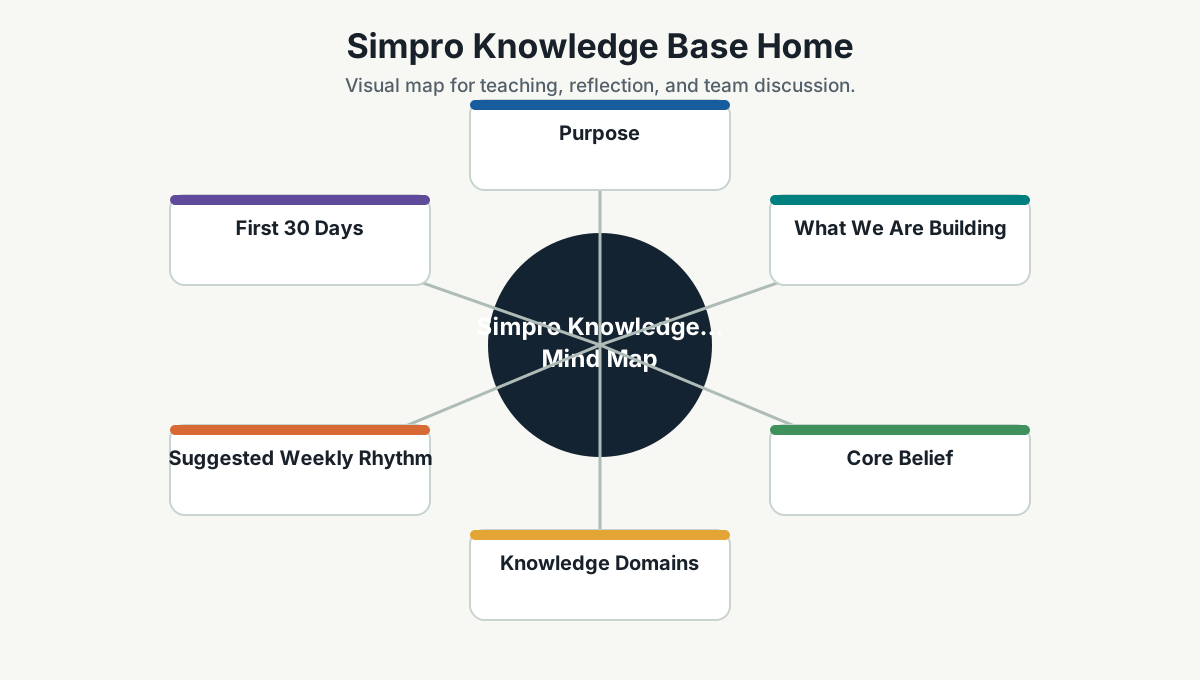
Purpose
This wiki exists to tune the team toward a culture that is high-performing, curious, resilient, secure, product-minded, and accountable.
The goal is not to make people follow more ceremonies. The goal is to help teams understand value, make better decisions, learn faster, and own outcomes.
What We Are Building
We want teams that:
- Understand the business and customer value behind the work.
- Take ownership instead of waiting for instructions.
- Use engineering discipline as a speed multiplier.
- Learn continuously from users, incidents, metrics, research, competitors, open source, and experiments.
- Use AI as an amplifier while protecting quality, security, and human understanding.
- Balance innovation with reliability, privacy, safety, and cost.
- Communicate clearly across engineering, product, design, operations, marketing, and sales.
- Measure progress by outcomes, not activity.
Core Belief
High performance is a system. It is not a motivational speech, a tool purchase, or a process framework.
It emerges from:
- Clear strategy and context.
- Small empowered teams.
- Strong engineering fundamentals.
- Fast feedback loops.
- Psychological safety with high accountability.
- Reliable operations.
- Customer discovery.
- Visible metrics.
- Learning rituals.
- Leaders who model the behavior they expect.
Knowledge Domains
| Domain | What Good Looks Like |
|---|---|
| Engineering | Small changes, clean architecture, test automation, code review, continuous delivery, measurable quality |
| Product | Clear outcomes, customer discovery, problem framing, prioritization by value and risk |
| Design | Human-centered research, prototype-first thinking, usability, accessibility, coherent experiences |
| AI | Practical copilots, local and edge inference where useful, governed AI agents, secure RAG, measurable productivity |
| DevSecOps | Security integrated into delivery, supply-chain visibility, automated checks, threat modeling, zero trust habits |
| SRE | SLOs, error budgets, observability, incident response, blameless postmortems, reliability ownership |
| Platform Engineering | Golden paths, self-service delivery, service ownership, secure defaults, reusable environments |
| Growth Engineering | Product instrumentation, activation metrics, experiments, adoption loops, responsible growth |
| Leadership | Context over control, coaching, clarity, decision discipline, change adoption |
| Go-to-market | Customer insight, positioning, revenue learning, product-led and sales-led coordination |
| Learning | Daily reading, demos, research notes, GitHub scanning, design/architecture trend reviews |
Suggested Weekly Rhythm
| Cadence | Ritual | Output |
|---|---|---|
| Daily | 15-minute learning scan | One useful link, experiment, or insight per person or team |
| Twice weekly | Product/engineering sync | Decisions, risks, blockers, customer insight |
| Weekly | Tech radar review | Adopt, trial, assess, hold decisions |
| Weekly | Customer/discovery review | Opportunity tree, customer quotes, assumptions |
| Weekly | Reliability/security review | Incidents, SLOs, vulnerabilities, risky changes |
| Fortnightly | Demo day | Working software, learnings, data, tradeoffs |
| Monthly | Architecture council | Decisions, standards, platform debt, emerging trends |
| Quarterly | Strategy and operating review | Outcomes, bets, team topology, capability gaps |
First 30 Days
- Ask each team to read Operating Principles and Team Culture Playbook.
- Identify each team's top three customer/business outcomes.
- Define or refresh each team's service ownership map.
- Pick one engineering baseline to improve: CI, test reliability, deployment frequency, incident response, observability, or code review quality.
- Start the daily research ritual in Learning System.
- Prepare the June 25 annual-day sessions in Annual Day Interactive Sessions.
Recommended Reading Path
Read the wiki as a connected story:
- Simpro Knowledge Themes: choose the right learning path by theme or role.
- Software Industry Evolution: why modern practices emerged.
- Integrated Simpro Operating System: how the disciplines connect.
- Industry Practices Playbook: what to learn from leading companies.
- Book and Article Synthesis: practical lessons from major books and articles.
- Visual Models: diagrams for discussion and presentations.
- Facilitator Explanations And Visual Learning Guide: teaching explanations, examples, questions, and visuals.
- Storytelling And Gamified Learning Journey: the learning journey from signal hunter to system improver.
- Team Quest Catalog: practical quests, badges, and evidence rules.
- Expanded Concepts Through Story Cards: story-based concept explanations for teaching and onboarding.
- Gamified Annual Day And Team Workshop Formats: ready-to-run session formats.
- Simpro Field Guide Home: the book-like operating guide for Simpro.
- Simpro Platform and Growth Engineering Stakeholder Brief: a stakeholder-ready narrative for the new initiative.
- Simpro 90-Day Platform and Growth Roadmap: a concrete start plan.
- Then read the domain pages from culture, engineering, methodology, AI, DevSecOps/SRE, product, architecture, leadership, operations, and learning.
Simpro Field Guide
- Simpro Knowledge Themes
- Field Guide Home
- Simpro Operating System
- Industry Transformation Stories
- Small Company To Market Leader Playbook
- Strong Foundations For Scale
- Reusable Platform Strategy
- Growth Engineering Strategy
- Simpro Technology Review Dashboard And Rituals
- Adoption Plan For Simpro
- Learning Retention System
Developer Help Pack
- Developer Help Home
- VS Code Cheatsheet
- Git Cheatsheet
- PowerShell And Bash Cheatsheet
- .NET CLI Cheatsheet
- Docker And Podman Cheatsheet
- Kubernetes Local Clusters Cheatsheet
- Python Environment Cheatsheet
- Agile Scrum Kanban Cheatsheet
- Simpro Engineering Fundamentals Playbook
- Evolution Of Software Design
- Design And Architecture For Developers
- On-Premise And Cloud Architecture Fundamentals
- System Design Patterns Cheatsheet
- Generative AI Across Software Delivery
- Agentic AI For Platform And Growth Engineering
- Frontend Technology Choice Guide
- Micro Frontends And Monorepos
- .NET, C#, And ASP.NET Good Practices
- Python Project Good Practices
- TypeScript, JavaScript, React, And Angular Practices
- Simpro Security Learning Path
- Secure Development Lifecycle
- Defense In Depth And Zero Trust
- Threat Modeling And Risk Analysis
- Security Testing Tools And Practices
- OWASP Developer Security Guide
- Encryption, TLS, Certificates, And PKI
- Human Side Of Security
- Software Security Standards And Certifications
- Performance, Reliability, Scalability, High Availability, And Cost Learning Path
- Performance Engineering Guide
- Reliability Engineering And SLOs
- Scalability And High Availability
- Cost Control And FinOps
- Observability, Capacity, And Operational Readiness
- Daily Engineering Hygiene Standard
- Simpro Knowledge Themes
Gamified Learning Pack
- Storytelling And Gamified Learning Journey
- Team Quest Catalog
- Expanded Concepts Through Story Cards
- Gamified Annual Day And Team Workshop Formats
Simpro Platform And Growth Engineering Pack
- Stakeholder Brief
- Platform Engineering Foundation
- Growth Engineering Foundation
- 90-Day Roadmap
- Tooling and Environment Lab
- Book Synthesis
Team Reference Guide
How To Explain This Page
Use this page as a reference conversation, not as a checklist to read aloud. Start by explaining why the topic matters, then connect it to current team work, and finally ask what behavior should change.
The most useful way to teach this material is to move from concept to example. Explain the principle, show how it appears in daily work, ask the team where it is currently strong or weak, and finish with one small action.
Guidelines For Teams
- Connect the topic to a current project, customer problem, incident, or decision.
- Translate concepts into visible behaviors.
- Keep the guidance lightweight enough to use weekly.
- Capture decisions, examples, and improvements back into the wiki.
- Review the page again after a project, incident, or retrospective to update what the team has learned.
Reflection Questions
- What part of this topic is already working well for us?
- What part is still mostly theory?
- What is one behavior we can change in the next 30 days?