Growth Engineering Strategy
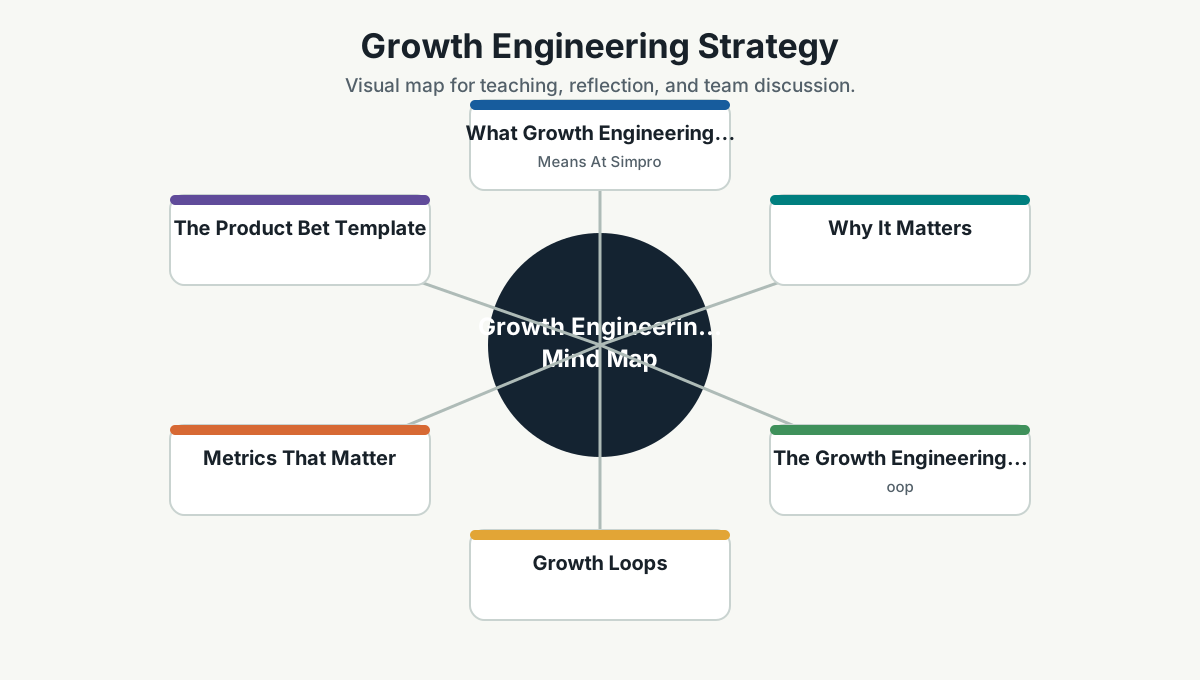
What Growth Engineering Means At Simpro
Growth engineering is the discipline of engineering measurable product learning.
It is not only marketing. It is not only analytics. It is not only experiments. It is the connection between product insight, engineering execution, data, and business growth.
Growth engineering asks:
What customer behavior should change, what product bet might change it, how do we test it, and what evidence will guide the next decision?
Why It Matters
Small companies cannot afford feature factories. Every month spent building low-impact features is a month not spent learning where the market is pulling.
Growth engineering helps Simpro:
- Reduce wasted feature effort.
- Improve activation and adoption.
- Learn from real usage.
- Shorten feedback loops.
- Connect product decisions to business outcomes.
- Find scalable growth loops.
The Growth Engineering Loop
- Signal.
- Hypothesis.
- Experiment.
- Instrumentation.
- Measurement.
- Decision.
- Scaling or refinement.
Good growth engineering begins before code and continues after release.
Growth Loops
A growth loop is a repeatable mechanism where product usage creates more product value or market reach.
Examples:
- A user invites another user.
- Better onboarding increases activation, which increases retention, which increases referrals.
- Integrations make the product more useful, which increases adoption.
- Customer success insights improve product, which reduces support pain and increases expansion.
For Simpro, growth loops may come from:
- Better onboarding.
- Faster customer setup.
- Role-based workflows.
- Integrations.
- Reporting and insights.
- Automation that saves customer time.
- Platform reliability that increases trust.
Metrics That Matter
Avoid vanity metrics. Page views, signups, and feature clicks may be useful, but only if connected to value.
Useful product-growth metrics:
- Activation: did the user reach first value?
- Adoption: is the feature used repeatedly?
- Retention: does the user return?
- Expansion: does usage grow across teams/accounts?
- Time saved: does workflow time reduce?
- Support reduction: does confusion decrease?
- Conversion: does the product influence buying?
Useful engineering-health metrics:
- Lead time.
- Deployment frequency.
- Change failure.
- Recovery time.
- Performance.
- Error rate.
- Cost per workflow.
- Security findings.
The Product Bet Template
Use this:
We believe change will improve metric for user group because evidence. We will test this by experiment. We will decide scale/refine/stop based on threshold.
Example:
We believe a guided onboarding checklist will improve first-week activation for new administrators because support tickets show missed setup steps. We will test it with a prototype and then a feature-flagged pilot. We will scale if 70% of pilot users complete setup without support assistance.
Engineering Requirements For Growth
Growth engineering needs technical foundations:
- Feature flags.
- Event tracking.
- Funnel analytics.
- Experiment configuration.
- Clean data definitions.
- Fast release path.
- Rollback path.
- Performance monitoring.
- Privacy controls.
- Cost visibility.
Without these, growth remains opinion-driven.
Humor:
If we launch an experiment and cannot measure it, that is not growth engineering. That is product astrology.
Anti-Patterns
Feature Factory Growth
Shipping more features and hoping something works.
Vanity Metric Growth
Celebrating numbers that do not represent customer value or business value.
Unsafe Growth
Increasing usage while damaging reliability, privacy, support load, or cost.
Experiment Theater
Calling something an experiment without a hypothesis, metric, or decision rule.
Simpro Growth Guideline
For every customer-facing initiative, define:
- Product outcome.
- Growth hypothesis.
- Instrumentation.
- Engineering health signal.
- Decision rule.
This creates the bridge between product imagination and market evidence.
Team Reference Guide
How To Explain This Page
Use this page as a reference conversation, not as a checklist to read aloud. Start by explaining why the topic matters, then connect it to current team work, and finally ask what behavior should change.
The most useful way to teach this material is to move from concept to example. Explain the principle, show how it appears in daily work, ask the team where it is currently strong or weak, and finish with one small action.
Guidelines For Teams
- Connect the topic to a current project, customer problem, incident, or decision.
- Translate concepts into visible behaviors.
- Keep the guidance lightweight enough to use weekly.
- Capture decisions, examples, and improvements back into the wiki.
- Review the page again after a project, incident, or retrospective to update what the team has learned.
Reflection Questions
- What part of this topic is already working well for us?
- What part is still mostly theory?
- What is one behavior we can change in the next 30 days?