Simpro Operating System
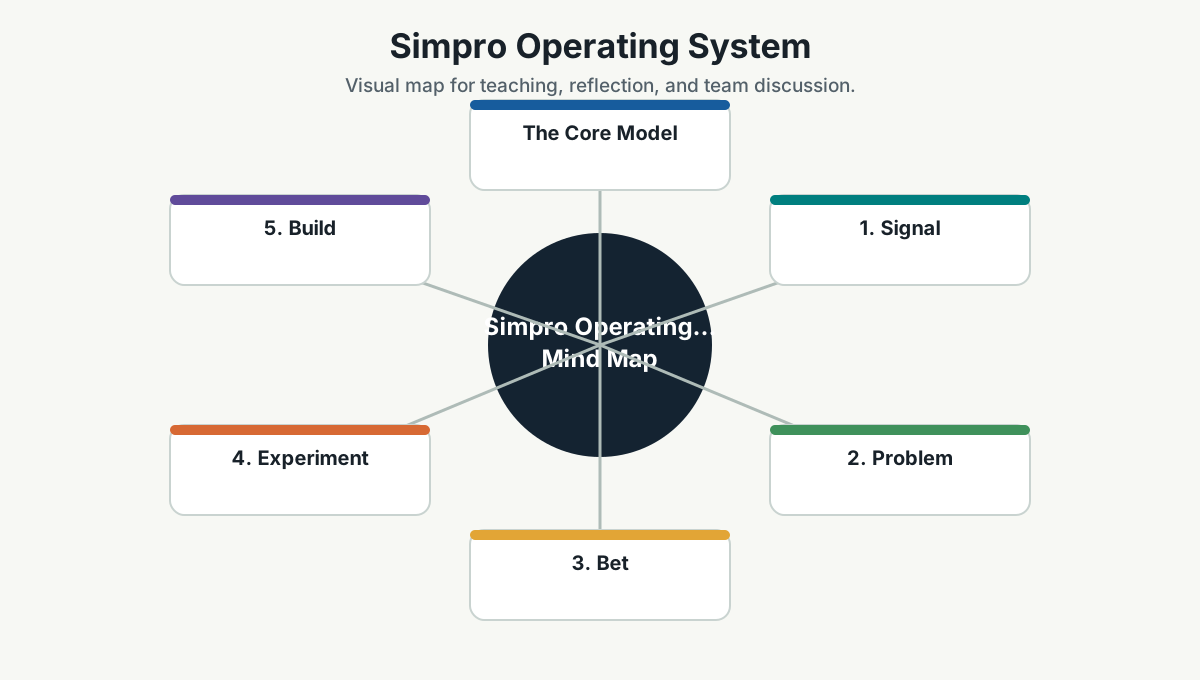
The Core Model
The Simpro operating system is the repeatable way we convert signals into value.
Signal -> Problem -> Bet -> Experiment -> Build -> Release -> Measure -> Learn -> Improve
This model matters because teams often break the chain.
They hear a signal and jump straight to build. They build without a success measure. They release without instrumentation. They measure activity instead of value. They learn but do not change the system.
The operating system keeps the chain connected.
1. Signal
A signal is a clue from reality.
Signals come from:
- Customers.
- Sales.
- Support.
- Product usage.
- Production incidents.
- Engineering friction.
- Security findings.
- Competitor movement.
- Technology trends.
- Cost and performance data.
The team's job is not to chase every signal. The job is to notice patterns and decide which signals deserve investigation.
Humor:
One complaint is a complaint. Ten similar complaints are a product manager tapping you on the shoulder through the universe.
2. Problem
A problem is a framed signal.
Weak problem:
Customer wants dashboard.
Better problem:
Operations managers cannot identify job scheduling risk before weekly planning, causing last-minute escalations and manual spreadsheet work.
The better problem names the user, workflow, pain, and consequence.
Guideline:
Do not let the solution enter the room before the problem has introduced itself properly.
3. Bet
A bet is a decision to invest effort under uncertainty.
Every product bet should answer:
- What outcome do we want?
- What evidence supports this?
- What assumption is risky?
- What is the appetite?
- What will make us stop or change direction?
This is where strategy meets discipline. Small companies cannot afford unlimited bets. Focus is a competitive advantage.
4. Experiment
An experiment is a low-cost way to reduce uncertainty.
It can be:
- A customer interview.
- Prototype.
- Manual service.
- Technical spike.
- Feature flag rollout.
- A/B test.
- Analytics review.
- Support-ticket analysis.
The point is not experimentation theater. The point is decision-making.
Good experiment:
After this test, we will decide whether to build, change, or stop.
Weak experiment:
We will try something and see.
5. Build
Build is where ideas become systems.
Engineering must protect:
- Simplicity.
- Maintainability.
- Testability.
- Security.
- Performance.
- Observability.
- Cost.
- Operability.
The product is not only the UI. The product is the whole experience, including whether it works when users need it.
6. Release
Release is not a ceremony. It is a risk transition.
Good release habits:
- Small changes.
- Automated checks.
- Feature flags for risky work.
- Rollback path.
- Monitoring.
- Stakeholder communication.
- Support readiness.
Fast release does not mean careless release. Fast release means the organization has reduced the cost and risk of change.
7. Measure
Measurement connects intention to reality.
Measure both:
- Product value: activation, adoption, retention, conversion, time saved, reduced support pain.
- Engineering health: lead time, deployment frequency, change failure, recovery time, performance, security, cost.
Do not celebrate growth that damages trust. Do not celebrate engineering health that creates no customer value.
8. Learn
Learning means changing our mind or behavior because of evidence.
If no decision changes, learning probably did not happen.
Useful learning questions:
- What surprised us?
- What assumption was wrong?
- What should we do again?
- What should we stop?
- What should we automate?
- What should we document?
9. Improve
Improve the operating system, not only the feature.
Examples:
- Add a checklist.
- Improve CI.
- Add a dashboard.
- Change Definition of Done.
- Create a reusable platform capability.
- Update a template.
- Improve stakeholder review cadence.
- Add a security guardrail.
The highest form of ownership is not fixing a problem once. It is making the problem less likely to repeat.
Simpro Team Guideline
For meaningful work, every team should be able to show:
| Stage | Artifact |
|---|---|
| Signal | Customer/support/sales/technical evidence |
| Problem | Problem statement |
| Bet | Product or technical bet |
| Experiment | Test plan or delivery slice |
| Build | Design, code, tests |
| Release | Release and rollback plan |
| Measure | Product and engineering metrics |
| Learn | Decision or insight |
| Improve | System improvement |
The One-Minute Explanation
We are not trying to add process. We are trying to connect learning. The operating system ensures we do not jump from request to code without understanding value, and we do not jump from release to the next task without learning from reality.
Team Reference Guide
How To Explain This Page
Use this page as a reference conversation, not as a checklist to read aloud. Start by explaining why the topic matters, then connect it to current team work, and finally ask what behavior should change.
The most useful way to teach this material is to move from concept to example. Explain the principle, show how it appears in daily work, ask the team where it is currently strong or weak, and finish with one small action.
Guidelines For Teams
- Connect the topic to a current project, customer problem, incident, or decision.
- Translate concepts into visible behaviors.
- Keep the guidance lightweight enough to use weekly.
- Capture decisions, examples, and improvements back into the wiki.
- Review the page again after a project, incident, or retrospective to update what the team has learned.
Reflection Questions
- What part of this topic is already working well for us?
- What part is still mostly theory?
- What is one behavior we can change in the next 30 days?