Secure Development Lifecycle
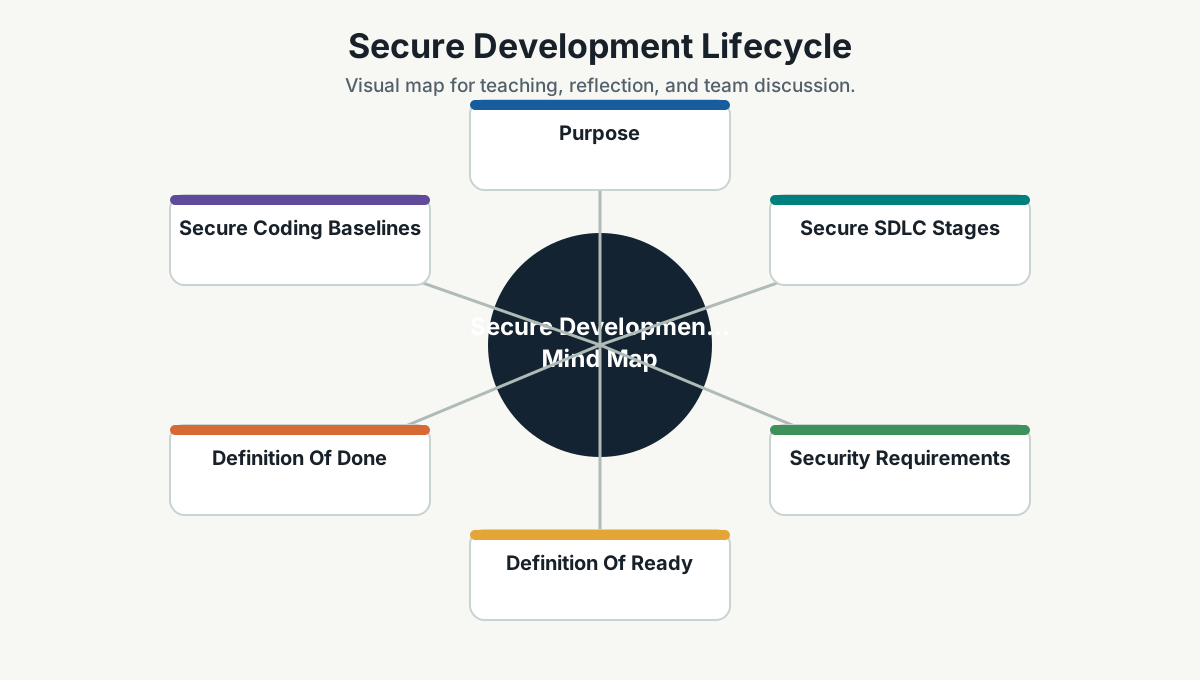
Purpose
The Secure Development Lifecycle, or SDL, is the practice of building security into every stage of software delivery.
The old model says: build the feature, test it, then ask security to inspect it. The modern model says: understand risk early, design secure defaults, automate checks, and verify continuously.
Secure SDLC Stages
| Stage | Security Practice |
|---|---|
| Idea/discovery | Identify sensitive data, compliance needs, abuse cases, and business risk |
| Requirements | Add security and privacy requirements alongside functional requirements |
| Design | Threat model important flows and choose controls |
| Implementation | Follow secure coding standards and use approved libraries |
| Review | Review code, dependencies, secrets, IaC, auth, logging, and error handling |
| Testing | Run SAST, SCA, secrets scanning, DAST/API tests, and manual abuse-case testing |
| Release | Verify configuration, deployment permissions, TLS, monitoring, and rollback |
| Operations | Patch, monitor, respond to incidents, and review vulnerabilities |
| Learning | Feed incidents, audits, and near-misses back into standards and training |
Security Requirements
Security requirements should be explicit. Examples:
- Only authorized users can access customer records.
- Administrative actions must be logged.
- Tokens must expire and be revocable.
- Passwords must never be stored in plain text.
- Sensitive fields must not appear in logs.
- File uploads must be scanned and size-limited.
- APIs must enforce rate limits.
- Backups must be encrypted.
- Critical systems must have monitored health and alerts.
Definition Of Ready
Before starting sensitive work, ask:
- What data is involved?
- Who should access it?
- What are the abuse cases?
- What third-party services are involved?
- What secrets or certificates are needed?
- What logs/metrics/alerts are required?
- What security tests should be added?
Definition Of Done
For security-relevant features:
- Access control is implemented and tested.
- Input validation is present at trust boundaries.
- Sensitive data is protected in transit and at rest.
- Secrets are not in code, config files, logs, or tickets.
- Dependencies are scanned.
- Error messages do not leak internals.
- Audit logs exist for important actions.
- Threat model assumptions are captured.
- Release configuration is reviewed.
Secure Coding Baselines
Developers should routinely check:
- Broken access control.
- Injection risks.
- Cryptographic failures.
- Insecure design.
- Security misconfiguration.
- Vulnerable dependencies.
- Authentication/session weaknesses.
- Insecure deserialization or unsafe parsing.
- Missing security logging and monitoring.
- Server-side request forgery.
These map closely to OWASP Top 10 categories.
Secure Design Habits
- Make the secure path the default path.
- Deny by default.
- Use least privilege.
- Validate input at boundaries.
- Encode output in the right context.
- Avoid custom crypto.
- Keep secrets out of source control.
- Log security-relevant events.
- Fail safely.
- Design for patching and recovery.
Security In Agile/Kanban
Security work should be visible in normal planning:
- Security acceptance criteria.
- Abuse stories.
- Threat-model tasks.
- Security test tasks.
- Vulnerability remediation work.
- Security debt items.
- Incident follow-up actions.
Security debt is still debt. It also charges emotional interest during audits and incidents.
Team Reference Guide
Guidelines For Teams
- Add security requirements to stories where risk exists.
- Include security in design reviews and PR reviews.
- Automate repeatable checks in CI/CD.
- Track vulnerabilities as normal work with owner and due date.
- Convert repeated issues into standards, templates, or tests.
Reflection Questions
- Which current feature should have had a threat model earlier?
- What security check happens too late today?
- What secure default can the platform provide for every team?
- What vulnerability pattern keeps repeating?
Further Study
- NIST SSDF SP 800-218: https://csrc.nist.gov/pubs/sp/800/218/final
- Microsoft SDL: https://www.microsoft.com/en-us/securityengineering/sdl/
- OWASP SAMM: https://owasp.org/www-project-samm/
- OWASP ASVS: https://owasp.org/www-project-application-security-verification-standard/
- OWASP Secure Coding Practices Checklist: https://owasp.org/www-project-secure-coding-practices-quick-reference-guide/