Simpro Platform Engineering Foundation
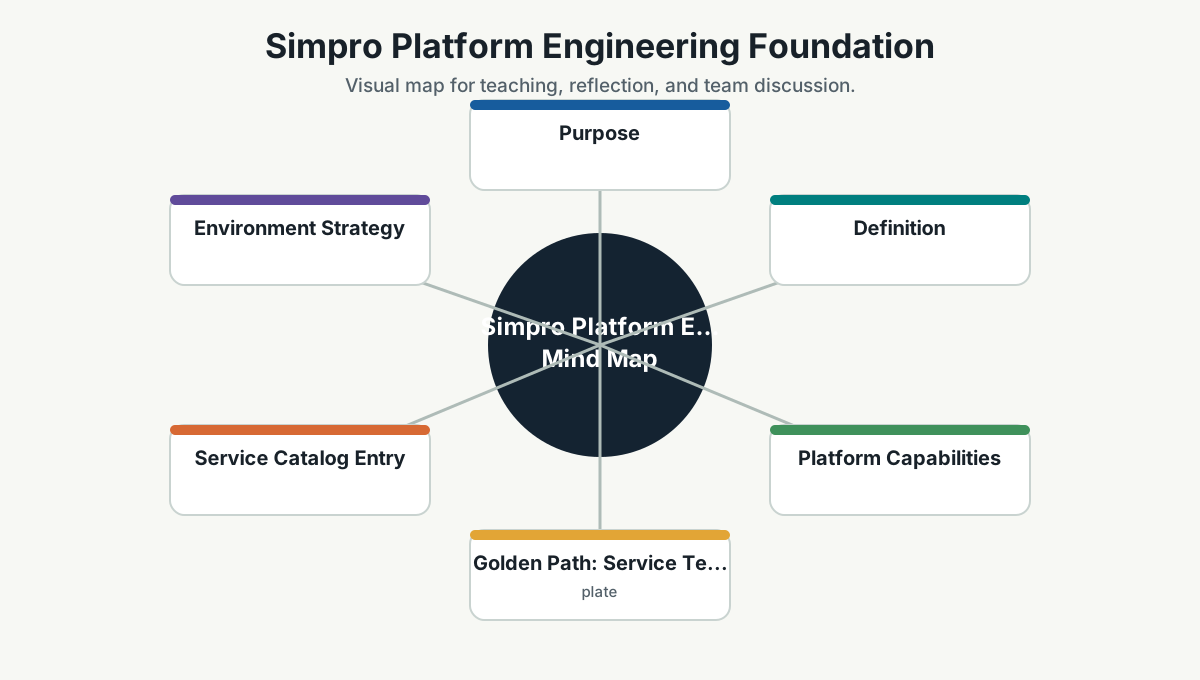
Purpose
Platform engineering at Simpro should create reusable internal capabilities that help product teams deliver safely and quickly.
It should not become a central team that owns every deployment or blocks every decision. Its job is to reduce friction by giving teams clear paved roads.
Definition
Platform engineering is the discipline of building and operating internal products that make software delivery easier for product teams.
For Simpro, the platform should provide:
- Standard ways to create services and applications.
- Standard ways to build, test, scan, deploy, and observe software.
- Standard ways to manage environments, secrets, configuration, and infrastructure.
- Standard ways to understand ownership, dependencies, reliability, and cost.
- Standard ways to integrate security and compliance into normal delivery.
Platform Capabilities
| Capability | Why It Matters | First Lightweight Version |
|---|---|---|
| Developer portal | Teams need one place to discover services, docs, ownership, and runbooks | Markdown-backed catalog or Backstage/Port trial |
| Golden paths | Teams should not reinvent project setup and delivery | One service template with CI/CD and observability |
| CI/CD | Delivery should be repeatable and visible | Shared pipeline template with build, test, scan, package |
| Environment management | Teams need safe places to test changes | Local dev guide plus shared test/staging pattern |
| Feature flags | Releases and experiments need controlled rollout | Standard flag naming, ownership, and cleanup policy |
| Observability | Teams need to see failures and user impact | Logs, metrics, traces, errors, and business events |
| Security baseline | Security should be part of the paved road | Dependency scan, secret scan, SAST, IaC checks |
| Service ownership | Every system needs accountable owners | Catalog entry with owner, repo, runtime, docs, SLO |
| Incident learning | Failures should improve the system | Lightweight incident template and review ritual |
| Cost visibility | Small companies must avoid hidden cloud waste | Monthly infra cost review and tagging standard |
Golden Path: Service Template
The first golden path should define the standard shape of a Simpro service or application.
Minimum contents:
- Repository structure.
- Local development instructions.
- Build command.
- Test command.
- Linting and formatting.
- Docker or runtime packaging approach.
- CI/CD workflow.
- Configuration and secret handling.
- Health check endpoint.
- Logging standard.
- Metrics standard.
- Error tracking.
- API documentation.
- Security scans.
- Deployment instructions.
- Rollback instructions.
- Ownership metadata.
Service Catalog Entry
Every production service should have a catalog entry.
Minimum fields:
- Service name.
- Business capability.
- Product area.
- Owner.
- Repository.
- Runtime or hosting model.
- Dependencies.
- Database or data stores.
- External integrations.
- Deployment pipeline.
- Environments.
- Dashboards.
- Alerts.
- Runbook.
- SLO or reliability target.
- Data classification.
- Security notes.
Environment Strategy
Start simple and make environments consistent before adding advanced tooling.
Recommended stages:
| Environment | Purpose |
|---|---|
| Local | Fast developer feedback with realistic dependencies where possible |
| Preview | Validate pull requests or feature branches when feasible |
| Test | Integration testing with shared services and representative data |
| Staging | Production-like release validation |
| Production | Customer-facing runtime with monitoring, alerts, rollback |
Environment rules:
- Configuration should be externalized.
- Secrets should not live in repositories.
- Test data should be safe and reproducible.
- Each environment should have a clear owner.
- Promotion should be automated where possible.
- Manual steps should be documented until automated.
Release Strategy
Simpro should prefer small, frequent, observable releases.
Recommended practices:
- Use feature flags for risky or customer-visible changes.
- Separate deployment from release.
- Roll out to internal users first when practical.
- Use tenant, region, or cohort-based rollout when risk is high.
- Define rollback before production deployment.
- Track flag ownership and cleanup dates.
- Connect release events to observability dashboards.
Security Baseline
The first platform security baseline should include:
- Secret scanning.
- Dependency vulnerability scanning.
- Static analysis.
- Infrastructure-as-code scanning.
- Container or artifact scanning if containers are used.
- API authentication and authorization review.
- Logging of sensitive access.
- Data classification for services.
- Basic threat modeling for critical workflows.
Security should be integrated into pipelines as feedback. Blocking gates should be reserved for severe and clearly defined risks.
Observability Baseline
Every service should emit:
- Structured logs.
- Error events.
- Health checks.
- Request latency.
- Request volume.
- Failure rate.
- Dependency failures.
- Business events for important product workflows.
For Simpro-style workflows, important business events may include:
- Lead created.
- Quote created.
- Quote accepted.
- Job created.
- Job scheduled.
- Technician assigned.
- Mobile job opened.
- Field update submitted.
- Invoice generated.
- Payment attempted.
- Payment completed.
- Integration sync failed.
Platform Team Operating Model
In the first phase, create a virtual platform team instead of a large permanent group.
Responsibilities:
- Build and maintain the first golden path.
- Run tool experiments.
- Coach pilot teams.
- Maintain platform documentation.
- Track developer experience and delivery metrics.
- Remove repeated friction.
The platform team should operate like a product team:
- Identify internal users.
- Understand their pain.
- Prioritize by value and adoption.
- Ship small improvements.
- Measure usage and satisfaction.
Adoption Model
Use adoption through pull, not only mandate.
Adoption steps:
- Build the golden path with one pilot team.
- Document what became easier.
- Improve rough edges.
- Invite a second team.
- Turn repeated practices into standards.
- Automate standards after they prove useful.
Anti-Patterns
Avoid:
- Platform as a ticket queue.
- Tool-first transformation.
- Central approvals for routine changes.
- Overbuilding for scale before adoption.
- Inconsistent templates that become stale.
- Metrics without action.
- Security as a late review stage.
- Documentation that is separate from real workflows.
Team Reference Guide
How To Explain This Page
Use this page as a reference conversation, not as a checklist to read aloud. Start by explaining why the topic matters, then connect it to current team work, and finally ask what behavior should change.
The most useful way to teach this material is to move from concept to example. Explain the principle, show how it appears in daily work, ask the team where it is currently strong or weak, and finish with one small action.
Guidelines For Teams
- Connect the topic to a current project, customer problem, incident, or decision.
- Translate concepts into visible behaviors.
- Keep the guidance lightweight enough to use weekly.
- Capture decisions, examples, and improvements back into the wiki.
- Review the page again after a project, incident, or retrospective to update what the team has learned.
Reflection Questions
- What part of this topic is already working well for us?
- What part is still mostly theory?
- What is one behavior we can change in the next 30 days?