Book and Article Synthesis
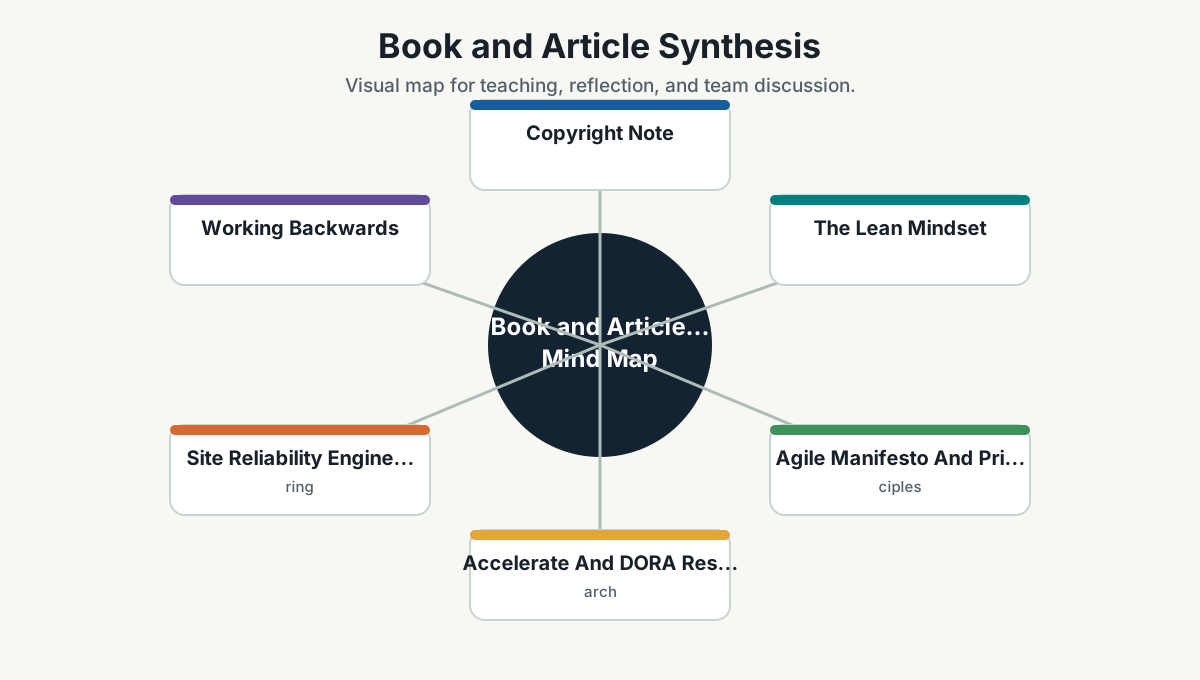
Copyright Note
This page is original synthesis. It does not reproduce full copyrighted books or articles. It extracts practical lessons, mental models, and team actions so the knowledge base contains useful content rather than only links.
The Lean Mindset
Based on ideas from Toyota Production System, Lean Software Development, and later lean/agile practice.
Core Insight
The central problem in software is not that people are not busy enough. It is that organizations create too much waste between idea and value.
Waste appears as:
- Building features nobody uses.
- Waiting for decisions.
- Waiting for environments.
- Waiting for code review.
- Rework from unclear requirements.
- Bugs found late.
- Manual release steps.
- Excess work in progress.
- Context switching.
- Overly complex architecture.
Practical Lesson
To improve performance, map the value stream. Follow one idea from request to production to customer impact. Count the waiting time, handoffs, defects, approvals, and rework. The bottleneck is often not where leaders assume it is.
Team Action
Run a value-stream workshop for one important delivery path. Identify the top three delays and remove one within 30 days.
Agile Manifesto And Principles
Core Insight
Agile is not a delivery ritual. It is a decision philosophy for uncertain work.
The heart of agile is:
- Make work visible.
- Deliver working increments.
- Learn from real feedback.
- Adapt plans.
- Keep teams close to users.
- Trust motivated people.
- Reflect and improve.
Practical Lesson
If a team runs Scrum but does not talk to users, does not demo working software, does not improve after retrospectives, and cannot change direction based on evidence, it is not truly agile.
Team Action
For every sprint or flow cycle, document one thing learned and one decision changed because of that learning.
Accelerate And DORA Research
Core Insight
High delivery performance and stability can improve together. The old tradeoff between speed and quality is often false when teams invest in the right technical and cultural capabilities.
Important capabilities include:
- Continuous delivery.
- Version control.
- Trunk-based development or small-batch integration.
- Test automation.
- Deployment automation.
- Monitoring and observability.
- Lean product management.
- Westrum-style generative culture.
- Clear architecture.
- Empowered teams.
Practical Lesson
Do not chase DORA metrics as a scoreboard. Use them as diagnostic signals. If lead time is high, inspect batching, review delays, test speed, deployment friction, and unclear requirements. If change failure is high, inspect test quality, code review, observability, release size, and ownership.
Team Action
Choose one flow metric and one stability metric per team. Review them weekly with a learning question, not a blame question.
Site Reliability Engineering
Core Insight
Reliability should be explicitly engineered and economically managed.
Users do not need infinite reliability for every feature. They need the right reliability for the promises the product makes.
Practical Lesson
SLOs and error budgets create a shared language between product and engineering. Product can move fast while reliability is healthy. When reliability degrades, the organization has a pre-agreed reason to invest in stability.
Team Action
Pick one critical user journey and define:
- SLI.
- SLO.
- Error budget policy.
- Dashboard.
- Alert.
- Runbook.
Working Backwards
Based on Amazon's public descriptions and the book "Working Backwards" by Colin Bryar and Bill Carr.
Core Insight
The most expensive mistake is not bad execution. It is executing well on the wrong customer problem.
Working backwards forces the team to describe the customer benefit before falling in love with the solution.
Practical Lesson
A PR/FAQ-style document is useful because writing exposes vague thinking. If the team cannot explain the customer, benefit, objections, risks, and launch story in plain language, the idea is not ready for heavy investment.
Team Action
Before major initiatives, write a product brief with:
- Customer.
- Problem.
- Future experience.
- Measurable benefit.
- FAQ.
- Risks.
- Launch approach.
Use product-brief-template.md.
High Output Management
Based on Andy Grove's management philosophy.
Core Insight
Managerial output is the output of the organization influenced by the manager.
Management is not activity. It is leverage.
Practical Lesson
Leaders should spend time where their judgment, coaching, or system design has multiplicative effect. A manager who personally solves every problem may feel productive while reducing team capability.
Team Action
For each leader, identify:
- One decision they should delegate.
- One coaching habit they should strengthen.
- One system constraint they should remove.
- One metric that shows team output, not manager activity.
Measure What Matters And OKRs
Core Insight
OKRs create focus and alignment when they express meaningful outcomes. They fail when they become task lists or performance theater.
Practical Lesson
Good objectives are memorable and directional. Good key results are measurable evidence of progress. Initiatives are the work; key results are the proof that the work mattered.
Team Action
Rewrite one team goal:
- From: "Launch reporting dashboard."
- To: "Help managers make weekly staffing decisions faster."
- Key result: "Reduce time to create staffing report from 2 hours to 15 minutes for 80% of pilot managers."
Inspired, Empowered, And Product Operating Model Thinking
Based on Silicon Valley Product Group themes.
Core Insight
Strong product teams are not feature factories. They are empowered teams responsible for outcomes.
Practical Lesson
Product managers, designers, and engineers must work as a product trio. Product defines value and viability, design defines usability and experience, engineering defines feasibility and system quality. The team discovers solutions together.
Team Action
For each major initiative, hold a product trio discovery session before delivery planning.
Continuous Discovery Habits
Based on Teresa Torres's continuous discovery approach.
Core Insight
Discovery is not a phase. It is a continuous habit.
Practical Lesson
Teams should maintain a living map of opportunities, assumptions, experiments, and evidence. Weekly customer contact keeps product decisions connected to reality.
Team Action
Start an opportunity solution tree for one product area. Add one customer insight every week.
Design Thinking
Based on IDEO and human-centered design practice.
Core Insight
Innovation happens at the intersection of human desirability, technical feasibility, business viability, and responsible impact.
Practical Lesson
The first solution is rarely the best solution. Prototype to learn. Observe real users. Design for the workflow, not the feature list.
Team Action
Before engineering a complex workflow, run a low-fidelity prototype test with at least five representative users or internal proxies.
Team Topologies
Core Insight
Team design is architecture. If team boundaries and software boundaries conflict, delivery becomes slow and coordination-heavy.
Practical Lesson
Organize teams to reduce cognitive load and handoffs. Stream-aligned teams should own flow of value. Platform teams should provide self-service. Enabling teams should coach temporarily. Complicated subsystem teams should own specialized areas when needed.
Team Action
Map current teams against systems and customer flows. Identify one ownership ambiguity and resolve it.
Netflix Culture
Core Insight
Freedom works only with responsibility, talent density, and context.
Practical Lesson
Removing process without increasing context and accountability creates chaos. The transferable lesson is not "few rules." It is "give capable people enough context to make excellent decisions."
Team Action
For each approval step, ask:
- What risk is this controlling?
- Can better context, automation, or guardrails replace the approval?
- Who should own the decision?
Microsoft Growth Mindset
Core Insight
An organization becomes stronger when learning is more valuable than looking smart.
Practical Lesson
Growth mindset must show up in incentives, leadership behavior, hiring, feedback, postmortems, and collaboration. If it stays a slogan, it becomes cynicism.
Team Action
At the end of each project, capture:
- What we learned.
- What surprised us.
- What we would do differently.
- What capability we need to build next.
OWASP LLM And Agentic Security
Core Insight
AI systems introduce new attack surfaces because natural language becomes an interface to data, tools, and decisions.
Practical Lesson
AI security is not only model safety. It includes prompt injection, data leakage, insecure tool use, excessive agency, insecure output handling, dependency risk, and monitoring.
Team Action
Every AI feature must define:
- Data classification.
- Model/tool permissions.
- Human approval boundary.
- Prompt injection defense.
- Evaluation tests.
- Audit logs.
- Rollback plan.
The Combined Reading Lesson
The best books and industry articles converge on one message:
High performance is created by connecting value, learning, quality, ownership, and feedback.
If a practice does not strengthen one of those, it is noise.
Simpro Platform And Growth Engineering Synthesis
The Simpro-specific synthesis from the platform engineering and growth engineering books is maintained in Simpro Book Synthesis: Platform Engineering And Growth Engineering.
The practical takeaway is that Simpro should build a delivery-and-learning loop:
- Platform engineering creates the paved road for delivery, security, observability, environments, and operations.
- Growth engineering creates the evidence loop for activation, adoption, retention, experiments, and responsible product decisions.
- The first 90 days should prove value through one pilot workflow and one usable golden path.
Team Reference Guide
How To Explain This Page
Use this page as a reference conversation, not as a checklist to read aloud. Start by explaining why the topic matters, then connect it to current team work, and finally ask what behavior should change.
The most useful way to teach this material is to move from concept to example. Explain the principle, show how it appears in daily work, ask the team where it is currently strong or weak, and finish with one small action.
Guidelines For Teams
- Connect the topic to a current project, customer problem, incident, or decision.
- Translate concepts into visible behaviors.
- Keep the guidance lightweight enough to use weekly.
- Capture decisions, examples, and improvements back into the wiki.
- Review the page again after a project, incident, or retrospective to update what the team has learned.
Reflection Questions
- What part of this topic is already working well for us?
- What part is still mostly theory?
- What is one behavior we can change in the next 30 days?