Industry Practices Playbook
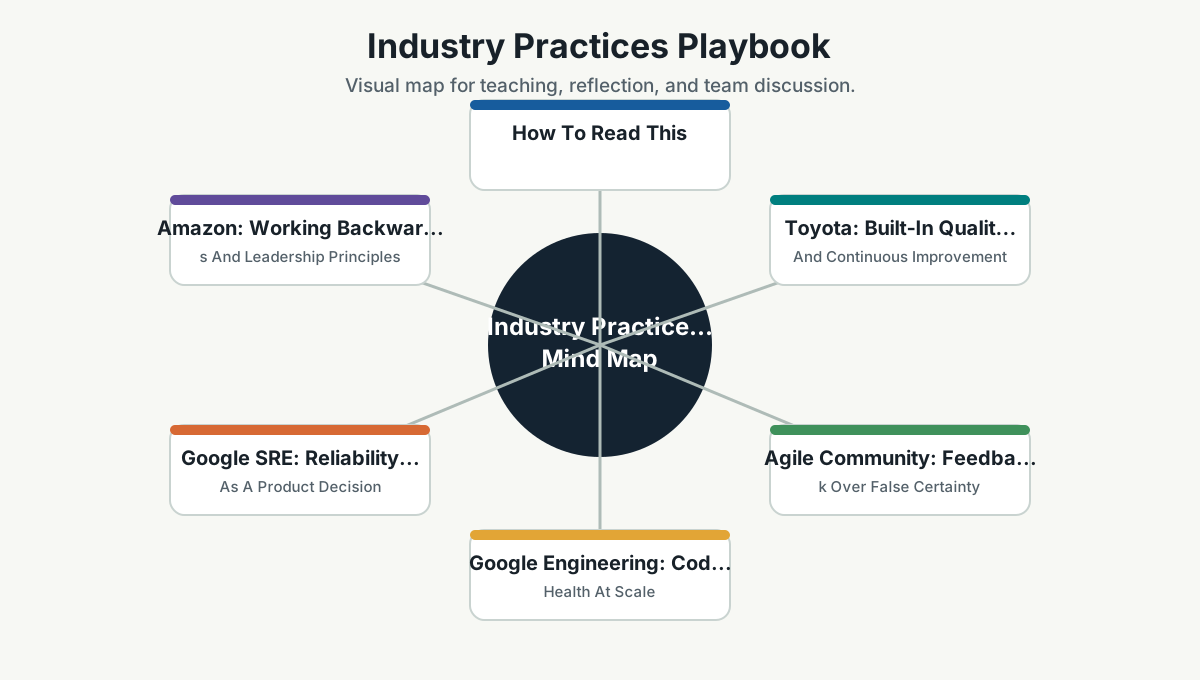
How To Read This
This page does not say "copy Google" or "copy Amazon." Industry leaders operate in contexts that may not match ours. The goal is to extract the principle behind the practice and adapt it.
Toyota: Built-In Quality And Continuous Improvement
What They Are Known For
Toyota Production System, lean thinking, just-in-time, jidoka, kaizen, standard work, respect for people.
The Deeper Value
Quality is created during the work, not inspected after the work. People closest to the work should be empowered to identify abnormalities and improve the system.
Software Translation
- Stop the line when CI is broken.
- Treat flaky tests as production risks.
- Limit work in progress.
- Run retrospectives that change the system.
- Make defects visible.
- Standardize good practices, then improve them.
- Reduce handoffs and waiting.
Team Habit
Every week ask: "What repeated friction did we normalize this week, and how do we remove it?"
Agile Community: Feedback Over False Certainty
What They Are Known For
Iterative development, working software, collaboration, responding to change.
The Deeper Value
Reality teaches faster than documents. Build in small increments, show real work, and adapt.
Software Translation
- Demo working software frequently.
- Keep requirements connected to outcomes.
- Involve users and stakeholders early.
- Use sprint or flow rituals only when they improve learning.
- Keep backlog items small enough to validate.
Team Habit
Every planning conversation must include the question: "What do we need to learn?"
Google Engineering: Code Health At Scale
What They Are Known For
Public engineering practices, code review guidelines, readability, testing culture, monorepo practices, SRE.
The Deeper Value
The health of the codebase matters more than the convenience of a single change. Code review is a mechanism for maintaining shared standards and spreading knowledge.
Software Translation
- Review for long-term maintainability, not only functional correctness.
- Prefer small pull requests.
- Teach through review.
- Require authors to understand their changes.
- Treat tests as part of design.
- Use style and tooling to reduce subjective arguments.
Team Habit
Reviewers should ask: "Does this change improve or degrade the system's future changeability?"
Google SRE: Reliability As A Product Decision
What They Are Known For
SLOs, error budgets, toil reduction, observability, incident management, blameless postmortems.
The Deeper Value
Reliability is not a vague desire. It is a measurable promise that must be balanced against innovation speed and cost.
Software Translation
- Define user-centered SLIs.
- Set SLOs for critical journeys.
- Use error budgets to guide release risk.
- Automate toil.
- Run postmortems that produce owned actions.
- Alert on symptoms that matter to users.
Team Habit
Every service review should ask: "What promise are we making to users, and are we keeping it?"
Amazon: Working Backwards And Leadership Principles
What They Are Known For
Customer obsession, ownership, invent and simplify, high standards, working backwards, PR/FAQ narratives, long-term thinking.
The Deeper Value
Start from the customer's future experience, then reason backward to what must be true. Written narratives force clarity before expensive execution.
Software Translation
- Write a one-page product brief before major builds.
- Define customer benefit before solution details.
- Include FAQs for business, technical, operational, and security concerns.
- Prefer clear writing over slide theater for important decisions.
- Make ownership explicit.
Team Habit
Before building, write: "When this succeeds, what will the customer be able to do that they cannot do today?"
Netflix: Freedom With Responsibility
What They Are Known For
High talent density, context over control, freedom and responsibility, candid feedback, fewer rules, strong ownership.
The Deeper Value
Autonomy works only when people have context, capability, and accountability. Process should not compensate for unwillingness to make good judgments.
Software Translation
- Share strategic context widely.
- Reduce approval layers where teams have capability.
- Expect clear judgment from owners.
- Give candid feedback quickly.
- Keep policies minimal but standards high.
Team Habit
Leaders should ask: "What context would let this team decide without me?"
Microsoft: Growth Mindset And Cultural Renewal
What They Are Known For
Satya Nadella's growth mindset transformation, learn-it-all culture, empathy, collaboration, cloud and AI strategic renewal.
The Deeper Value
Organizations decline when intelligence becomes status. They renew when learning becomes status.
Software Translation
- Reward curiosity and improvement.
- Treat mistakes as learning opportunities with accountable follow-through.
- Encourage cross-team collaboration.
- Make leaders model learning publicly.
- Build capability through coaching, not only evaluation.
Team Habit
After a failure ask: "What did we learn that changes how we work?"
Meta: Move Fast With Infrastructure
What They Are Known For
Rapid iteration, shared infrastructure, research-to-production loops, large-scale engineering platforms, AI stack investment.
The Deeper Value
Speed at scale requires infrastructure. "Move fast" without stable systems becomes chaos; "stable infrastructure" makes speed repeatable.
Software Translation
- Invest in internal tools.
- Reuse shared platforms.
- Keep deployment paths fast.
- Measure developer friction.
- Use production learning carefully.
- Build infrastructure that lets teams experiment safely.
Team Habit
Ask: "What platform capability would make the next ten teams faster, not just this one project?"
Spotify: Autonomy With Alignment
What They Are Known For
Squads, tribes, chapters, guilds, autonomy, alignment, knowledge sharing.
The Deeper Value
Teams need autonomy to move quickly, but autonomy without alignment creates fragmentation.
Software Translation
- Organize around value streams.
- Use chapters or communities of practice for craft standards.
- Use guilds for voluntary knowledge sharing.
- Keep architecture principles visible.
- Avoid copying the exact model without matching scale and context.
Team Habit
Ask: "Where do we need stronger alignment, and where do we need more autonomy?"
Intel And Google OKRs: Focus And Measurable Alignment
What They Are Known For
Objectives and Key Results, popularized from Intel to Google and beyond.
The Deeper Value
Focus requires saying no. Alignment requires measurable intent.
Software Translation
- Use few objectives.
- Make key results measurable outcomes, not task lists.
- Review progress regularly.
- Separate committed work from aspirational bets.
- Use OKRs as learning tools, not performance theater.
Team Habit
Ask: "If we can do only one thing this quarter, which outcome matters most?"
Thoughtworks Technology Radar: Deliberate Technology Adoption
What They Are Known For
Adopt, trial, assess, hold model for techniques, tools, platforms, languages, and frameworks.
The Deeper Value
Technology choices should be intentional and revisited. Novelty is not strategy.
Software Translation
- Maintain an internal radar.
- Assign owners for trials.
- Define exit criteria for experiments.
- Retire tools deliberately.
- Explain "hold" decisions to prevent hidden adoption.
Team Habit
Ask: "Are we choosing this technology because it solves our problem or because it is fashionable?"
DORA: Measuring Software Delivery Performance
What They Are Known For
Research on software delivery performance, deployment frequency, lead time, change failure rate, failed deployment recovery time, reliability, culture, and capabilities.
The Deeper Value
Delivery performance is a system outcome. Strong culture, architecture, automation, lean product management, and technical practices reinforce each other.
Software Translation
- Measure flow and stability together.
- Improve capabilities, not just metrics.
- Use metrics for learning.
- Connect delivery to reliability and product outcomes.
Team Habit
Ask: "What system constraint is limiting our ability to deliver value safely?"
OWASP And NIST: Security As Trust Engineering
What They Are Known For
OWASP application and LLM security guidance; NIST Secure Software Development Framework.
The Deeper Value
Security is not an audit event. It is a lifecycle of design, implementation, verification, release, operation, and response.
Software Translation
- Threat model early.
- Secure CI/CD.
- Scan dependencies.
- Manage secrets.
- Control AI tools and agents.
- Protect data.
- Respond to vulnerabilities with root-cause learning.
Team Habit
Ask: "What can go wrong, and how would we know before customers are harmed?"
The Combined Lesson
| Organization/Movement | Do Not Copy Blindly | Copy The Value |
|---|---|---|
| Toyota | Factory rituals | Built-in quality and kaizen |
| Agile | Ceremonies | Feedback and adaptation |
| Scale-specific tooling | Code health and reliability economics | |
| Amazon | Internal jargon | Customer obsession and written clarity |
| Netflix | Low process | Context-rich accountability |
| Microsoft | Sloganized growth mindset | Learning as status |
| Meta | Speed slogans | Infrastructure-enabled velocity |
| Spotify | Org chart names | Autonomy with alignment |
| Intel/Google OKRs | Quarterly paperwork | Focus and measurable outcomes |
| Thoughtworks | Trend watching | Deliberate tech adoption |
| DORA | Dashboard fixation | Capability improvement |
| OWASP/NIST | Compliance checklist | Trust by design |
Team Reference Guide
How To Explain This Page
Use this page as a reference conversation, not as a checklist to read aloud. Start by explaining why the topic matters, then connect it to current team work, and finally ask what behavior should change.
The most useful way to teach this material is to move from concept to example. Explain the principle, show how it appears in daily work, ask the team where it is currently strong or weak, and finish with one small action.
Guidelines For Teams
- Connect the topic to a current project, customer problem, incident, or decision.
- Translate concepts into visible behaviors.
- Keep the guidance lightweight enough to use weekly.
- Capture decisions, examples, and improvements back into the wiki.
- Review the page again after a project, incident, or retrospective to update what the team has learned.
Reflection Questions
- What part of this topic is already working well for us?
- What part is still mostly theory?
- What is one behavior we can change in the next 30 days?