Small Company To Market Leader Playbook
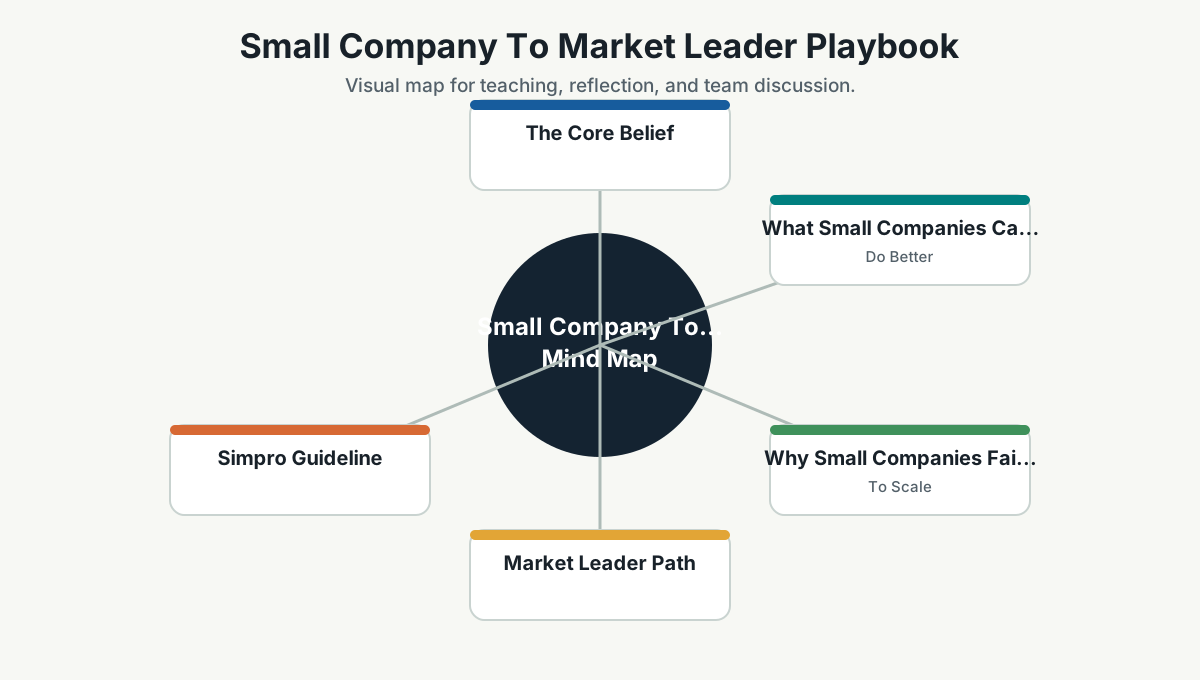
The Core Belief
A small company can become a market leader by being more focused, closer to customers, faster at learning, and more disciplined about foundations than larger competitors.
Big companies have advantages: brand, capital, distribution, talent depth, and mature processes. But they also have disadvantages: coordination cost, politics, slower decisions, legacy systems, and distance from customers.
Small companies win when they turn smallness into leverage.
What Small Companies Can Do Better
1. Customer Closeness
Small teams can speak to customers directly and act quickly. This is a major advantage if the team listens carefully and converts customer signals into product learning.
Guideline:
Every product decision should have a visible customer or business signal.
2. Faster Decisions
Small companies can avoid unnecessary approval chains. But speed requires clarity. Otherwise fast decisions become fast reversals.
Guideline:
Push decisions close to the work, but provide context, constraints, and success measures.
3. Focused Bets
Small companies cannot win by doing everything. They win by choosing narrow spaces where they can become excellent.
Guideline:
Say no clearly. Strategy is the courage to disappoint some possibilities.
4. Reusable Foundations
Small teams cannot afford to solve the same infrastructure, deployment, security, observability, and environment problems repeatedly. Platform thinking matters earlier than people assume.
Guideline:
Build reusable foundations before repeated friction becomes culture.
5. AI Leverage
AI can help small teams research, code, test, document, analyze, and support users faster. But AI must be paired with review, security, and understanding.
Guideline:
Use AI to reduce toil and expand thinking, not to outsource accountability.
Why Small Companies Fail To Scale
Small companies often fail not because they lack ideas, but because they normalize chaos.
Common failure patterns:
- Every customer request becomes a priority.
- Architecture grows accidentally.
- Quality depends on a few heroes.
- Deployments are risky.
- Security is informal.
- Cost is discovered after it hurts.
- Metrics are vanity or absent.
- Teams work hard but do not learn systematically.
- Leaders become bottlenecks.
Humor:
Startup speed is wonderful until the invoice, incident, and customer escalation all arrive for the same shortcut.
Market Leader Path
Stage 1: Earn Trust In A Narrow Space
Pick a specific customer problem and solve it better than alternatives.
Focus on:
- Deep customer understanding.
- Fast feedback.
- Quality basics.
- Support responsiveness.
- Clear value proposition.
Stage 2: Build Repeatability
Once value is clear, make delivery repeatable.
Focus on:
- CI/CD.
- Environments.
- Observability.
- Security basics.
- Reusable components.
- Onboarding.
- Documentation.
Stage 3: Scale Learning
As the team grows, preserve learning speed.
Focus on:
- Product discovery.
- Growth experiments.
- Technology radar.
- Team health.
- Metrics.
- Decision logs.
Stage 4: Create Platform Leverage
As repeated patterns appear, build platform capabilities.
Focus on:
- Internal developer experience.
- Self-service tooling.
- Standard release paths.
- Service templates.
- Data and analytics foundations.
- Security guardrails.
Stage 5: Lead The Category
Market leaders create a point of view, not only features.
Focus on:
- Thought leadership.
- Customer outcomes.
- Ecosystem.
- Integrations.
- Reliability and trust.
- Fast learning at scale.
Simpro Guideline
To become a market leader in any chosen space, Simpro needs three engines:
- Product learning engine: customer signals, product bets, growth experiments.
- Engineering execution engine: quality, architecture, CI/CD, DevSecOps, SRE.
- Platform leverage engine: reusable foundations, automation, observability, cost control.
When these three engines reinforce each other, a small company can behave with the maturity of a larger company without inheriting its bureaucracy.
Team Reference Guide
How To Explain This Page
Use this page as a reference conversation, not as a checklist to read aloud. Start by explaining why the topic matters, then connect it to current team work, and finally ask what behavior should change.
The most useful way to teach this material is to move from concept to example. Explain the principle, show how it appears in daily work, ask the team where it is currently strong or weak, and finish with one small action.
Guidelines For Teams
- Connect the topic to a current project, customer problem, incident, or decision.
- Translate concepts into visible behaviors.
- Keep the guidance lightweight enough to use weekly.
- Capture decisions, examples, and improvements back into the wiki.
- Review the page again after a project, incident, or retrospective to update what the team has learned.
Reflection Questions
- What part of this topic is already working well for us?
- What part is still mostly theory?
- What is one behavior we can change in the next 30 days?