Defense In Depth And Zero Trust
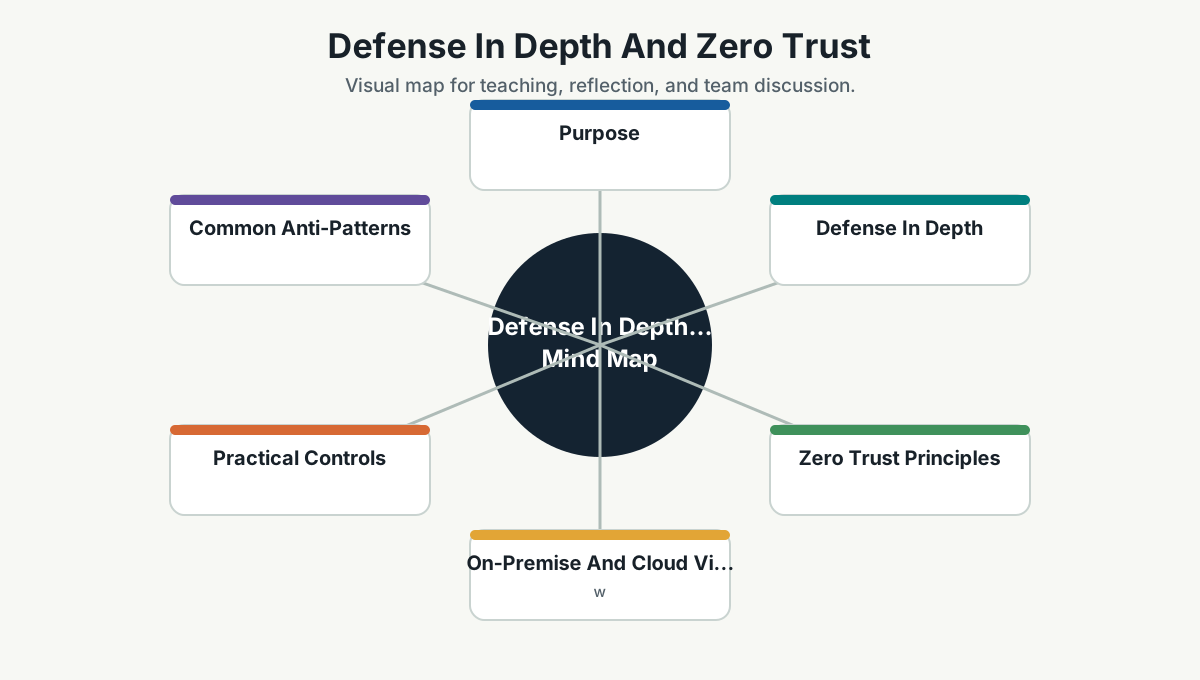
Purpose
Defense in depth and zero trust are two complementary security ideas.
Defense in depth says: use multiple layers of protection so one failure does not become total compromise.
Zero trust says: do not automatically trust a user, device, network, service, or request just because it is "inside." Verify explicitly, use least privilege, and assume breach.
Defense In Depth
Layered defense protects systems at multiple points:
| Layer | Examples |
|---|---|
| Identity | MFA, SSO, strong authentication, conditional access |
| Device | Endpoint protection, patching, disk encryption |
| Network | Segmentation, firewalls, private endpoints, ingress controls |
| Application | Authz checks, validation, secure session handling |
| API | Rate limiting, schema validation, token validation |
| Data | Encryption, masking, classification, backups |
| Infrastructure | Hardened images, IaC scanning, least-privilege service accounts |
| Pipeline | Code review, SAST, SCA, secrets scanning, signed artifacts |
| Monitoring | Logs, alerts, anomaly detection, incident response |
| People | Training, phishing awareness, reporting culture |
The point is not to buy every tool. The point is to avoid single points of security failure.
Zero Trust Principles
The common zero-trust principles are:
- Verify explicitly.
- Use least privilege.
- Assume breach.
For developers, this means:
- Do not trust internal traffic automatically.
- Validate tokens and permissions at service boundaries.
- Use short-lived credentials where possible.
- Avoid broad service accounts.
- Limit database permissions.
- Log sensitive actions.
- Treat admin features as high-risk.
- Segment environments.
- Make production access exceptional and auditable.
On-Premise And Cloud View
Zero trust applies both on-premise and in cloud.
On-premise risks:
- Flat networks.
- Long-lived admin accounts.
- Shared service accounts.
- Manual patching.
- Limited observability.
- Trust based on network location.
Cloud risks:
- Over-permissive IAM.
- Public storage buckets.
- Misconfigured security groups.
- Leaked secrets.
- Supply-chain exposure.
- Fast resource creation without governance.
Simpro should avoid thinking "on-prem is safer" or "cloud is safer." Safety comes from architecture, operations, identity, monitoring, and discipline.
Practical Controls
Identity
- Use MFA.
- Use SSO where possible.
- Remove inactive accounts.
- Separate admin and normal user privileges.
- Review access regularly.
Application
- Enforce authorization on the server side.
- Avoid trusting UI-only checks.
- Validate all external input.
- Use secure headers and cookies.
- Protect against CSRF where relevant.
- Use rate limiting for sensitive APIs.
Infrastructure
- Store secrets in a secrets manager.
- Use least-privilege service accounts.
- Scan container images and IaC.
- Patch base images.
- Use TLS for service communication where practical.
Data
- Classify sensitive data.
- Encrypt in transit.
- Encrypt at rest where required.
- Mask sensitive values in logs.
- Restrict direct database access.
- Test backup and restore.
Common Anti-Patterns
- "It is internal, so no authentication is needed."
- "Only admins can see this button, so the API is safe."
- "We will add security after the demo."
- "This secret is only in a private repo."
- "The firewall protects everything."
- "We trust our people, so access reviews are unnecessary."
Trust people. Verify systems. These are not enemies.
Team Reference Guide
Guidelines For Teams
- Design as if one layer may fail.
- Use least privilege for users, services, and pipelines.
- Add server-side authorization tests for important actions.
- Treat secrets and production access as high-risk.
- Make monitoring part of the control, not an afterthought.
Reflection Questions
- What single failure could expose too much?
- Which service account has more access than it needs?
- Which internal endpoint assumes the network is trusted?
- What would we detect quickly if an account was compromised?
Further Study
- Microsoft Zero Trust guidance: https://www.microsoft.com/en-us/security/business/zero-trust
- NIST Zero Trust Architecture SP 800-207: https://csrc.nist.gov/pubs/sp/800/207/final
- CISA Zero Trust Maturity Model: https://www.cisa.gov/resources-tools/resources/zero-trust-maturity-model
- Google BeyondCorp research: https://research.google/pubs/beyondcorp-a-new-approach-to-enterprise-security/