Learning Retention System
Purpose
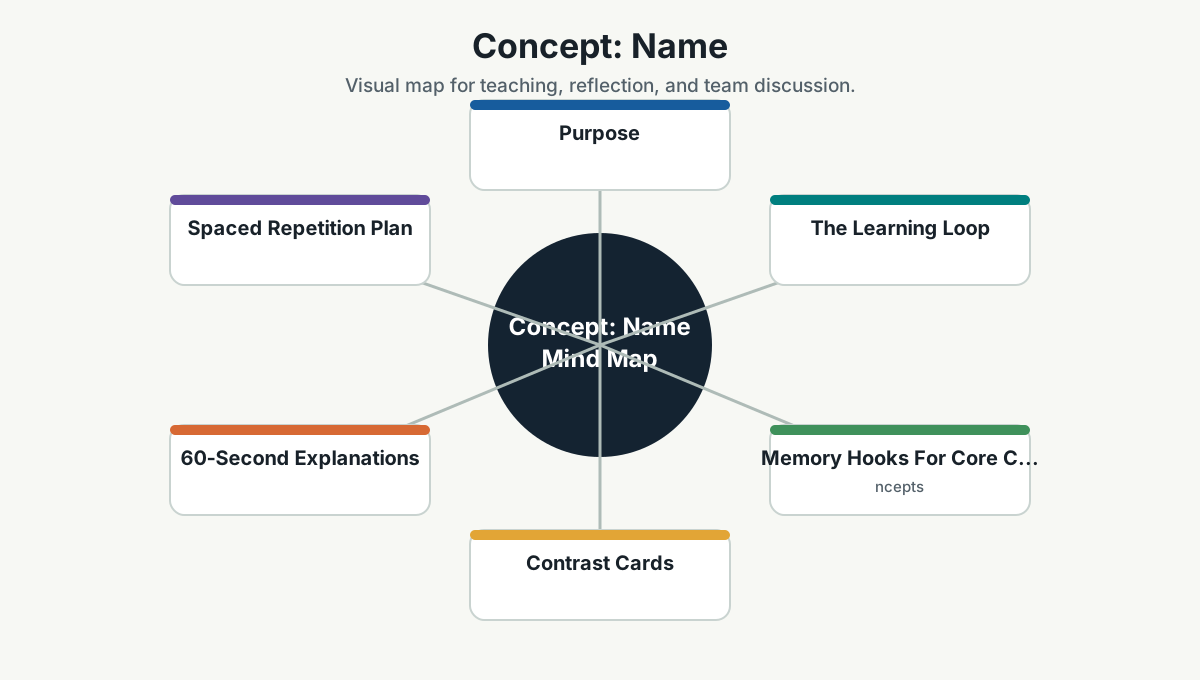
This page explains how the entire knowledge base should be used for easier grasping and long-term retention. Annual day is only one event. The real goal is that these ideas become part of how people think, speak, decide, and work.
People do not retain concepts because they read them once. They retain concepts when they:
- Understand a simple model.
- Hear a memorable story.
- Compare good and bad examples.
- Apply the idea in real work.
- Recall it later.
- Teach it to someone else.
- See it reinforced by leaders.
This is why every concept in the wiki should eventually have:
- A mental model.
- A plain-English explanation.
- A contrast.
- A story.
- A practical example.
- A team guideline.
- A reflection question.
- A small practice.
- A recall prompt.
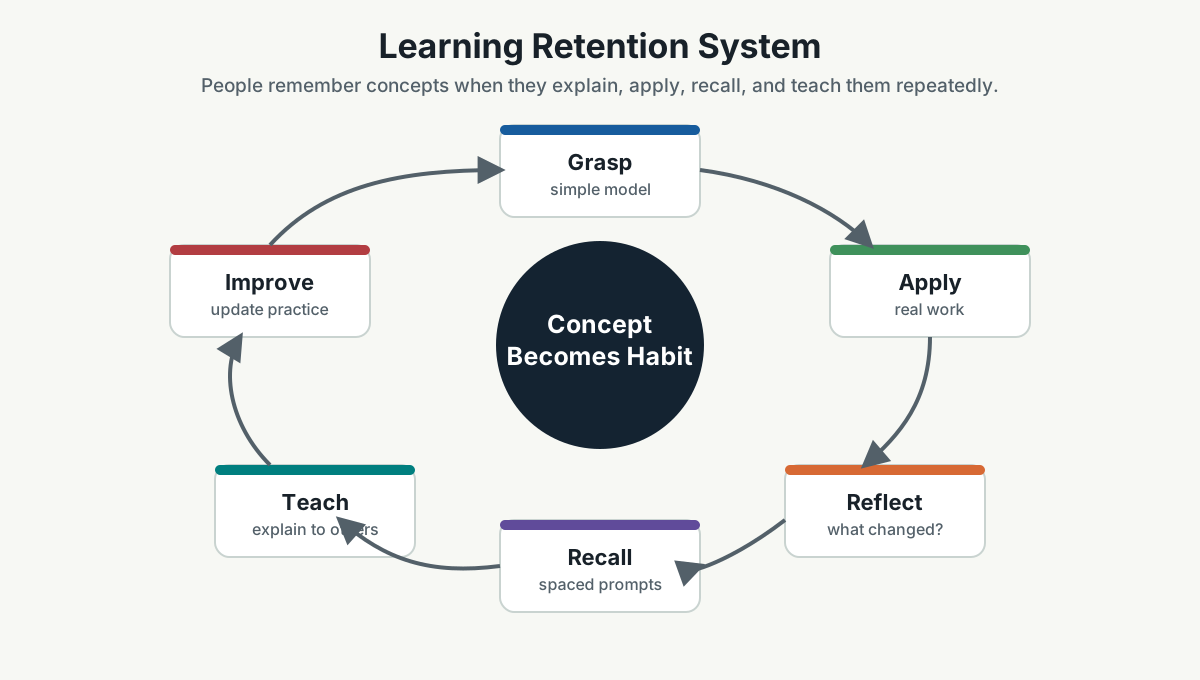
The Learning Loop
The learning loop is:
Grasp -> Apply -> Reflect -> Recall -> Teach -> Improve
1. Grasp
Grasping means the person can explain the idea simply.
Example:
Growth engineering means we do not just ship features; we engineer measurable learning about customer value.
If a person cannot explain the concept in one minute, the concept is not yet ready to guide behavior.
2. Apply
Application means using the idea in real work.
Example:
For the dashboard feature, we define user, problem, metric, experiment, and engineering health signal before building.
3. Reflect
Reflection turns experience into understanding.
Ask:
- What did we expect?
- What happened?
- What surprised us?
- What should we change?
4. Recall
Recall is how concepts move from short-term awareness to long-term memory.
Use short prompts:
- What is the operating loop?
- What is the difference between output and outcome?
- What makes a good product bet?
- What is one DORA metric?
- What does "quality is built in" mean?
5. Teach
Teaching proves understanding.
Ask team members to explain one concept to another person using:
- One sentence.
- One example.
- One anti-pattern.
- One team guideline.
6. Improve
The final step is improving the work system.
If learning does not change a habit, checklist, metric, template, architecture decision, or review conversation, it remains intellectual decoration.
Memory Hooks For Core Concepts
Use these hooks repeatedly.
| Concept | Memory Hook | Meaning |
|---|---|---|
| Operating system | Signal to system improvement | Work should become learning |
| Product mindset | Love the problem | Understand value before solution |
| Growth engineering | Guess, but verify | Treat ideas as hypotheses |
| Platform engineering | Build once, reuse often | Remove repeated friction |
| Engineering excellence | Future speed needs present clarity | Simple, tested, operable systems |
| DevSecOps | Trust built in | Security is lifecycle work |
| SRE | Reliability is a promise | Measure what users depend on |
| DORA | Flow plus stability | Speed and quality together |
| Ownership | Improve the system | Do not stop at task completion |
| Psychological safety | Truth without fear | High standards with voice |
| Learning culture | Learn faster than change | Keep adapting deliberately |
| AI with judgment | Fast assistant, human owner | AI helps, humans remain accountable |
Contrast Cards
Contrasts help retention because the mind remembers difference.
Output vs Outcome
Output:
We built the dashboard.
Outcome:
Managers reduced weekly planning time from two hours to thirty minutes.
Process vs Operating System
Process:
Follow these steps because the organization says so.
Operating system:
Use this loop because it helps us decide, build, measure, and improve.
Autonomy vs Alignment
Autonomy without alignment:
Teams move fast in different directions.
Alignment without autonomy:
Everyone waits for permission.
High performance:
Teams understand context and can make good decisions close to the work.
AI Use vs AI Judgment
AI use:
AI generated this code.
AI judgment:
AI helped generate options, but I reviewed, tested, understood, and own the result.
60-Second Explanations
Use these when you need to explain quickly.
Operating Loop
The operating loop is how we turn reality into improvement. A signal becomes a problem. A problem becomes a product bet. A bet becomes an experiment. Engineering builds it safely. Release creates evidence. Evidence creates learning. Learning improves the system.
Product Mindset
Product mindset means we do not start with the feature. We start with the user, problem, outcome, and evidence. A feature is only useful if it changes customer behavior or business results in a meaningful way.
Growth Engineering
Growth engineering is measurable product learning. It connects product ideas, engineering execution, instrumentation, and business outcomes. Every growth bet should have a hypothesis, metric, experiment, and decision rule.
Platform Engineering
Platform engineering creates reusable paths that make good engineering easier. It reduces repeated friction in setup, deployment, observability, security, and operations. The platform is a product for internal teams.
Engineering Excellence
Engineering excellence is making systems easy to understand, change, test, secure, operate, and retire. It is not perfectionism. It is how we protect future speed.
DevSecOps
DevSecOps means security is built into design, code, build, test, release, and operate. It prevents trust from becoming a last-minute gate.
SRE
SRE treats reliability as a product promise. We define what users depend on, measure it, set objectives, and use incidents to improve the system.
Ownership
Ownership means caring about the outcome, not only the task. The highest form of ownership is improving the system so the same problem is less likely to repeat.
Spaced Repetition Plan
Use this over 30 days.
Day 1
Read:
- Operating loop.
- Product mindset.
- Ownership ladder.
Recall:
- Explain output vs outcome.
- Name one current request that needs problem framing.
Day 3
Read:
- Growth engineering.
- Product bet template.
Recall:
- Write one hypothesis for current work.
Day 7
Read:
- Engineering excellence.
- Build-right stack.
Recall:
- Name one quality risk discovered too late.
Day 14
Read:
- Platform engineering.
- DevSecOps/SRE.
Recall:
- Name one repeated friction that should become platform capability.
- Name one reliability or security signal we need earlier.
Day 21
Read:
- Leadership loop.
- Psychological safety and accountability.
Recall:
- Explain context, commitment, action, evidence, refinement.
Day 30
Review:
- What changed in behavior?
- What evidence improved?
- What concept should be reinforced next?
Role-Based Retention Paths
Developers
Focus concepts:
- Engineering excellence.
- Ownership.
- AI with judgment.
- DevSecOps.
- DORA.
- Platform engineering.
Practice:
- Explain one PR using outcome, risk, test, and operability.
QA
Focus concepts:
- Build-right stack.
- Risk thinking.
- Product mindset.
- DevSecOps.
- Observability.
Practice:
- Add three risk scenarios before development starts.
Team Leads
Focus concepts:
- Operating loop.
- Psychological safety with accountability.
- Team lead loop.
- DORA.
- Growth engineering.
Practice:
- Write one weekly update using context, commitment, action, evidence, refinement.
Stakeholders/Product
Focus concepts:
- Product mindset.
- Problem framing.
- Growth engineering.
- Prioritization.
- Outcome metrics.
Practice:
- Convert one request into a product bet.
IT/Ops
Focus concepts:
- Platform engineering.
- SRE.
- Observability.
- Resilience.
- Security.
- Cost control.
Practice:
- Identify one repeated operational friction and propose a reusable fix.
Weekly Learning Ritual
Use 20 minutes.
- Pick one concept.
- Ask someone to explain it in 60 seconds.
- Discuss one real example.
- Identify one anti-pattern.
- Choose one small behavior change.
- Record one learning note.
Concept Retention Template
Use this for every major concept.
# Concept: Name

## One-Sentence Meaning

## Why It Matters At Simpro

## Story

## Good Example

## Bad Example

## Team Guideline

## 60-Second Explanation

## Reflection Question

## Practice For This Week

## Recall Prompt
How To Know It Is Working
The learning system is working when:
- People use the same language without looking at slides.
- Team leads ask for evidence, not only status.
- Developers discuss operability and risk earlier.
- QA participates before late testing.
- Stakeholders frame problems better.
- Teams stop or refine weak ideas based on evidence.
- Repeated friction becomes platform work.
- Postmortems change the system.
Team Reference Guide
How To Explain This Page
Use this page as a reference conversation, not as a checklist to read aloud. Start by explaining why the topic matters, then connect it to current team work, and finally ask what behavior should change.
The most useful way to teach this material is to move from concept to example. Explain the principle, show how it appears in daily work, ask the team where it is currently strong or weak, and finish with one small action.
Guidelines For Teams
- Connect the topic to a current project, customer problem, incident, or decision.
- Translate concepts into visible behaviors.
- Keep the guidance lightweight enough to use weekly.
- Capture decisions, examples, and improvements back into the wiki.
- Review the page again after a project, incident, or retrospective to update what the team has learned.
Reflection Questions
- What part of this topic is already working well for us?
- What part is still mostly theory?
- What is one behavior we can change in the next 30 days?