Frontend Technology Choice Guide
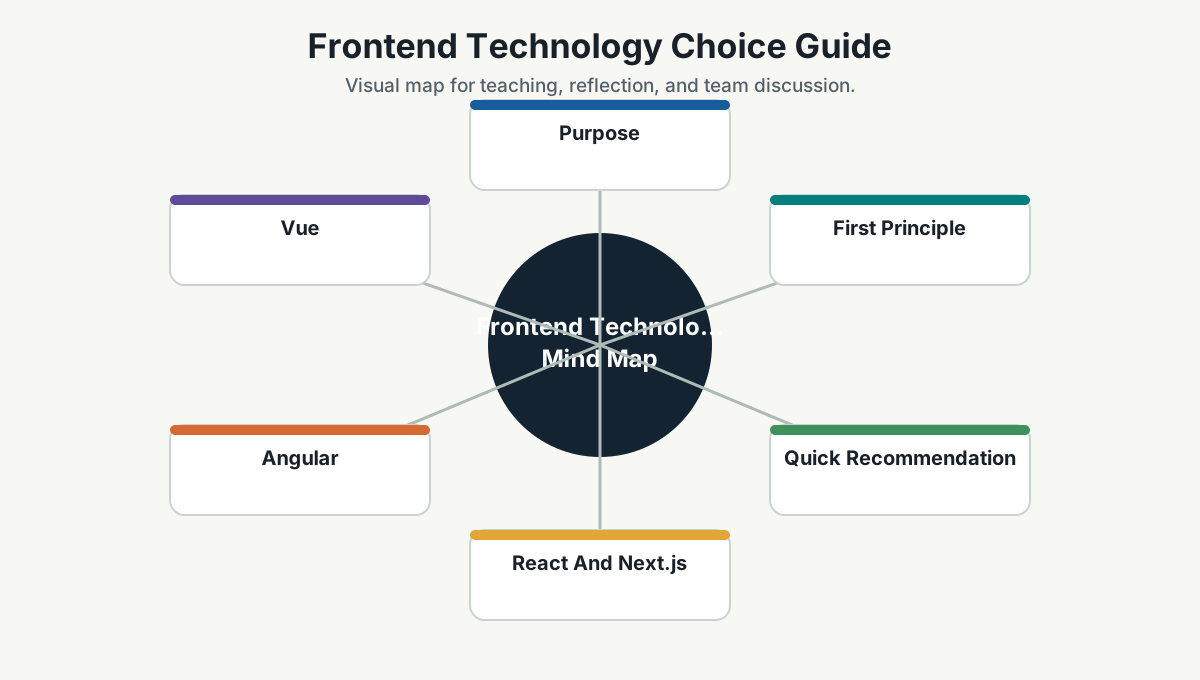
Purpose
Frontend technology choices should be made by product needs, team capability, ecosystem risk, long-term maintainability, and delivery model. A framework is not a personality test. React, Next.js, Angular, Vue, and Svelte can all produce excellent products when used in the right context.
The goal of this page is to help Simpro make consistent choices without turning every new project into a festival of framework debates.
First Principle
Choose boring where the business needs reliability. Choose experimental only where the learning value is real and the blast radius is small.
Frontend choices affect hiring, onboarding, design systems, test strategy, performance, accessibility, upgrade path, hosting, security, and platform support. A good framework decision is not "which one feels modern?" It is "which one lets this team deliver value safely for years?"
Quick Recommendation
| Situation | Recommended Default |
|---|---|
| Product app with broad hiring needs and rich ecosystem | React with Next.js |
| Enterprise application with strong structure and long-term governance | Angular |
| Small to medium app where simplicity and progressive adoption matter | Vue |
| Highly interactive app where small bundles and developer experience matter | Svelte or SvelteKit |
| Content-heavy site, docs, marketing, or mostly static pages | Astro, Next.js, or SvelteKit |
| Internal admin tool | React, Angular, Vue, or low-code depending on team skill and lifecycle |
For Simpro, the safest default for most new customer-facing web applications is React plus Next.js, unless there is a strong reason to choose Angular, Vue, or Svelte.
React And Next.js
React is a UI library with a huge ecosystem. Next.js adds application structure: routing, server rendering, static generation, API routes/server functions, optimization, and deployment patterns.
Use React plus Next.js when:
- You need a widely adopted ecosystem.
- Hiring and onboarding matter.
- You need good support for complex product UI.
- You want a large library ecosystem for forms, data fetching, testing, charts, auth, and design systems.
- You need SSR, SSG, or hybrid rendering.
- You expect multiple teams to work on related frontend surfaces.
Watch out for:
- Too many ways to do the same thing.
- Client/server confusion in modern React and Next.js patterns.
- State management sprawl.
- Performance issues if teams over-render or ship too much JavaScript.
- Framework upgrades that require discipline.
Simpro guidance:
- Use Next.js for full product apps or portals.
- Create a shared design system and component standards.
- Standardize data fetching, error handling, authentication, logging, and testing.
- Keep components small and domain-aware.
- Teach developers server/client boundaries clearly.
Angular
Angular is a full framework with strong opinions, TypeScript-first development, dependency injection, routing, forms, testing patterns, and enterprise structure.
Use Angular when:
- The application is large and long-lived.
- The team benefits from strong conventions.
- Enterprise governance, consistency, and maintainability matter.
- You want a complete framework rather than assembling many libraries.
- The organization already has Angular capability.
Watch out for:
- Higher initial learning curve.
- More ceremony for small apps.
- Slower experimentation if the team treats structure as paperwork instead of clarity.
Simpro guidance:
- Angular is a strong choice for large internal enterprise systems or teams already productive in Angular.
- Keep architecture modular.
- Avoid over-engineering simple flows.
- Use Angular's structure to reduce ambiguity, not to create bureaucracy.
Vue
Vue is approachable, flexible, and productive. It is often liked by teams that want a balance between structure and simplicity.
Use Vue when:
- The team values fast onboarding and readability.
- The app is small to medium or gradually evolving.
- You want a gentle learning curve.
- You need enough structure without Angular-level opinion.
Watch out for:
- Ecosystem size may be smaller than React for some enterprise needs.
- Teams must still standardize routing, state, testing, and component conventions.
Simpro guidance:
- Vue is a good candidate for internal tools, focused product modules, and teams that already have Vue experience.
- Use Nuxt when SSR, routing conventions, and full app structure are needed.
Svelte And SvelteKit
Svelte compiles components into efficient JavaScript and often feels simpler because less runtime abstraction is exposed to developers. SvelteKit provides the application framework around Svelte.
Use Svelte/SvelteKit when:
- You want excellent developer experience and concise code.
- You care about small bundles and highly interactive UI.
- The team can absorb a newer ecosystem.
- The project has a bounded scope or a strong technical owner.
- You want to prototype quickly without sacrificing quality.
Watch out for:
- Smaller hiring pool compared with React and Angular.
- Fewer enterprise battle-tested patterns in some domains.
- Need for team standards if the project grows.
Simpro guidance:
- Svelte is worth piloting for small tools, prototypes, dashboards, or focused interactive experiences.
- Do not choose it only because it is fashionable.
- Use a pilot to evaluate maintainability, hiring, libraries, testing, and platform fit.
Framework Decision Matrix
Score each item from 1 to 5 before choosing.
| Factor | Why It Matters |
|---|---|
| Team skill | A weaker fit slows delivery and increases defects |
| Hiring market | Long-lived products need maintainable staffing |
| Ecosystem | Auth, forms, testing, charts, accessibility, i18n, design systems |
| Product complexity | Complex apps need stronger architecture discipline |
| Performance needs | Rendering model and bundle size matter |
| Security | Framework patterns must support safe defaults |
| Accessibility | Component system must support inclusive design |
| Deployment model | Static, SSR, edge, container, CDN, on-prem |
| Upgrade path | Framework churn becomes platform cost |
| Observability | Errors, traces, logs, and user experience monitoring |
Rendering Choices
| Rendering Style | Good For | Caution |
|---|---|---|
| SPA | Authenticated apps, internal tools, rich interactions | Initial load, SEO, bundle size |
| SSR | SEO, faster first content, dynamic pages | Server complexity |
| SSG | Docs, marketing, knowledge bases, mostly stable content | Rebuild workflow |
| ISR/hybrid | Content with periodic updates | Cache invalidation and operational clarity |
| Edge rendering | Low-latency global experiences | Runtime limitations and debugging |
Simpro Frontend Standards
Regardless of framework:
- Use TypeScript for serious applications.
- Define component ownership and design-system rules.
- Use accessible components by default.
- Measure performance using Core Web Vitals or equivalent user-experience metrics.
- Standardize API error handling.
- Avoid leaking business logic randomly across components.
- Add automated tests at the right levels: unit, component, integration, and end-to-end.
- Treat frontend security seriously: XSS, CSRF, auth flows, secrets, dependency risk.
- Build observability: error tracking, frontend logs, performance monitoring, user journey signals.
- Keep UX consistent across products.
Decision Rule For Simpro
Use this rule:
- Default to React plus Next.js for strategic customer-facing web apps.
- Use Angular when enterprise structure and existing team skill make it clearly better.
- Use Vue when simplicity and incremental adoption are the main advantage.
- Use Svelte/SvelteKit for bounded, high-learning-value projects or where its performance and simplicity provide a real product advantage.
- Revisit the decision after a pilot, not after a hallway debate.
Team Reference Guide
Guidelines For Teams
- Write a short frontend ADR before starting a meaningful new app.
- Include team skill, product lifecycle, hosting, performance, accessibility, testing, and maintainability.
- Prefer fewer supported stacks across Simpro.
- Allow pilots, but define what the pilot must prove.
- Do not confuse developer excitement with business fit.
Reflection Questions
- Are we choosing this framework because it solves the product problem or because it feels new?
- Can we maintain this choice for five years?
- How hard will it be to hire, onboard, test, secure, monitor, and upgrade?
- What standards must exist before more teams use this stack?
Further Study
- React documentation: https://react.dev/
- Next.js documentation: https://nextjs.org/docs
- Angular documentation: https://angular.dev/
- Vue documentation: https://vuejs.org/
- Nuxt documentation: https://nuxt.com/docs
- Svelte documentation: https://svelte.dev/docs
- SvelteKit documentation: https://svelte.dev/docs/kit
- Astro documentation: https://docs.astro.build/
- Stack Overflow Developer Survey: https://survey.stackoverflow.co/
- State of JS: https://stateofjs.com/