Generative AI Across Software Delivery
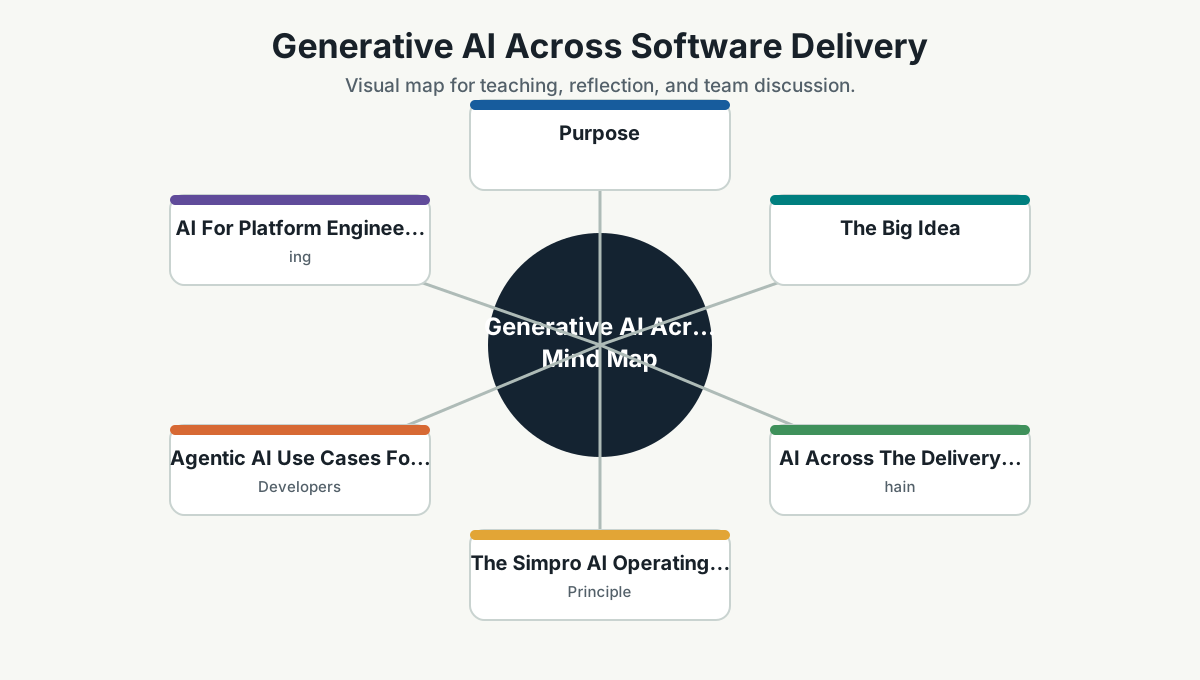
Purpose
Generative AI should not be treated as one more developer tool. Used well, it becomes a capability across the software delivery system: discovery, planning, design, coding, testing, security, release, operations, documentation, support, and learning.
The important shift is this: AI does not remove engineering discipline. It makes discipline more important. A weak team with AI can produce mistakes faster. A strong team with AI can learn faster, reduce boring work, increase quality checks, and spend more time on judgment.
The Big Idea
Software delivery is a supply chain. Ideas become requirements. Requirements become designs. Designs become code. Code becomes packages. Packages become deployments. Deployments become customer experience. Customer experience becomes learning. AI can help at every node, but every node still needs ownership, review, traceability, and measurement.
Think of AI like a powerful junior teammate who is fast, tireless, and sometimes confidently wrong. It can draft, compare, explain, summarize, generate options, and automate routine tasks. It should not silently decide architecture, security posture, production risk, or customer promise.
AI Across The Delivery Chain
| Node | AI Can Help With | Human Must Own |
|---|---|---|
| Strategy | Summarize market signals, competitors, support tickets, win/loss notes | Which bets matter and why |
| Product discovery | Draft interview questions, cluster feedback, create opportunity maps | Customer truth and prioritization |
| Requirements | Turn messy notes into user stories, acceptance criteria, edge cases | Scope, tradeoffs, and business value |
| UX/design | Generate flow alternatives, critique usability, draft microcopy | User empathy, accessibility, and brand fit |
| Architecture | Compare patterns, create ADR drafts, identify risks | System boundaries, reversibility, cost, security |
| Coding | Generate boilerplate, tests, refactors, explanations | Correctness, maintainability, domain fit |
| Code review | Find smells, missing tests, security issues, complexity | Final approval and engineering judgment |
| Testing | Generate test cases, boundary cases, mocks, data sets | Test strategy and signal quality |
| DevSecOps | Suggest pipeline checks, IaC reviews, dependency risk summaries | Policy, compliance, and release gates |
| Release | Draft release notes, compare changes, create rollout plans | Go/no-go decision and customer impact |
| SRE/operations | Summarize incidents, correlate logs, propose runbook steps | Incident command and risk decisions |
| Support | Draft responses, classify tickets, suggest knowledge-base updates | Customer tone, correctness, escalation |
| Learning | Summarize articles, generate quizzes, create team exercises | What becomes team standard |
The Simpro AI Operating Principle
Use AI to increase thinking, not to avoid thinking.
Good use:
- "Give me three design options and the tradeoffs."
- "Review this PR for security, performance, and missing tests."
- "Summarize this incident and suggest prevention actions."
- "Turn this support pattern into product and engineering insights."
- "Create a checklist for deploying this service safely."
Bad use:
- "Write the whole feature and I will paste it."
- "Approve this architecture because AI said it is good."
- "Generate tests after the fact so the coverage number looks nice."
- "Summarize the customer without reading the actual problem."
The funny but useful rule: if AI makes you feel like you can skip understanding, stop. That is not acceleration. That is technical debt wearing sunglasses.
Agentic AI Use Cases For Developers
Agentic AI means AI systems that can plan multi-step work, use tools, inspect code, run tests, update files, and iterate. For developers, this is useful when the task has clear boundaries and fast feedback.
High-value examples:
- Generate a first version of a service adapter, DTO mapping, or migration script.
- Add tests around an existing defect before fixing it.
- Explain an unfamiliar module and create a reading path.
- Find all callers of a risky method and propose a refactor plan.
- Update documentation after a code change.
- Create a small proof of concept for a library or architecture pattern.
- Compare implementation choices and produce an ADR draft.
Guardrails:
- Keep changes small.
- Run tests.
- Review diffs carefully.
- Never paste secrets, customer data, or private production data into unmanaged AI tools.
- Ask AI to explain reasoning and assumptions.
- Prefer repo-aware tools for repo work and source-linked answers for research.
AI For Platform Engineering
Platform engineering is about golden paths, self-service, secure defaults, and reduced cognitive load. AI can help the platform team become a service team, not just a ticket queue.
Useful agent patterns:
- Environment doctor: inspects local setup, versions, ports, certificates, containers, and common failures.
- Pipeline assistant: explains failed builds and suggests focused fixes.
- Kubernetes helper: explains pod status, events, logs, resource limits, and rollout problems.
- IaC reviewer: reviews Terraform, Bicep, Helm, Kubernetes manifests, and Dockerfiles for security and maintainability.
- Runbook assistant: turns repeated operational fixes into documented runbooks.
- Golden path generator: scaffolds service templates, CI files, health checks, logging, metrics, and deployment manifests.
Platform AI should be measured by:
- Lower onboarding time.
- Fewer repeated support questions.
- Faster failed-build resolution.
- Higher adoption of standard templates.
- Fewer production configuration mistakes.
- Better developer satisfaction.
AI For Growth Engineering
Growth engineering connects product usage, customer behavior, experiments, and revenue learning. AI can help teams see patterns earlier.
Useful agent patterns:
- Funnel analyst: summarizes activation, retention, drop-off, and conversion metrics.
- Experiment designer: drafts hypotheses, guardrail metrics, and sample-size considerations.
- Customer insight miner: clusters support tickets, feedback, call notes, and sales objections.
- Release impact assistant: connects product changes to metric movement.
- Pricing and packaging researcher: compares market signals and customer objections.
- Personalization helper: proposes segment-specific onboarding or messaging experiments.
Guardrail: growth AI must not become manipulation AI. The goal is to help users receive value faster, not to trick them into clicking more things.
AI For Software Supply Chain
AI can also improve the security and traceability of the build and release chain.
Use it to:
- Explain dependency changes and risky licenses.
- Summarize vulnerability reports.
- Generate SBOM review notes.
- Review Dockerfiles and base image choices.
- Check CI/CD pipeline changes.
- Compare build provenance and deployment records.
- Suggest SLSA-style controls for build integrity.
Minimum expectations:
- Source control for everything important.
- Branch protection and review for sensitive changes.
- Dependency scanning.
- Secret scanning.
- Reproducible build practices where practical.
- Traceability from work item to commit to build to deployment.
- Clear release and rollback records.
Simpro Adoption Roadmap
Stage 1: AI Hygiene
- Define allowed tools and data rules.
- Teach prompt patterns for planning, coding, reviewing, testing, and documentation.
- Add AI review prompts to PR and design-review rituals.
- Track examples where AI saved time or caught issues.
Stage 2: AI In The Developer Loop
- Standardize repo-aware AI usage for coding and refactoring.
- Create prompt templates for common tasks.
- Add AI-supported test generation and review.
- Use AI to keep docs and runbooks fresh.
Stage 3: AI In Platform And Operations
- Build environment, CI, Kubernetes, and incident assistants.
- Connect AI to safe internal knowledge sources.
- Keep humans in charge of production-impacting actions.
- Measure platform outcomes before and after.
Stage 4: AI In Growth And Learning
- Use AI to summarize customer and product signals.
- Create learning cards, quizzes, and architecture exercises.
- Turn repeated incidents and support patterns into improvement quests.
- Build a Simpro knowledge loop: signal to insight to action to standard.
Team Reference Guide
Guidelines For Teams
- Use AI where feedback is fast and verification is possible.
- Use human review where judgment, risk, context, and accountability matter.
- Ask AI for alternatives and tradeoffs, not only answers.
- Keep an evidence trail for important decisions.
- Improve the system, not only the individual task.
Reflection Questions
- Where are we still doing repetitive work that should become a golden path or AI-assisted workflow?
- Where could AI increase quality checks before code reaches review?
- What AI usage would create risk if people used it silently?
- Which team metric should improve if AI is genuinely helping us?
Further Study
- GitHub Octoverse: https://github.blog/news-insights/octoverse/
- Google DORA research: https://dora.dev/research/
- SLSA supply-chain security framework: https://slsa.dev/
- OWASP Top 10 for LLM Applications: https://owasp.org/www-project-top-10-for-large-language-model-applications/
- Microsoft Code With Engineering Playbook: https://microsoft.github.io/code-with-engineering-playbook/